

What if the very things you dislike most about your reactions; the sudden outbursts, the crushing fatigue, or that constant feeling of being “on edge”; were actually your body’s way of trying to protect you? It is incredibly exhausting to live in a body that feels like it’s constantly scanning for a threat that isn’t there. You might feel as though these reactions are character flaws or that you’re somehow “broken,” but the reality is far more compassionate. Understanding the deep connection between trauma and the nervous system is the first step toward realising that your body is doing exactly what it was designed to do: survive.
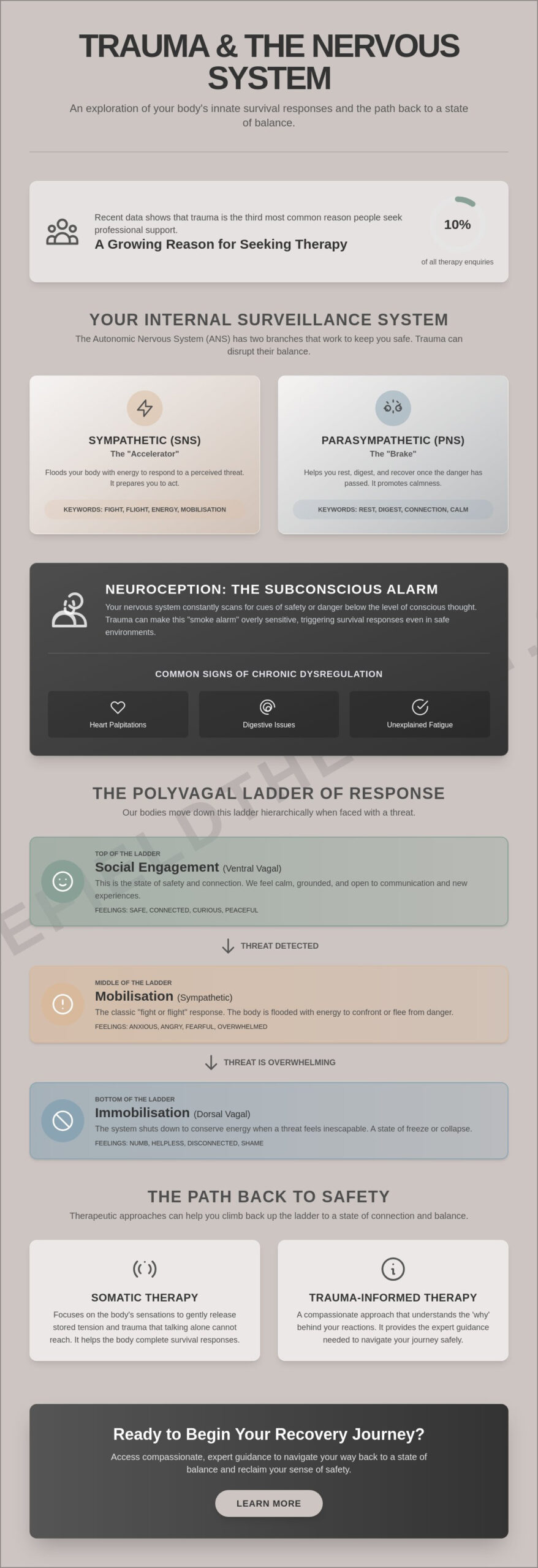
You aren’t alone in this struggle. Recent data shows that trauma is now the third most common reason people seek professional support, accounting for nearly 10 per cent of all therapy enquiries. We’ve created this guide to help you discover how trauma reshapes your physiological responses and to offer gentle, evidence-based pathways to regain your sense of safety. We will explore the science behind your survival mechanisms, discuss practical tools to calm your body, and look at how trauma-informed therapy in Cheshire can help you move from a state of constant high alert to one of lasting balance.
Key Takeaways
- Learn how your autonomic nervous system acts as an internal surveillance system, prioritising your survival above all else during times of distress.
- Understand the deep connection between trauma and the nervous system, moving beyond “fight or flight” to explore the three distinct levels of physiological response.
- Identify your personal “Window of Tolerance” to help you recognise when your body is entering a state of hyper-arousal or emotional overwhelm.
- Discover why somatic therapy is often essential for releasing stored tension, particularly when traditional talking therapies feel like they cannot reach the root of the issue.
- Explore how accessing trauma-informed therapy in Cheshire can provide the compassionate, expert guidance needed to navigate your journey back to a state of balance.
The Biological Blueprint: How Your Nervous System Responds to Trauma
Imagine your body has a silent guardian working 24 hours a day. This is your Autonomic Nervous System (ANS). It manages everything from your heartbeat to your digestion without you ever having to think about it. When we explore how psychological trauma impacts our physiology, we begin to see this system as a sophisticated internal surveillance network. Its only goal is to keep you alive. The intricate relationship between trauma and the nervous system explains why your body continues to react to the past as if it were the present.
Think of your Sympathetic Nervous System (SNS) as the “accelerator.” When you perceive a threat, it floods your body with energy to fight or run. Conversely, your Parasympathetic Nervous System (PNS) acts as the “brake.” It’s designed to help you rest, digest, and recover once the danger has passed. In a healthy system, these two work in a rhythmic, balanced dance. Trauma can act like a glitch in the software. It often hijacks these controls, leaving your foot slammed on the accelerator or your hand locked on the emergency brake, even when the road ahead is clear.
Neuroception: Your Body’s Subconscious Smoke Alarm
Dr Stephen Porges coined the term “neuroception” to describe how our neural circuits scan the environment for cues of safety or peril. This happens entirely below the level of conscious thought. It’s why your heart might race when you enter a crowded room or why you feel a sudden chill in a specific place. If you’ve experienced trauma and the nervous system dysregulation, your smoke alarm becomes incredibly sensitive. You might feel profoundly unsafe in a quiet living room or whilst walking through a peaceful park. This isn’t a failure of your character. It’s your body being over-protective, trying to ensure that what happened before never happens again.
When the Alarm Stays On: Chronic Dysregulation
Living in a state of constant high alert carries a heavy physical price. When the body stays “on” for too long, it begins to wear down. You might notice persistent heart palpitations, digestive issues, or a type of exhaustion that sleep cannot fix. We call this nervous system dysregulation; a persistent state where your body remains trapped in survival mode long after the threat has vanished. Recognising these symptoms as physiological signals rather than personal failings is a vital step in your recovery. Your body isn’t broken; it’s simply stuck in a defensive loop that it hasn’t yet learned how to leave.
The Polyvagal Lens: Beyond the Traditional Fight or Flight
Whilst most of us grew up hearing about “fight or flight,” this simple binary often fails to explain the complex ways we actually survive overwhelming events. Polyvagal Theory, developed by Dr Stephen Porges, offers a more nuanced map of our internal world. It suggests that our responses to threat exist on a hierarchy, moving from social connection down into deep immobilisation. This perspective shifts the conversation around trauma and the nervous system from “What is wrong with me?” to “What is my body trying to tell me?”
Our system operates through three primary states of arousal. At the top is Social Engagement, where we feel safe, connected, and able to communicate. Below that is Mobilisation, the familiar territory of fight or flight. At the very bottom is Immobilisation, a state of total shutdown. These aren’t choices we make with our thinking brain. They are reflexive, lightning-fast shifts that happen long before we are consciously aware of a threat. Understanding the neurobiological impact of trauma helps us see that these states are hardwired into our biology for our protection.
It’s vital to recognise that a “trauma-stuck” response is simply a healthy survival mechanism that hasn’t received the signal that the war is over. In a balanced system, we might feel a surge of anxiety before a presentation and then settle back into calm. For those living with the legacy of trauma and the nervous system dysregulation, the body might stay trapped in a state of high alert or deep numbness for years. If these patterns feel familiar, exploring trauma-informed therapy can help you begin to unpick these reflexive responses in a safe, guided environment.
The Freeze Response: When the Body Shuts Down
When the system decides that neither fighting nor fleeing will ensure survival, it chooses the “dorsal vagal” state. This is the freeze response. It often manifests as a heavy sense of numbness, dissociation, or feeling “spaced out” and disconnected from reality. Many survivors carry deep shame for “not doing anything” during a traumatic event, but freezing is a brilliant, last-resort strategy to preserve life when mobilisation is impossible.
The Fawn Response: Please and Appease as Survival
Often overlooked in traditional guides, the “fawn” response is a strategy used to avoid conflict by instinctively pleasing others. In adult life, this might look like chronic people-pleasing in the workplace or an inability to set boundaries in relationships. You might find yourself mirroring the emotions of others just to maintain a sense of safety. Ultimately, pleasing is often a sophisticated survival strategy designed to minimise harm when other options feel out of reach.
The Window of Tolerance: Why You Feel Stuck or Overwhelmed
Have you ever felt like your emotions are either a raging storm or a frozen lake, with almost nothing in between? Dr Dan Siegel introduced a concept called the “Window of Tolerance” to describe the optimal zone of arousal where we can flourish. When we are within this window, we can process information, feel our feelings without being overwhelmed, and respond to life with flexibility. However, the intersection of trauma and the nervous system often results in this window becoming painfully narrow. Daily life starts to feel like navigating a minefield; one small misstep can send you spiralling into states that feel impossible to control.
Outside this window, we fall into two extremes. Hyper-arousal is the “too much” state. It’s the feeling of electricity under the skin, racing thoughts, and sudden flashes of rage or panic. On the other end lies hypo-arousal, the “too little” state. This is marked by a heavy sense of emptiness, depression, and a lack of motivation. When you are hypo-aroused, it’s as if your system has pulled the curtains and gone into energy-saving mode. Trauma makes these boundaries fragile. You might find yourself oscillating between the two with very little time spent in the calm centre.
Identifying Your Personal Triggers and Glimmers
Recovery involves becoming a curious observer of your own internal weather. Triggers are sensory inputs; a specific scent, a tone of voice, or even a certain time of day; that signal the brain to exit the window of tolerance. Conversely, we can look for “Glimmers.” These are micro-moments of safety or joy that signal to the brain that it is okay to relax. It might be the warmth of a tea mug or the way light hits a leaf. Start by noticing subtle shifts. Does your jaw tighten? Does your chest feel cool or warm? These small physical clues are your body’s way of communicating its state before an emotional wave hits.
Self-Compassion as a Regulatory Tool
It’s easy to feel frustrated with yourself when you “overreact” or “shut down,” but judgement is actually a form of stress that keeps you stuck outside your window. Self-compassion isn’t just a nice idea; it’s a physiological necessity. By being kind to yourself, you activate your Social Engagement System, which helps you return to a state of balance. Co-regulation with others also plays a role in widening your capacity to handle stress. For daily grounding reminders and gentle support, you can follow Dionne Field’s Instagram, where we share regular insights into managing the delicate dance between trauma and the nervous system.
Navigating the Path Back to Safety: Somatic and Trauma-Informed Approaches
Many people find that even after years of talking about their past, their body still reacts with the same old intensity. This happens because the legacy of trauma and the nervous system is not stored as a clear narrative in the thinking brain. Instead, it lives in the tissues, the breath, and the reflexive muscles of the body. Whilst traditional “top-down” talking therapies are incredibly valuable, they sometimes struggle to reach the “bottom-up” physiological imprints of survival. To truly heal, we must often include the body in the conversation.
Somatic Therapy offers a way to work directly with these physical sensations, helping to gently release the stored energy that your system has been holding onto for protection. If you are wondering whether this approach might be right for you, our compassionate guide to somatic therapy in Cheshire explores how body-based healing works and what to look for when choosing the right support. Cognitive Behavioural Therapy (CBT) and Acceptance and Commitment Therapy (ACT) can also be highly effective when adapted with a trauma-sensitive lens. The key is pacing. We move at the speed of safety, ensuring that we don’t overwhelm your system. Rushing into deep trauma work can sometimes lead to re-traumatisation; our goal is to build your capacity for regulation one small, manageable step at a time.
If you feel ready to explore these body-focused pathways to healing, you can book a session for Somatic Therapy and trauma-informed support to begin your journey back to balance.
Grounding Techniques to Anchor the Nervous System
When you feel yourself slipping out of your Window of Tolerance, grounding exercises act as a physical anchor. Try these three steps to invite your system back to the present moment:
- The 5-4-3-2-1 Exercise: Name five things you can see, four you can touch, three you can hear, two you can smell, and one you can taste. This pulls your attention away from internal distress and back to your surroundings.
- Extended Exhales: Breathe in for a count of four and out for a count of six. Making the exhale longer than the inhale sends a direct signal to the vagus nerve that it is safe to relax.
- Physical Containment: Use a weighted blanket or simply cross your arms and give yourself a firm, steady squeeze. This provides a sense of boundary and “holding” for a fragmented nervous system.
The Role of Trauma-Informed Therapy
Being “trauma-informed” is more than just a buzzword. It represents a fundamental shift in perspective from “What is wrong with you?” to “What happened to you?” In a trauma-informed setting, your safety, choice, and collaboration are the highest priorities. A therapist who understands the delicate relationship between trauma and the nervous system will never push you to share details before you are ready. To understand why this approach has become such a vital standard of care, you can explore what trauma informed therapy means for healing in 2026 and how it differs from traditional approaches. When seeking support, look for BACP-accredited professionals who can provide a steady, ethical, and compassionate container for your recovery.
Beginning Your Recovery Journey with Dionne Field Therapy
Healing is rarely a straight line. It is a gentle unfolding, a process of slowly reclaiming the parts of yourself that trauma once forced into hiding. As we have explored, the relationship between trauma and the nervous system is profound and physical. It requires more than just willpower to resolve. It requires a witness. Dionne Field provides that steady, compassionate presence, offering a safe harbour for those navigating the complex aftermath of anxiety and overwhelming life experiences. Whether you are visiting our quiet, professional practice in Sandbach or connecting through online therapy from the comfort of your own home, the priority remains the same: honouring your pace and your boundaries.
Choosing to seek support is a significant act of self-care. For many in Cheshire, finding a local therapist who truly understands the physiological roots of distress can be a turning point. Dionne’s work is grounded in the belief that you aren’t broken; you’re simply a human being whose system has done its best to survive. By creating a space of unconditional support and professional reassurance, she helps you lower your defences so that true, lasting change can begin to take root.
A Tailored Approach in Sandbach and Beyond
There is no “one size fits all” when it comes to the human spirit. Dionne integrates a variety of evidence-based frameworks, including Cognitive Behavioural Therapy (CBT), Acceptance and Commitment Therapy (ACT), and Somatic Therapy, to meet your unique needs. This isn’t just about learning new thoughts. It’s about co-regulation. In the therapy room, the relationship itself becomes a tool for healing. As you sit together in the calm environment of our Sandbach centre, your nervous system learns to mirror the steadiness of a guide who is comfortable with complexity. We work together to bridge the gap between what your mind knows and what your body feels, ensuring that your recovery is as deep as it is enduring.
Taking the First Brave Step
It’s completely natural to feel a knot of anxiety when considering your first session. You might wonder if you’ll have to relive everything at once or if you’ll be judged for your reactions. Dionne manages this transition with immense gentleness, ensuring that the first step feels like a conversation rather than an interrogation. You can learn more about her background and approach by viewing Dionne’s profile on the Counselling Directory. When you feel ready to move from a state of survival to one of balance, please reach out. Contact Dionne today to begin your path to regulation and peace; your body is ready to come home to itself.
Your Path to Reclaiming Balance
You now understand that your reactions are not signs of weakness, but evidence of a survival system that has worked tirelessly to keep you safe. By exploring the intricate link between trauma and the nervous system, you’ve taken the first step toward moving from a state of constant survival into a state of living. You’ve seen how your window of tolerance can be widened and how somatic approaches offer a way to speak to the body in a language it actually understands; a language of sensation, breath, and safety.
Healing is a journey that doesn’t have to be walked alone. As a BACP-accredited therapist and specialist in somatic and trauma-informed care, Dionne Field offers a gentle, structured environment to help you navigate this process. Whether you seek face-to-face support in Sandbach, Tarporley, or across Cheshire, or prefer the accessibility of online therapy, the focus remains on your agency and your pace. We don’t rush the process; we build the foundation for a life that feels manageable and bright again.
Book a trauma-informed consultation with Dionne Field today to begin restoring your sense of internal peace. You’ve spent a long time looking after your survival. It’s finally time for someone to look after you. You deserve to live in a body that feels like a safe place to be.
Frequently Asked Questions
What exactly is nervous system dysregulation?
Nervous system dysregulation is a state where your body’s internal surveillance system becomes stuck in a defensive loop, unable to return to a baseline of calm. Instead of reacting to a threat and then settling back into rest, your system remains on high alert or completely shut down. It’s like a thermostat that is broken, keeping the “heat” of anxiety or the “chill” of numbness constant regardless of the actual environment.
Can trauma actually be ‘stored’ in the body?
Trauma is indeed “stored” in the body as physiological memory rather than just a mental narrative. When we experience trauma and the nervous system is overwhelmed, the energy of that survival response can remain trapped in our muscles, breath patterns, and fascia. This is why you might feel physical tension or a racing heart even when you aren’t thinking about the past; your body is holding the record of what happened. Addressing this physical record often requires a multi-disciplinary approach; for example, Fit & Healthy Chiropractic emphasises how nerve health and physical alignment are key to supporting the body’s recovery from long-term defensive patterns.
How do I know if I am in a ‘freeze’ response or just lazy?
The primary difference lies in your biology and agency. Laziness is usually a choice or a lack of motivation, but a “freeze” response is an involuntary, biological shutdown designed to protect you from a perceived threat. If you feel heavy, numb, or “spaced out” and find it physically difficult to move or speak, your system has likely chosen immobilisation as a survival strategy. It is an act of protection, not a lack of character.
Is it possible to heal my nervous system without reliving my trauma?
It is absolutely possible to find healing without needing to recount every distressing detail of your past. Modern somatic and trauma-informed approaches focus on the present-moment sensations in your body rather than the narrative of the event. By working with your breath, posture, and internal felt sense, we can help your system complete its survival cycles and return to safety without the need for painful re-exposure. If you are curious about what this process looks like in practice, our guide to somatic therapy in Cheshire offers a detailed and compassionate overview of body-based healing options available to you.
How long does it take to regulate a traumatised nervous system?
There is no fixed timeline for healing, as every system is unique and has its own rhythm. Regulating a traumatised nervous system is less about a “quick fix” and more about the gradual process of widening your window of tolerance. Some people notice a shift in their baseline after just a few sessions of somatic work, whilst for others, the journey of reclaiming safety is a longer, more methodical unfolding.
What is the difference between a trauma-informed therapist and a regular one?
A trauma-informed therapist has undergone specific training to understand how trauma and the nervous system interact. They prioritise your safety and choice above all else, ensuring that the therapeutic process does not accidentally re-traumatise you. They are trained to recognise subtle physiological signs of distress and will adjust the pace of the work to ensure you always remain within your capacity to cope. You can read more about what sets this approach apart in our dedicated guide to the importance of trauma informed therapy and why it matters for lasting recovery.
Can online therapy be as effective as in-person for trauma work?
Online therapy can be incredibly effective for trauma work, particularly for those who find their own home to be their safest environment. Feeling secure in your physical space can actually make it easier to explore difficult sensations. Modern platforms allow for the same deep connection and co-regulation found in a face-to-face setting, provided the therapist is skilled in reading non-verbal cues through a screen.
What should I do if I feel a panic attack coming on right now?
If you feel a panic attack approaching, the most immediate tool is to lengthen your exhale. Try to breathe out for longer than you breathe in, perhaps counting to six as you release the air. This simple shift sends a direct signal to your brain that you aren’t in immediate physical danger. You can also try pressing your feet firmly into the floor to remind your system that you are grounded and held by the earth.

Article by
Dionne Field
Dionne Field is an integrative psychotherapist. She's passionate about helping clients understand themselves with greater compassion and clarity. With experience in both NHS mental health services & private practice, her work combines trauma-informed, person-centred therapy, ACT, CBT, DBT, 'parts work' & somatic therapy. Dionne believes that meaningful change happens when people feel safe, understood and empowered to reconnect with who they truly are.
Disclaimer
The information provided in this blog is intended for educational and informational purposes only and should not be considered a substitute for professional mental health advice, diagnosis, or treatment.
Whilst every effort is made to ensure the information shared is accurate and up to date, the content reflects general therapeutic knowledge and perspectives and may not be applicable to your individual circumstances.
Reading this blog does not create a therapeutic relationship between you and Dionne Field Therapy. If you are currently experiencing emotional distress, mental health difficulties, or require support specific to your situation, please seek advice from a qualified healthcare professional or mental health practitioner.
If you are in crisis, experiencing thoughts of self-harm, or feel unable to keep yourself safe, please contact your GP, NHS 111, emergency services, or an appropriate crisis support service immediately.
Any external links provided are for convenience and informational purposes only. Dionne Field Therapy is not responsible for the content, accuracy, or availability of third-party websites.
By using this website and blog, you acknowledge and accept this disclaimer.

Leave a Reply