

What if the voice in your head, the one that relentlessly points out every flaw and mistake, wasn’t an enemy to be defeated but a part of you that simply doesn’t know how to feel safe? You likely know the exhaustion of “trying harder” whilst feeling as though you’re failing just for having human emotions. It is a wearying cycle. Building self-compassion in therapy offers a different path, moving away from the internal battlefield and towards a sense of quiet, grounded security. Recent research from April 2026 suggests that self-kindness is actually the strongest predictor of positive mental health, proving that being gentle with yourself is a practical necessity rather than a luxury.
You may believe that your inner critic is the only thing keeping you productive, yet this constant pressure often fuels the very anxiety you wish to escape. This guide will show you how the therapeutic process helps you transform that harsh monologue into a source of supportive strength. We will explore how working with a therapist through modalities such as CBT, ACT, or somatic therapy can help you cultivate “fierce” self-compassion. By the end of this article, you’ll understand how to navigate your internal world with more ease, ultimately finding a way to feel safe within your own mind… perhaps for the first time.
Key Takeaways
- Learn how the three pillars of self-compassion, including self-kindness and mindfulness, create a steady foundation for emotional resilience.
- Understand the protective origins of your internal critic to soften its impact on your nervous system and your overall wellbeing.
- Discover how building self-compassion in therapy uses the therapeutic relationship to help you internalise a kinder, more supportive inner voice.
- Master practical tools like the “Self-Compassion Break” to find immediate calm during moments of acute stress or emotional overwhelm.
- Explore how integrating compassion into treatments like ACT and CBT can foster the psychological flexibility needed for lasting recovery.
What is Self-Compassion? Understanding the Three Pillars
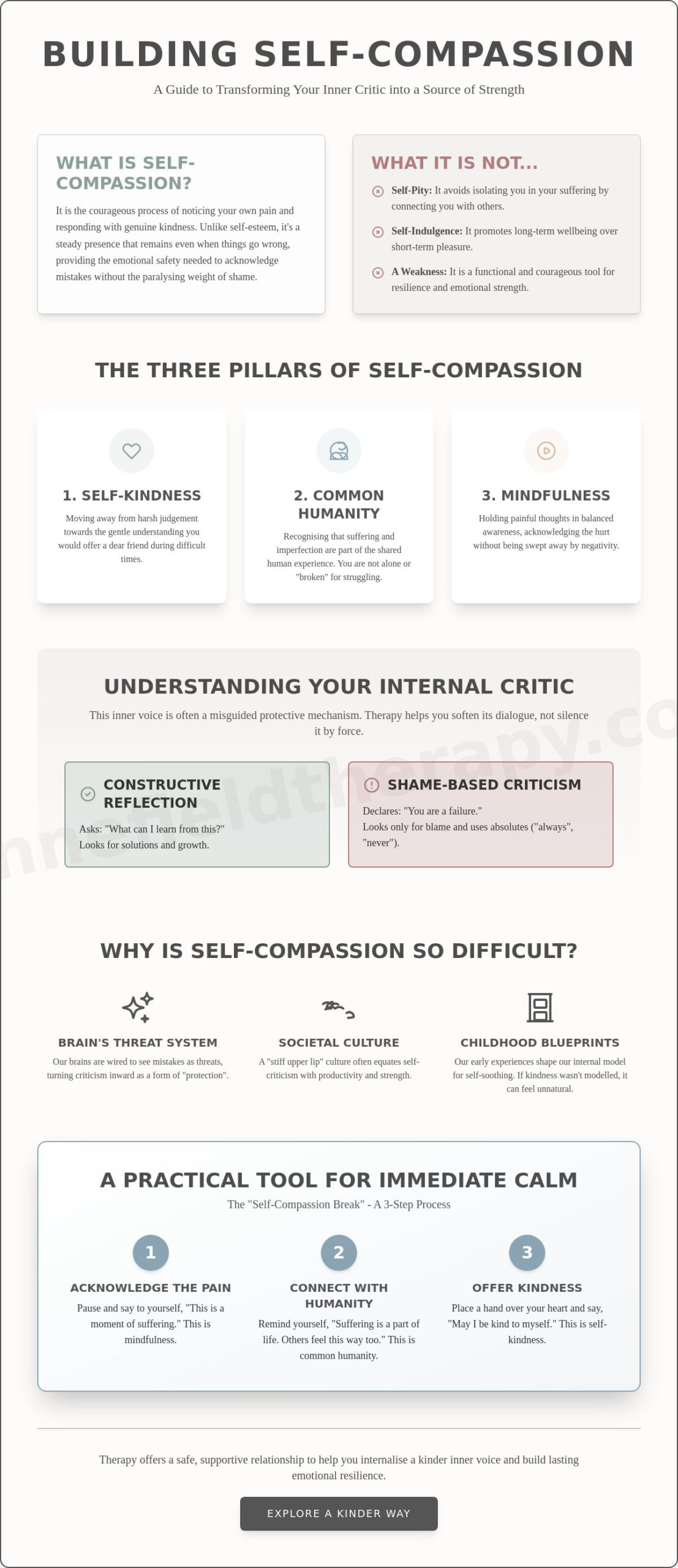
Self-compassion is often misunderstood as a form of weakness or a “soft option” for those who cannot face the harsh realities of life. In truth, it is a courageous, dynamic process. It requires the strength to notice your own pain without turning away and the wisdom to respond with genuine kindness. Unlike self-esteem, which often depends on being “better” than others or achieving specific goals, self-compassion is a steady presence that remains even when things go wrong. Building self-compassion in therapy involves shifting from a state of constant self-correction to one of curious, gentle observation. It is a skill that can be cultivated through practice; it isn’t a fixed personality trait you either have or lack.
It is helpful to clarify what self-compassion is not. It isn’t self-pity, which tends to isolate us in our suffering, making us feel like we are the only ones struggling. It also isn’t self-indulgence, which seeks short term pleasure at the expense of long term health. In exploring What is Self-Compassion?, we see it is actually a functional tool for resilience. It provides the emotional safety needed to acknowledge mistakes and make meaningful changes without the paralysing weight of shame.
The Three Essential Components Explained
Dr Kristin Neff, a leading researcher in the field, identifies three core pillars that support this practice. Self-Kindness is the first, involving a move away from harsh, critical judgement toward the kind of understanding you would naturally offer a dear friend. Common Humanity reminds us that suffering and imperfection are part of the shared human experience. You aren’t “broken” for struggling; you are simply human. Finally, Mindfulness allows us to hold our painful thoughts in balanced awareness. We acknowledge the hurt without becoming “over-identified” with it or swept away by a tidal wave of negativity.
Why We Struggle to Be Compassionate
If being kind to ourselves is so beneficial, why is it so difficult? Our brains are evolutionarily wired with a “threat-defence” system designed to keep us safe. When we perceive a mistake, this system often turns inward, triggering the inner critic as a misguided way to “protect” us from future failure. In the UK, this is often compounded by a societal culture that equates “stiff upper lip” stoicism and relentless self-criticism with productivity. We worry that if we stop being hard on ourselves, we will lose our edge. Additionally, our early childhood experiences often shape the “internal blueprint” for how we soothe ourselves. If kindness wasn’t modelled for us, building self-compassion in therapy becomes an essential part of re-parenting our internal world and creating a new, safer way of being.
The Internal Critic: Identifying the Barriers to Self-Kindness
Many of us live with a relentless internal commentator that points out every perceived flaw. It is easy to view this “inner critic” as an enemy, yet in a therapeutic context, we often see it as an overactive protective mechanism. This voice likely developed to shield you from the pain of external rejection or failure by getting there first; it’s a misguided attempt at safety. Building self-compassion in therapy doesn’t mean silencing this voice through force. Instead, it involves understanding why it feels the need to be so loud. When you begin to soften this internal dialogue, you may experience “backdraft.” This is the phenomenon where being kind to yourself initially triggers pain or fear, much like how warm water can sting frozen hands. It’s a sign that your system is beginning to thaw.
Recognising the Voice of Self-Criticism
Distinguishing between constructive self-reflection and shame-based criticism is a vital skill. Constructive reflection asks, “What can I learn from this?” whilst the critic simply declares, “You are a failure.” The critic often speaks in absolutes, using words like “should,” “must,” and “always.” It doesn’t look for solutions; it only looks for blame. You might notice this voice through physical sensations before you even hear the words. Perhaps your chest feels tight, your shoulders hunch, or you find yourself unable to meet your own gaze in the mirror. By learning Practical Techniques for Building Self-Compassion, you can begin to witness these sensations without being consumed by them. This awareness is the first step in building self-compassion in therapy, as it allows you to pause before the shame cycle takes hold.
Deconstructing the Myth of Motivation Through Shame
A common fear is that without the “whip” of self-criticism, you will lose your drive and become stagnant. However, research indicates the opposite. Shame actually shuts down the learning centres of the brain, making it harder to adapt and grow. It puts the body into a state of paralysis. True resilience comes from a place of safety, not fear. When you are kind to yourself, you create an internal environment where it is safe to fail, which is the only way to truly succeed. Transitioning from fear-based goals to values-based living allows you to move towards what matters to you with a sense of purpose rather than pressure. If you’re finding this transition difficult, exploring these patterns through individual counselling can provide the steady support needed to navigate this shift safely.
How Therapy Facilitates the Growth of Self-Compassion
Whilst self-help books offer valuable insights, building self-compassion in therapy is a distinct, relational experience. It is not a solo achievement. Instead, it is something co-created within the safety of a professional partnership. Central to this process is the concept of co-regulation. When you are caught in a spiral of self-criticism, your nervous system is often in a state of high alert. A therapist provides a steady, calm presence that helps to anchor you. Over time, The Role of Self-Compassion in Psychotherapy becomes clear: the therapist’s non-judgemental stance begins to mirror back a new way of relating to yourself. This external kindness eventually becomes an internalised voice, gently challenging the critic that has lived there for so long.
This journey is particularly effective through individual counselling in Cheshire, where the focus is entirely on your personal evolution. A trauma-informed approach is vital here. It ensures that the pace of work respects your boundaries, never pushing you faster than your sense of safety allows. By prioritising this internal security, building self-compassion in therapy transforms an abstract concept into a felt, bodily experience. You begin to move from a state of potential overwhelm to a state of structured, calm support.
The Relational Mirror: Experiencing Compassion First
How do we learn to be kind to ourselves if we have never experienced it? The therapist acts as a “relational mirror.” In moments when you feel at your lowest or most “unlovable,” the therapist remains present and accepting. Being “seen” in your most vulnerable state without facing judgement is transformative. It allows the therapeutic room to become a laboratory. Here, you can test out new behaviours and ways of speaking to yourself, knowing you are supported by a guide who holds a compassionate perspective even when you cannot.
Creating a Safe Space in Sandbach and Beyond
Whether you are seeking support through face to face sessions in Sandbach or via online therapy, the environment is carefully curated to lower your defences. This dedicated space provides a necessary pause from the “hustle culture” that often fuels self-criticism. For many in the local Cheshire community, having a grounding, professional space to explore deep-seated shame is the key to lasting change. Professional guidance is often necessary because shame thrives in secrecy. When we bring these parts of ourselves into the light of a compassionate therapeutic relationship, they lose their power to dictate our lives.
Practical Techniques for Building Self-Compassion in Daily Life
Building self-compassion in therapy creates the blueprint, but daily practice is how you build the home. It’s about taking the gentle presence of the therapeutic room and carrying it into your morning commute, your workplace, and your family life. These exercises help bridge the gap between understanding kindness intellectually and feeling it in your bones. By practising these tools regularly, you begin to rewire the neural pathways that previously led straight to self-criticism. It’s a methodical process of replacing old habits with new, more supportive ones.
The “Treating a Friend” Framework
This exercise is one of the most effective ways to bypass the “blind spot” we often have for our own suffering. It’s a simple four-step process that you can use whenever you notice your inner critic becoming loud:
- Step 1: Identify a specific situation where you are currently being self-critical or feeling “not enough.”
- Step 2: Imagine how you would speak to a dear friend in the exact same position. What would you say to them? What would your body language look like?
- Step 3: Notice the difference in your tone, pace, and vocabulary. You’ll likely find your voice is softer and your words are more patient when directed at someone else.
- Step 4: Practice directing that same warmth inward. Try to use the exact same words and tone you imagined for your friend.
Somatic and Mindfulness Exercises for Grounding
Our bodies often react to self-criticism as a physical threat. When you notice your chest tightening or your breath becoming shallow, you can use “Soothing Touch” to calm your nervous system. Placing a hand gently over your heart or cradling your cheek sends a signal of safety to the brain, releasing oxytocin and lowering cortisol. Mindful breathing further supports this by creating a necessary “buffer” between you and the critical thought. Instead of being the thought, you become the person observing it. This allows you to “drop” out of the frantic energy in your head and into the quiet safety of the body. If you’re ready to explore these somatic tools more deeply, you can book an individual therapy session to begin your journey.
For moments of acute stress, the “Self-Compassion Break” is a rapid intervention. Briefly acknowledge that “this is a moment of suffering,” remind yourself that “suffering is a part of life,” and ask “may I be kind to myself in this moment?” Tracking these shifts in a self-compassion journal can be incredibly illuminating. It isn’t about recording successes; it’s about noticing the subtle evolution of your inner world over time. Building self-compassion in therapy gives you the space to reflect on these entries, identifying patterns and celebrating the small, quiet victories of self-kindness.
Integrating Compassion into Your Healing Journey
Building self-compassion in therapy is not a linear process with a fixed destination. It is a continuous practice of returning to yourself with kindness, especially when you feel you have “failed” at being compassionate. This integration is where the real transformation happens. By weaving self-kindness into your broader healing journey, you create a foundation that can withstand the inevitable storms of life. Whether you are working through specific trauma or seeking help to overcome anxiety, this shift in internal posture changes how you experience every other part of your world. It moves you from a state of constant self-defence to a state of open, courageous growth.
ACT and CBT: Different Paths to the Same Heart
Different therapeutic frameworks offer unique ways to cultivate this inner warmth. For instance, Acceptance and Commitment Therapy (ACT) focuses on fostering psychological flexibility. In ACT, self-compassion helps you acknowledge your “internal weather”-those passing clouds of difficult thoughts and feelings-without trying to force them away. You learn to observe the critic with curiosity rather than obedience. This allows you to take values-based action, making choices based on who you want to be rather than what you are afraid of.
When considering CBT vs Psychotherapy, the role of compassion remains equally vital but looks slightly different. In CBT, compassion provides the safety needed to challenge the accuracy of the inner critic’s claims. It allows you to dismantle “should” statements without feeling attacked by your own mind. Whilst CBT offers structured tools for anxiety recovery, psychotherapy often goes deeper into the roots of self-criticism. Both paths eventually meet at the same point: the realisation that you are worthy of care exactly as you are. If you are based in the local area and want to understand how specialist support can help, exploring psychotherapy for anxiety in Tarporley and Sandbach can help you find the right path forward.
Taking the First Step with Dionne Field Therapy
Does the idea of being kind to yourself still feel slightly out of reach? That is completely understandable. For many, deep-seated shame makes self-compassion feel like a foreign language. This is why working with a BACP-accredited therapist is so beneficial. Having a professional guide helps you navigate the complexities of your internal world at a pace that feels safe. You don’t have to carry the heavy weight of self-criticism alone; therapy provides a shared space where that burden can be slowly unpacked and understood.
Building self-compassion in therapy is a journey of practice, not perfection. It takes immense courage to lower your defences and meet your imperfections with a gentle gaze. If you feel ready to begin this work, you can enquire about individual counselling sessions in Sandbach, Tarporley, or via online therapy. There is a quiet, steady strength in choosing to be your own ally. Whenever you are ready to take that first step, a safe and non-judgemental space is waiting for you.
Embracing a Kinder Path Forward
The path to inner healing often begins with the gentle realisation that you no longer wish to be at war with yourself. Throughout this guide, we have seen how the three pillars of self-compassion provide a steady foundation and how somatic grounding tools can calm a weary nervous system. Building self-compassion in therapy is not about achieving a state of perfection. It is about creating a reliable, internal safe haven where you can navigate life’s complexities with resilience rather than the heavy weight of shame.
Taking the first step towards this shift is a profound act of courage. I offer trauma-informed, evidence-based care as a BACP-accredited therapist, providing a steady presence as you learn to re-parent your inner world. With flexible online sessions and face to face therapy available across Cheshire, professional support is accessible in a way that fits your life. You have spent long enough being your own harshest critic. Perhaps it is time to discover what happens when you become your own most trusted ally.
Begin your journey toward a kinder inner life; enquire about individual therapy today.
You deserve the same warmth and understanding that you so freely offer to others. It is okay to start being kind to yourself now.
Frequently Asked Questions
Is self-compassion just another word for being lazy or making excuses?
No, self-compassion is actually a functional tool for accountability and resilience. Excuses seek to avoid reality, whilst self-compassion provides the safety needed to face mistakes without being crushed by shame. It’s about acknowledging a struggle so you can address it effectively, rather than ignoring it or being paralysed by self-criticism. It gives you the strength to take responsibility for your actions with kindness.
Can I build self-compassion if I have experienced significant trauma?
Yes, and it is often a fundamental part of trauma-informed therapy. Trauma can leave you feeling as though your body and mind are unsafe places to inhabit. Building self-compassion in therapy allows you to slowly establish a sense of internal security. This process helps you to relate to your survival responses with understanding rather than judgement, creating a bridge toward deeper healing and emotional regulation.
How long does it take to start feeling the benefits of self-compassion in therapy?
Many people notice a subtle shift in their internal “temperature” within a few weeks, though deep change is a gradual process. You might first notice small moments where you catch a critical thought before it spirals. Over several months, these individual moments coalesce into a more consistent sense of internal safety. It’s a methodical progression that replaces emotional exhaustion with lasting resilience.
What if I find it easier to be kind to others but impossible to be kind to myself?
This is a very common experience and often stems from early social conditioning or survival strategies. It is frequently easier to see the common humanity in others whilst holding ourselves to an impossible, singular standard. Therapy helps you bridge this gap by applying the same empathy you naturally give away to your own internal experience. You learn to treat yourself with the same dignity you offer others.
Does self-compassion mean I have to stop wanting to improve myself?
Quite the opposite, as self-compassion provides the stable foundation necessary for genuine growth. When you improve yourself out of shame, the change is often brittle and driven by fear. When you grow out of compassion, you are motivated by a desire for your own wellbeing. This leads to more sustainable and authentic life changes because the motivation comes from a place of love rather than lack.
What is the “backdraft” effect in self-compassion practice?
Backdraft occurs when an influx of self-kindness causes old, suppressed pain to surface. Just as a fire flares when oxygen enters a room, your heart may react to kindness by releasing years of stored hurt. This is a natural, albeit challenging, part of the healing process. It is best navigated with the support of a therapist who can help you manage these feelings without becoming overwhelmed.
How does self-compassion help with physical symptoms of anxiety?
It directly calms the “threat-defence” system by signalling to the brain that you are safe. By using somatic techniques like soothing touch or mindful breathing, you can lower your heart rate and reduce cortisol levels. Building self-compassion in therapy helps you move from a state of physiological high alert to one of grounded regulation. You begin to feel physically safer within the boundaries of your own skin.
Can I practice self-compassion exercises at home between therapy sessions?
Absolutely, and consistent home practice is highly encouraged to reinforce the work done in sessions. Simple acts like the “Treating a Friend” framework or a self-compassion journal can be done daily. These small, repetitive actions help to build “muscle memory” for kindness. Over time, this makes compassion your default response during challenging moments, even when you are outside the supportive environment of the therapy room.

Article by
Dionne Field
Dionne Field is an integrative psychotherapist. She's passionate about helping clients understand themselves with greater compassion and clarity. With experience in both NHS mental health services & private practice, her work combines trauma-informed, person-centred therapy, ACT, CBT, DBT, 'parts work' & somatic therapy. Dionne believes that meaningful change happens when people feel safe, understood and empowered to reconnect with who they truly are.
Disclaimer
The information provided in this blog is intended for educational and informational purposes only and should not be considered a substitute for professional mental health advice, diagnosis, or treatment. Whilst every effort is made to ensure the information shared is accurate and up to date, the content reflects general therapeutic knowledge and perspectives and may not be applicable to your individual circumstances. Reading this blog does not create a therapeutic relationship between you and Dionne Field Therapy. If you are currently experiencing emotional distress, mental health difficulties, or require support specific to your situation, please seek advice from a qualified healthcare professional or mental health practitioner. If you are in crisis, experiencing thoughts of self-harm, or feel unable to keep yourself safe, please contact your GP, NHS 111, emergency services, or an appropriate crisis support service immediately. Any external links provided are for convenience and informational purposes only. Dionne Field Therapy is not responsible for the content, accuracy, or availability of third-party websites. By using this website and blog, you acknowledge and accept this disclaimer.
Leave a Reply