

What if the very thing your brain does to protect you is actually the thing stealing your peace of mind? It’s a heavy burden to carry, the constant scanning for symptoms and the quiet terror that every ache is a sign of something catastrophic. You aren’t “crazy” for feeling this way. In fact, since 2023, health anxiety scores in the UK have remained about three points higher than pre-pandemic levels. Exploring CBT for health anxiety offers a gentle way to recognise these patterns and reclaim a sense of safety in your own body. If you find yourself trapped in a cycle of reassurance seeking that strains your closest relationships, please know that your nervous system is simply trying to keep you safe; even if its methods feel exhausting.
You can learn to quiet this internal alarm and break the loop of health-related worry. This article will help you understand why your brain gets stuck in these cycles and provide actionable tools to help you stop the urge to body-check. We’ll also look at how you can find a compassionate therapist in Cheshire to guide you through this process. It’s time to move away from the shadow of “what if” and toward a life where you feel grounded, supported, and truly at home in yourself.
Key Takeaways
- Understand why your physical sensations are very real and why health-related worry is a valid, distressing experience rather than “attention-seeking” behaviour.
- Discover how CBT for health anxiety decodes the vicious cycle between your internal triggers, catastrophic thoughts, and the exhausting urge to body-check.
- Learn practical, evidence-based tools such as cognitive restructuring to help you challenge fearful assumptions and reclaim a sense of grounded safety.
- Explore how a private therapeutic partnership in Cheshire or via online therapy can provide the personalised, steady support needed to navigate your path to calm.
Understanding Health Anxiety: Moving Beyond the “It’s Just in Your Head” Myth
It is a common experience to feel a sudden flutter in your chest or a sharp twinge in your side and feel a flicker of concern. For most, that thought passes. However, for those living with health anxiety, that flicker becomes a consuming flame. This condition, historically referred to as Understanding Health Anxiety, is a persistent and deeply distressing preoccupation with the belief that you have a serious, undiagnosed illness. It isn’t a choice, and it certainly isn’t a lack of logic. It is a protective mechanism of the nervous system that has become stuck in an “on” position.
One of the most painful aspects of this struggle is the feeling that others don’t believe you. You might have been told you’re “imagining things” or that it’s “just stress.” We need to be very clear: the physical sensations you feel are real. The tingling in your hands, the pounding of your heart, and the sharp pains in your stomach are actual physiological events. They aren’t imagined. They are the result of an internal alarm system that has become over-sensitive, misinterpreting normal, everyday bodily fluctuations as signs of an impending catastrophe. Through CBT for health anxiety, we begin to look at these alarms with compassion rather than terror.
The Physical Reality of Anxiety Sensations
When you perceive a threat to your health, your body’s “fight or flight” response ignites. This flood of adrenaline creates very real somatic symptoms, such as chest tightness, dizziness, or a racing pulse. These sensations are uncomfortable, but they are your body’s way of trying to protect you from a perceived danger. A cycle of hyper-vigilance often follows; the more we focus on a specific area of the body, the more likely we are to notice tiny, harmless changes that we previously ignored. Scanning your body for signs of illness actually amplifies the intensity of the sensations you feel.
For those who want to address the physical tension or injuries that can heighten these sensations, professional support from experts like RED Physiotherapy offers a structured path to rehabilitation and improved body awareness.
When Worry Becomes a Problem
There is a subtle tipping point where being health-conscious shifts into a cycle of anxiety that dictates your life. It’s often marked by the moment you can no longer enjoy a walk through Sandbach or a coffee with friends because your mind is elsewhere, trapped in a loop of checking and worrying. This constant state of alert can make daily functioning feel like an uphill battle. If you feel your world is shrinking because of these fears, exploring Individual Counselling in Cheshire can provide a safe, grounding space to start your recovery. Using CBT for health anxiety allows us to decode these patterns together, moving you away from hyper-vigilance and back toward a life of presence and calm.
The Vicious Cycle: How Cognitive Behavioural Therapy (CBT) Decodes the Loop
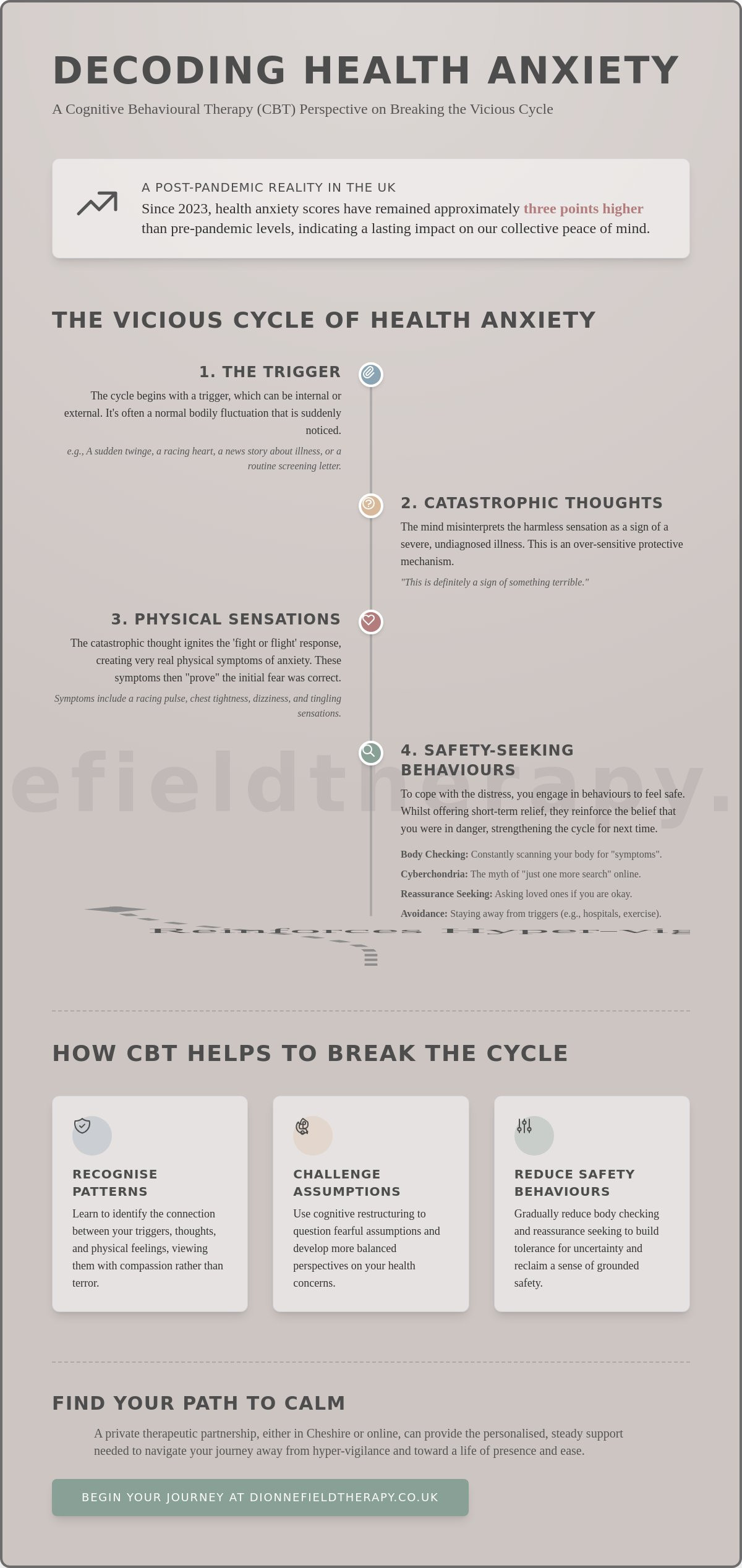
Imagine your mind is a highly skilled detective, but one that is perpetually looking for a crime that hasn’t been committed. In the context of CBT for health anxiety, we view your struggle not as a lack of logic, but as a series of interconnected threads: your thoughts, your physical feelings, and your behaviours. When these threads tangle, they create a loop that feels impossible to escape. It usually begins with a trigger. This might be a sudden, sharp sensation in your side, a distressing news story about a celebrity’s illness, or even the arrival of a routine screening letter in the post.
Once the trigger is pulled, the brain’s interpretation takes over. Instead of seeing a twinge as a muscle pull, the mind whispers, “This must be a sign of something terrible.” This thought immediately ignites the nervous system, producing the very physical symptoms—like a racing heart or breathlessness—that seem to confirm your worst fears. This is the “Somatic-Anxiety Loop.” Your anxiety creates the symptoms you fear, which then provides “evidence” to your brain that the danger is real. By using Practical CBT Tools for Health Anxiety, we can begin to untangle these threads and see them for what they truly are: a protective system that has become over-sensitive.
The Myth of “Just One More Search”
Many of us turn to the internet when we feel a new sensation. This is often called “Cyberchondria.” You might tell yourself that you’ll just do one more search to find a “benign” explanation. However, the relief this provides is incredibly short-lived. These “safety behaviours,” including constant body-checking or scrolling through medical forums, actually keep your anxiety alive. They prevent “disconfirmation”—the chance for your brain to learn that the sensation would have passed on its own without your intervention. In the landscape of our health, absolute certainty is a horizon we can never quite reach; the more we chase it, the further it retreats.
The Role of Reassurance Seeking
You may find yourself frequently asking your partner for their opinion on a mark on your skin, or perhaps you’ve visited your GP multiple times for the same “all-clear.” Whilst this feels necessary in the moment, it reinforces a painful belief: that you cannot cope with uncertainty alone. Reassurance is like a leaky bucket. It holds water for a few moments, but the worry always drains out, leaving you thirsty for more. Part of our work involves moving toward “Acceptance,” a bridge between CBT and exploring psychotherapy. It’s about learning to sit with the “maybe” and finding peace even when we don’t have all the answers. If you feel ready to step out of this cycle, a steady companion can help you find your way back to a sense of internal safety.
Myth vs Reality: Debunking Common Misconceptions About Health Anxiety
Have you ever felt that others might see your worry as a choice or perhaps a bid for attention? It’s a painful stigma to carry. One of the most pervasive myths is that health anxiety is simply “attention-seeking.” In reality, it is a deeply distressing and often incredibly lonely experience. Most people we support in Cheshire actually go to great lengths to hide their fears, terrified that they’ll be judged or dismissed. They don’t want attention; they want the peace of knowing they are safe.
Another common misconception is that you can just “stop thinking about it.” If it were that simple, you would have done so a long time ago. This isn’t a lack of willpower. It’s a biological response. Your brain is stuck in a loop of high-alert protection, and breaking that cycle requires structured tools rather than just “trying harder.” Similarly, worrying doesn’t make you “weak.” It often stems from a high capacity for empathy and a deeply ingrained desire to protect yourself and your loved ones. Your brain is simply doing its job too well. By engaging with CBT for health anxiety, we don’t try to switch off your brain; we work to re-train its focus.
There is also a fear that starting therapy means your real physical symptoms will be ignored. This couldn’t be further from the truth. A compassionate therapist won’t tell you that your pain isn’t real. Instead, we look at how you respond to those sensations. There is significant Evidence for CBT for anxiety disorders showing that by changing our cognitive and behavioural responses, we can actually lower the physical intensity of the symptoms themselves. It’s about building a partnership between your mind and your body, rather than a battle.
Why “Positive Thinking” Isn’t the Answer
You might have tried telling yourself “I am fine” or “everything is okay,” only to find the anxiety grows louder. This often backfires because your brain knows you’re trying to bypass the alarm. In CBT for health anxiety, we move away from “positive thinking” and toward “balanced thinking.” We don’t ignore the possibility of illness; we simply look for a more realistic, evidence-based perspective. From a trauma-informed lens, we acknowledge that your brain is trying to keep you safe. We respect that intention whilst gently suggesting that the alarm might be miscalibrated.
The Truth About “Cyberchondria”
It’s easy to believe that more information will lead to less worry. However, search engines operate on an “algorithm of anxiety.” They are designed to show you the most clickable, often most catastrophic, results first. This digital rabbit hole doesn’t provide clarity; it only provides more fuel for the fire. A preliminary step in our work often involves setting “digital boundaries.” This isn’t about ignoring your health, but about choosing when and where you seek information, ensuring it comes from a place of calm rather than a place of panic.
Practical CBT Tools: Moving from Hyper-vigilance to Safety
Moving from a state of hyper-vigilance to one of safety is a gradual, patient process. It isn’t about ignoring your body; instead, it is about changing how you relate to it. In CBT for health anxiety, we use structured, evidence-based steps to help your nervous system feel secure again. This transition is not about achieving a state of “never worrying,” but rather about building the resilience to handle worry when it arises. If you’re curious about the mechanics behind this approach, understanding how does CBT work for anxiety can help you feel more prepared and confident before beginning your therapeutic journey.
- Step 1: The Worry and Checking Diary. This involves identifying the specific moments your anxiety flares. By recording when you feel the urge to check your body or search for symptoms, we can spot the patterns and triggers that keep you stuck.
- Step 2: Cognitive Restructuring. Here, we gently question the evidence for the catastrophe. We look at the “worst-case” thought and balance it with more likely, benign explanations.
- Step 3: Response Prevention. This is the practice of gradually delaying the urge to check, search, or ask for reassurance. It teaches your brain that you can survive the discomfort of uncertainty without an immediate “rescue.”
- Step 4: Somatic Grounding. We use the breath and sensory awareness to calm the physical alarm. This signals to your brain that, in this very moment, you are safe.
Challenging Your Health Thoughts
A simple “Thought Record” can be a transformative tool. When a health worry strikes, we document the fearful thought and then list “Alternative Explanations.” For instance, if you feel a sharp pain in your chest, the anxiety might shout “heart attack.” A balanced alternative might be, “This pain could be muscle tension from my posture at work.” The goal is not to find a perfect answer, but to learn the quiet strength of sitting with the uncertainty until the alarm fades.
Somatic Tools for Body Safety
Nervous system regulation is a vital part of the recovery journey. We focus on staying within your “Window of Tolerance,” which is the space where you feel grounded enough to process difficult sensations without becoming overwhelmed or shutting down. By using basic somatic techniques, such as rhythmic breathing or “orienting” to your surroundings, you can lower the volume on the physical symptoms of anxiety. For those whose health-related worry is rooted in deeper past experiences, Healing Trauma through a trauma-informed approach can be an essential part of reclaiming your sense of safety.
If you find yourself constantly scanning for symptoms and feel ready to reclaim your focus, explore how psychotherapy can help you find your path to calm.
Finding Your Path to Calm: Private CBT for Health Anxiety in Cheshire
Whilst generic self-help guides can offer a starting point, the intricate nuances of your personal history and physical sensations often require a more tailored, intimate approach. Choosing private CBT for health anxiety allows us to move at a pace that feels safe for you. It creates a dedicated space where your specific fears are heard without the constraints of a rigid, one-size-fits-all system. You deserve a therapeutic relationship that feels like a steady companionship; one where your progress is the sole focus. If you are weighing your options and wondering where to begin, our comprehensive guide to anxiety therapy in Cheshire can help you understand what compassionate, private support truly looks like and how to find the right fit for your needs.
At Dionne Field Therapy, we maintain a BACP Accredited standard of care, ensuring that your journey is supported by professional excellence and ethical rigor. We don’t rely on a single framework. Instead, we use an integrative approach that blends the structured tools of CBT with the mindfulness of Acceptance and Commitment Therapy (ACT) and the grounding influence of somatic work. This holistic method addresses the thoughts in your mind whilst gently soothing the physical tension held in your body. It is about more than just managing symptoms; it’s about personal evolution. To better understand the step-by-step process you can expect, our guide on how does CBT work for anxiety walks you through exactly what this compassionate, structured journey looks like in practice.
Why Choose Private Therapy in Sandbach?
Accessibility and timing are often the first hurdles in seeking support. For those living in Middlewich, Nantwich, or Northwich, our local clinics in Sandbach and Tarporley offer a convenient, calm environment for face-to-face sessions. Whilst NHS Talking Therapies reported that 88.7% of individuals were seen within six weeks as of January 2026, private care provides the benefit of bypasssing these waiting lists entirely. You don’t have to wait for a target to be met to begin your recovery. Stepping into therapy is a courageous act of self-care, and having immediate access to a compassionate expert can make all the difference in your momentum.
Taking the First Step
The prospect of opening up about your health worries can feel daunting. You might wonder if you’ll be misunderstood or if your fears will be dismissed. Please know that in this space, you’ll be met with warmth, patience, and zero judgment. Our initial consultation is a gentle stepping stone. It’s an opportunity for us to sit together, explore your experiences, and see if our partnership feels like the right fit for your path to calm. There is no rush, and there are no “silly” questions. If you feel ready to move away from the cycle of worry, you are invited to book a gentle introductory session with Dionne and begin the process of reclaiming your sense of safety.
Reclaiming Your Sense of Safety and Presence
Living with constant health-related worry is exhausting. It is more than just a thought; it’s a physical experience that can make your world feel very small. We have explored how your nervous system’s alarm is simply trying to keep you safe, and how we can use CBT for health anxiety to gently re-train those responses. By understanding the somatic loops that keep you stuck and practising gradual response prevention, you can move from a state of hyper-vigilance back into the flow of your daily life in Cheshire.
You don’t have to navigate this path alone. As a BACP Accredited therapist, I offer a trauma-informed approach that respects your individual boundaries and history. Whether we meet face-to-face in Sandbach or Tarporley, or connect through online therapy, our work together will be a partnership built on trust and quiet strength. If you’re ready to break the cycle of checking and find your way back to calm, please reach out. You are invited to book a compassionate consultation for health anxiety today. Peace of mind is possible, and it begins with a single, courageous step toward support.
Frequently Asked Questions
Is health anxiety a form of OCD?
Health anxiety is often categorised alongside Obsessive-Compulsive Disorder because they share a similar cycle of intrusive thoughts and repetitive checking behaviours. Whilst OCD can focus on many different themes, health anxiety is specifically preoccupied with the fear of having a serious illness. Both conditions respond remarkably well to the structured approach of CBT for health anxiety, which helps you recognise and break the ritualistic patterns of searching for reassurance.
Can CBT actually cure health anxiety or just manage it?
Recovery is about moving from a state of constant fear to a state of resilience, where worry no longer dictates your life. Many people find that the tools they learn allow them to live a life where health-related thoughts are no longer the central focus. It’s less about “erasing” every thought and more about re-training your brain’s reaction to them. You learn to trust your body again and feel grounded in the present moment.
Why do I feel physical symptoms if there is nothing medically wrong?
Your nervous system cannot distinguish between a physical threat and a perceived one. When you worry, your body releases adrenaline and cortisol, which cause very real sensations like heart palpitations, chest tightness, or tingling. These are not “imagined” but are actual physiological responses to stress. The more you focus on them, the more intense they become, creating a cycle of somatic discomfort that feels frighteningly real but is actually a sign of an over-active alarm system.
How long does CBT for health anxiety typically take?
The duration of therapy is deeply personal and depends on the complexity of your history. Typically, a course might last between 6 and 20 sessions. Some individuals find significant relief within a few months, whilst others prefer a longer, more methodical journey to address deep-seated patterns. We work at your pace, ensuring you feel supported through every transition as you build your personal toolkit for calm and safety.
What should I do if I have a real medical symptom during therapy?
Therapy does not replace medical care, and we always encourage a balanced approach to your physical health. If you experience a new or concerning symptom, we discuss how to seek medical advice without falling back into the cycle of panic or excessive checking. We work together to differentiate between a routine GP visit and the “compulsive” seeking of reassurance; for those who value prompt, private medical care, Ready Health provides accessible services to help you navigate health decisions with a clear, calm mind.
How is private therapy in Cheshire different from NHS talking therapies?
Private therapy offers immediate accessibility and a more personalised, integrative relationship. As of January 2026, 88.7% of individuals referred to NHS Talking Therapies were waiting less than 6 weeks, but private care in Sandbach or Tarporley allows you to start your journey without any waiting list. You also benefit from a consistent therapist and a bespoke blend of CBT, ACT, and somatic tools that are tailored specifically to your unique life experiences.
Can health anxiety be related to past trauma?
Health anxiety is frequently a protective response rooted in past experiences of illness, medical trauma, or the loss of a loved one. If you have navigated difficult health challenges before, your brain may remain in a state of high alert to prevent future pain. Taking a trauma-informed approach allows us to honour these past experiences whilst gently teaching your nervous system that it is safe to lower its guard in the present, moving you toward a more peaceful future.
What is the “Z-code” or health anxiety diagnosis?
In clinical settings, “Z-codes” or specific ICD-11 codes are used by professionals to categorise factors influencing health status, often relating to Illness Anxiety Disorder. These codes help provide a structured framework for medical records and treatment plans. However, in our sessions, we focus less on the clinical label and more on the human experience behind it. Understanding the diagnosis can be validating, but our priority is always your personal path to recovery and emotional well-being.

Article by
Dionne Field
Dionne Field is an integrative psychotherapist. She's passionate about helping clients understand themselves with greater compassion and clarity. With experience in both NHS mental health services & private practice, her work combines trauma-informed, person-centred therapy, ACT, CBT, DBT, 'parts work' & somatic therapy. Dionne believes that meaningful change happens when people feel safe, understood and empowered to reconnect with who they truly are.
Disclaimer
The information provided in this blog is intended for educational and informational purposes only and should not be considered a substitute for professional mental health advice, diagnosis, or treatment.
Whilst every effort is made to ensure the information shared is accurate and up to date, the content reflects general therapeutic knowledge and perspectives and may not be applicable to your individual circumstances.
Reading this blog does not create a therapeutic relationship between you and Dionne Field Therapy. If you are currently experiencing emotional distress, mental health difficulties, or require support specific to your situation, please seek advice from a qualified healthcare professional or mental health practitioner.
If you are in crisis, experiencing thoughts of self-harm, or feel unable to keep yourself safe, please contact your GP, NHS 111, emergency services, or an appropriate crisis support service immediately.
Any external links provided are for convenience and informational purposes only. Dionne Field Therapy is not responsible for the content, accuracy, or availability of third-party websites.
By using this website and blog, you acknowledge and accept this disclaimer.
Leave a Reply