

What if the tightness in your chest and the constant hum of worry aren’t signs that you’re broken, but are actually your body’s way of asking for a different kind of support? When you’re searching for anxiety therapy Cheshire, it’s often because the physical weight of your thoughts has become too heavy to carry alone. You might feel lost in a system where waiting for NHS Talking Therapies feels like an eternity, even whilst statistics from early 2026 show that 88.7% of referrals are seen within six weeks. For many, being a name on a list isn’t enough when you need to feel seen, heard, and deeply understood right now.
We understand that making that first contact is often the hardest step, especially when anxiety makes every decision feel monumental. You deserve more than a clinical tick-box exercise; you deserve a therapeutic partnership that respects your pace. This guide will help you find a private, compassionate space tailored to your specific emotional needs. We’ll explore how integrating somatic awareness with proven methods like CBT and trauma-informed psychotherapy can help you move from a state of constant overwhelm to one of calm, grounded regulation. It’s time to discover a path toward lasting emotional quiet.
Key Takeaways
- Understand how anxiety therapy Cheshire serves as a collaborative partnership, offering accessible and personalised support in local communities like Sandbach and Tarporley.
- Explore the differences between structured frameworks like CBT and ACT to find the specific tools that help you navigate intrusive thoughts and somatic symptoms.
- Evaluate the practical benefits of private psychotherapy versus NHS services, focusing on the depth of work and the speed of accessing a safe, therapeutic space.
- Identify the non-negotiable standards for choosing a therapist, from professional BACP accreditation to the intuitive sense of safety required for a deep emotional connection.
- Discover how a trauma-informed approach integrates the mind and body, providing you with a more holistic path toward regulation and long-term emotional resilience.
Navigating Anxiety Therapy in Cheshire: Finding the Right Support
Seeking anxiety therapy Cheshire is often a quiet, deeply personal decision born from a desire for change. It’s important to understand that therapy is not a process where you’re “fixed” by an expert; rather, it’s a collaborative partnership. We view it as a shared exploration of your internal world, where we work together to regulate your nervous system and uncover the roots of your distress. This journey requires a space where you’re not just a number in a clinical system, but a person whose unique emotional history is respected and held with care.
Many people find that a “one size fits all” approach, often found in high-volume services, fails to address the complexities of deep-seated anxiety. Your experiences are yours alone. They don’t always fit into a standard treatment manual. A foundational step in your recovery is understanding anxiety disorders and the specific ways they manifest in your daily life. By moving away from rigid structures, we can focus on what you actually need in the moment, whether that’s a grounding technique or a deeper look at long-standing patterns. Choosing to engage in individual counselling in Cheshire is a profound act of self-care that validates your struggle and honours your capacity for growth.
Recognising When Anxiety Requires Professional Support
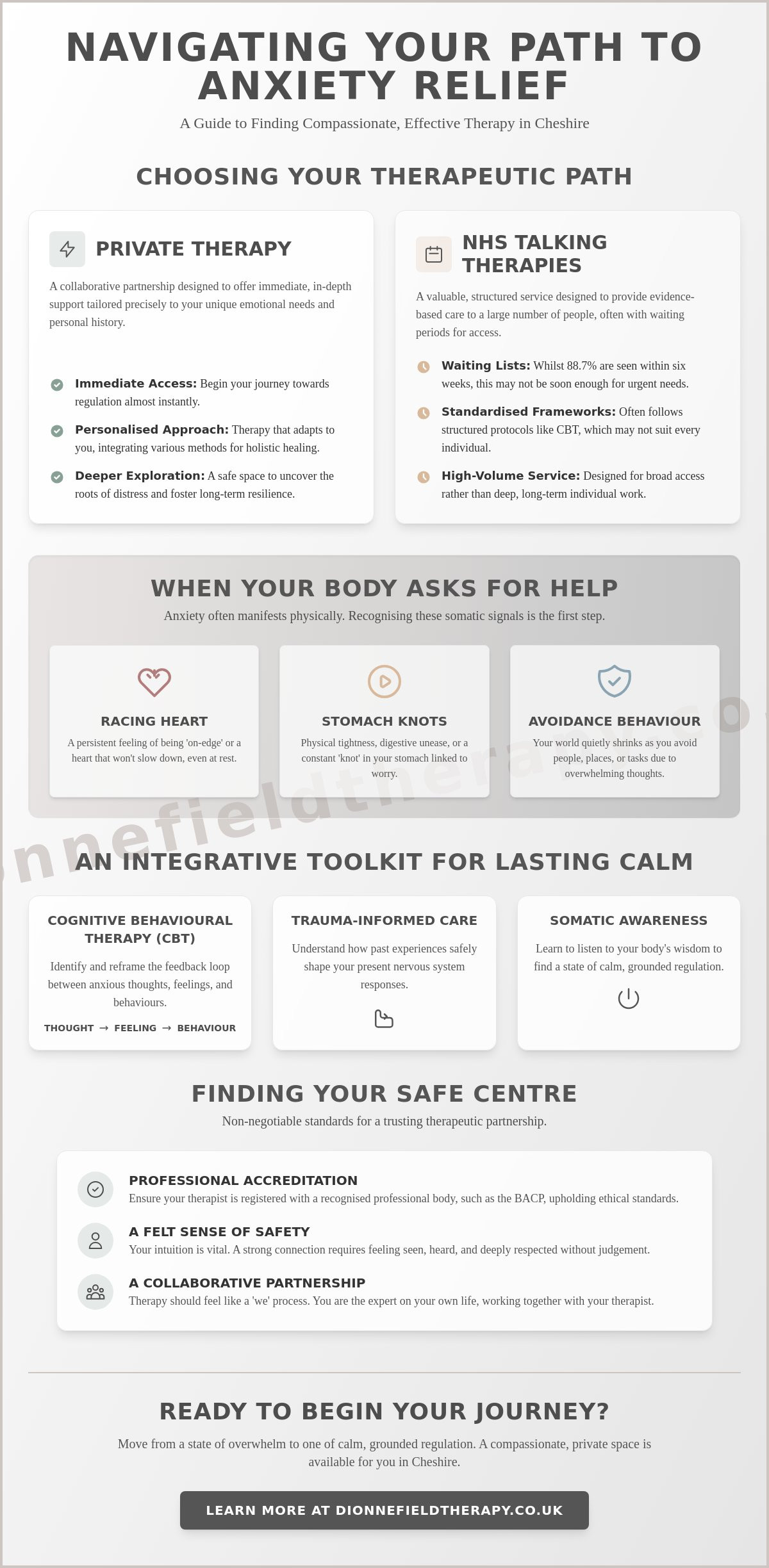
It’s natural to feel stressed, but there’s a distinct transition when worry becomes clinical anxiety. You might notice your body speaking what your mind cannot: a racing heart, a persistent knot in your stomach, or a sense of “on-edge” tension that won’t dissipate. When these physical symptoms begin to dictate your choices, it’s a sign that your nervous system is overwhelmed. Anxiety can quietly shrink your world, impacting your performance at work, the depth of your relationships, and your ability to feel present in your own life. Recognising these somatic signals is the first step toward reclaiming your agency. If you’re looking for practical strategies alongside professional support, our guide on how to overcome anxiety offers evidence-based tools to help you begin reclaiming your sense of calm.
The Local Landscape: Therapy in Sandbach and Beyond
Finding support close to home in towns like Sandbach or Tarporley can provide a necessary sense of stability. Choosing a private practitioner for anxiety therapy Cheshire allows for a level of consistency and immediate access that is often difficult to find elsewhere. Whilst national data from early 2026 indicates that 88.7% of NHS Talking Therapies referrals are seen within six weeks, private care offers the benefit of starting your journey almost immediately. This allows you to create a “safe centre” for your recovery. Whether you prefer the grounding presence of face-to-face sessions or the quiet convenience of online therapy, the goal is to establish a rhythm that fits your life, ensuring that help is always within reach when you need it most.
Evidence-Based Approaches: A Roundup of Effective Anxiety Treatments
When you are looking for anxiety therapy Cheshire, the variety of clinical terms can feel overwhelming. It’s helpful to remember that these frameworks are simply different lenses through which we can understand your experience. An integrative approach doesn’t just stick to one manual; instead, it blends different methodologies to meet you where you are. By combining cognitive tools with body-informed techniques, we create a more comprehensive path to wellness that respects both your mind and your physical reality. This prevents therapy from feeling like a rigid programme and allows it to become a personal evolution.
The Role of CBT in Managing Intrusive Thoughts
Cognitive Behavioural Therapy (CBT) is a cornerstone of modern psychological support. It focuses on the intricate link between your thoughts, feelings, and behaviours. When anxiety takes hold, it often creates a “feedback loop” where a worried thought triggers a physical sensation, which then reinforces the original fear. Following the NICE guidelines for anxiety, this structured approach is highly effective for identifying these patterns and providing immediate relief from the spiral of “what if” thinking.
CBT for anxiety helps you identify and gently challenge the distorted thought patterns that keep you trapped in a state of constant worry. In our sessions, we use practical tools for cognitive restructuring. This might involve keeping a thought diary or learning to “catch” an intrusive thought before it spirals. It’s about building a toolkit you can use in your daily life. This gives you a sense of agency over your mental landscape that lasts long after the session ends.
ACT and Somatic Therapy: Beyond Traditional Talk Therapy
While CBT looks at the content of your thoughts, Acceptance and Commitment Therapy (ACT) changes your relationship with them. Instead of trying to “fix” or delete an anxious feeling, ACT encourages you to stop the struggle against it. Have you ever noticed that the harder you fight a feeling, the louder it becomes? By learning to observe these sensations without judgement, you can begin to move toward your values, even whilst anxiety is present. It’s a shift from “I can’t do this because I’m anxious” to “I am feeling anxious, and I am still choosing to do what matters to me.”
Somatic Therapy takes this a step further by addressing the physiological roots of the stress response. Anxiety isn’t just in your head; it’s a state of your nervous system. We use somatic techniques for grounding, such as breathwork or focused body awareness, to help your system feel safe again. This body-informed care is essential for long-term recovery because it teaches your brain that the “threat” has passed. If you feel ready to explore a more holistic way of healing, you might find that trauma-informed therapy offers the gentle, integrated support you’ve been looking for in the local area.
Private Therapy vs. NHS Talking Therapies in Cheshire
Choosing between public and private care is a common crossroad for those seeking anxiety therapy Cheshire. While the NHS provides a vital service, its framework is often designed for high-volume throughput rather than long-term depth. In a private setting, the focus shifts entirely to you. You aren’t just a referral number in a queue; you’re an individual with a story that doesn’t always fit into a standardised six-session block. This freedom allows for a level of personalisation where the modality is chosen based on your resonance with the work, rather than what the system dictates. It’s about finding a rhythm that respects your specific emotional pace.
Consistency is perhaps the greatest gift of private psychotherapy. In many large systems, you might see different practitioners or be moved between departments. Private care ensures you see the same therapist every week. This stability allows for the development of a deep, trusting relationship. When you know exactly who will be waiting for you on the other side of the door, or the screen, your nervous system can begin to settle. It’s in this consistent, predictable space that the real work of transformation happens.
Bypassing the Wait: Why Timely Support Matters
Waiting for support whilst in the grip of anxiety has a heavy emotional cost. Every week spent on a list can feel like a month when your heart is racing and your sleep is fragmented. Early intervention is crucial. It prevents acute stress from settling into a chronic, life-limiting pattern. By opting for private care, you gain the agency to choose a therapist who truly aligns with your personality. This choice is foundational to your recovery. You can explore different types of therapy and decide which approach feels safest for your specific needs, rather than accepting whatever is available.
Trauma-Informed Care: A Private Practice Priority
One of the most significant advantages of private practice is the accessibility of specialised, trauma-informed care. In many clinical settings, the focus remains on rapid symptom reduction. However, a trauma-informed approach looks beneath the surface at how your past experiences have shaped your nervous system’s current response. We often work with the “Window of Tolerance” framework. This helps you understand that when you’re anxious, you’ve likely been pushed into a state of “hyper-arousal.” Staying within this window is vital for processing emotions without becoming overwhelmed. Trauma informed therapy prioritises your physical and emotional safety above all else, ensuring the work never moves faster than your system is ready to go. This depth of care is a cornerstone of effective anxiety therapy Cheshire, offering a path to healing that is as gentle as it is profound.
Choosing Your Anxiety Therapist: What to Look for Locally
Finding the right professional for anxiety therapy Cheshire is about more than just proximity. It’s a search for a person you can trust with your most vulnerable thoughts. While a directory might give you a long list of names, it cannot tell you if a therapist’s presence will feel grounding or if their voice will offer the quiet reassurance you need. You are looking for a guide who is both academically rigorous and emotionally intuitive. This delicate balance ensures that while the science of psychology is present, the human connection remains the priority of every session.
Beyond the qualifications, pay attention to your “gut feeling” during the first contact. Do you feel heard? Is there a sense of emotional safety that allows you to lower your defences? If you have struggled with the physical symptoms of stress, you might prioritise a therapist who understands somatic work or Acceptance and Commitment Therapy (ACT). These specialisms allow for a more nuanced approach than standard talk therapy, helping you navigate the complex way anxiety lives in both your mind and your body. It is this specific fit between your needs and the practitioner’s expertise that creates the foundation for lasting change.
The Importance of BACP Accreditation
Being an accredited member of the British Association for Counselling and Psychotherapy (BACP) is a non-negotiable standard for professional safety. It means your therapist has met high levels of training and experience, but more importantly, it means they are bound by a strict ethical framework. This protects the therapeutic process, ensuring that your well-being is always the primary focus. Accreditation also requires continuous professional development. This ensures that your practitioner is staying current with the latest research and evidence-based practices in mental health, providing you with the highest standard of care.
Practical Considerations for Your Search
The environment where you meet matters deeply for your sense of regulation. Whether you are looking for support in Sandbach or the wider Cheshire area, the physical space should feel like a sanctuary where you can breathe. If you value the grounding nature of in-person connection, check for local availability for face-to-face sessions in Sandbach. Balancing the cost of private care with the quality of experience is a personal decision, but investing in a practitioner who offers a truly bespoke, trauma-informed service can lead to a more sustainable recovery. If you’re ready to see if this approach resonates with you, you can enquire about an initial session to explore how we might work together in a safe, non-judgemental space.
Beginning Your Journey with Dionne Field Therapy
Choosing to begin anxiety therapy Cheshire is a significant commitment to your own well-being. At Dionne Field Therapy, the approach is built upon a foundation of deep empathy, safety, and evidence-based expertise. We don’t simply look at symptoms; we look at the person. By weaving somatic and trauma-informed techniques into every session, we move beyond the surface level to address the underlying patterns of your nervous system. This allows for a transition from a state of constant, vibrating overwhelm to a structured, calm sense of support. It’s a journey of navigation where you are the pilot and I am the steady guide by your side.
A Safe Space for Adults in Cheshire
Creating a gentle, non-judgemental invitation into therapy is at the heart of what I do. I act as a “steady companion” on your path to recovery, offering a grounding influence designed to lower your defences and build immediate emotional trust. We focus on the interpersonal relationship as a primary catalyst for change. Why does this matter? Because healing often happens within the context of a safe connection. In our sessions, your agency and perspective are always at the centre. We sit with the complexity of your experience together; never rushing toward easy answers, but instead building a foundation of understanding that allows for genuine personal evolution.
Taking the First Step Toward Calm
Reaching out for help can feel like the most difficult part of the entire process. What can you expect when you first get in touch? Our initial conversation is a quiet, confidential space to see if we feel like a good fit for one another. There is no pressure and no expectation. You can choose the grounding presence of face-to-face sessions at the Sandbach practice or the flexibility and privacy of online therapy from the comfort of your own home. Both options offer the same level of clinical rigor and compassionate care. Your well-being is worth the investment of time and care. If you feel ready to explore a path toward lasting emotional quiet, you can reach out via my contact page or find me on the Counselling Directory to begin this dialogue. You don’t have to carry the weight of anxiety therapy Cheshire alone anymore; support is available when you are ready.
Reclaiming Your Sense of Calm and Regulation
Finding the right space for anxiety therapy Cheshire is about more than just managing symptoms. It’s about discovering a therapeutic partnership where you feel truly safe to exhale. We’ve explored how an integrative approach, blending the cognitive tools of CBT and ACT with the physical grounding of somatic therapy, creates a more resilient path to recovery. By choosing private, trauma-informed care, you prioritise your long-term well-being and gain access to consistent support that respects your unique emotional pace. You deserve a space that is as gentle as it is clinically rigorous.
You don’t have to navigate these heavy feelings alone. As a BACP-accredited therapist specialising in evidence-based frameworks that honour both the mind and the body, I am here to help you find your way back to a state of balance. Taking that first step requires courage, but it’s the beginning of a deeper connection with yourself. Begin your journey to calm with a compassionate expert; contact Dionne Field Therapy today. You deserve to feel grounded, regulated, and deeply understood in every step you take toward a quieter mind.
Frequently Asked Questions
How many sessions of anxiety therapy will I need?
The number of sessions depends entirely on your unique goals and the complexity of your emotional history. Some clients find that six to twelve sessions of focused work provide the practical tools they need to manage immediate symptoms. Others prefer a longer term psychotherapeutic approach to explore deep-seated patterns and trauma. We will regularly review our progress together to ensure the pace and duration of the work feel right for your system.
Is private anxiety therapy in Cheshire more effective than the NHS?
Both routes offer evidence-based support, but private anxiety therapy Cheshire provides specific advantages like immediate access and greater clinical consistency. In private practice, you have the freedom to choose a therapist whose specific specialisms, such as somatic work or ACT, align with your personal resonance. This continuity of seeing the same practitioner every week often allows for a deeper therapeutic relationship than is possible in high-volume public systems.
What is the difference between a counsellor and a psychotherapist?
While there is significant overlap, psychotherapy typically involves a deeper, longer term exploration of your internal world and past experiences. Counselling often focuses on specific life events or immediate stressors, providing practical coping strategies. Psychotherapy looks at the roots of your distress, including how trauma may have shaped your current nervous system responses. I integrate both approaches to offer support that is as practical as it is profound.
Can I have therapy sessions online if I live in Chester or Nantwich?
Yes, online therapy is an effective and flexible option for anyone living in Chester, Nantwich, or the wider county. Many people find that being in their own familiar environment helps them feel safer and more regulated during our sessions. It also removes the stress of commuting, making it easier to maintain the consistency required for lasting change whilst fitting support into a busy life.
What happens if I feel too anxious to attend my first session?
Feeling a sense of overwhelm before your first appointment is a very natural response to an unfamiliar situation. We can move at a pace that feels safe for you; perhaps starting with a shorter introductory call or an online session to help you feel more comfortable. My role is to be a steady companion, and we can discuss these feelings of anxiety openly as part of the therapeutic process itself.
Do you offer specialised support for health anxiety or panic attacks?
Specialised support for panic attacks and health anxiety is a core part of the work I do with adults. We use a blend of Cognitive Behavioural Therapy to address intrusive thoughts and somatic techniques to ground your nervous system during physical symptoms. This dual approach helps you regain a sense of agency over your body’s responses and reduces the intensity of the “fear of the fear” cycle.
Is my information kept confidential during therapy?
Your privacy is a fundamental cornerstone of the therapeutic relationship and is maintained within strict professional boundaries. As an accredited member of the BACP, I follow a rigorous ethical framework that ensures your information remains confidential. There are only very specific legal or safety-related exceptions to this, such as a risk of serious harm, which we will discuss clearly during our first meeting.
How do I know if Somatic therapy or ACT is right for me?
These approaches are often particularly helpful if you feel that traditional talk therapy hasn’t reached the “physical” side of your worry. Somatic therapy focuses on how your body holds tension and stress, whilst ACT helps you move toward your values even whilst anxiety is present. We can explore these modalities together to see which lens offers you the greatest sense of relief and emotional regulation. For further reading on practical strategies you can begin using today, our compassionate guide to overcoming anxiety provides a helpful starting point alongside professional therapeutic support.

Article by
Dionne Field
Dionne Field is an integrative psychotherapist. She's passionate about helping clients understand themselves with greater compassion and clarity. With experience in both NHS mental health services & private practice, her work combines trauma-informed, person-centred therapy, ACT, CBT, DBT, 'parts work' & somatic therapy. Dionne believes that meaningful change happens when people feel safe, understood and empowered to reconnect with who they truly are.
Disclaimer
The information provided in this blog is intended for educational and informational purposes only and should not be considered a substitute for professional mental health advice, diagnosis, or treatment.
Whilst every effort is made to ensure the information shared is accurate and up to date, the content reflects general therapeutic knowledge and perspectives and may not be applicable to your individual circumstances.
Reading this blog does not create a therapeutic relationship between you and Dionne Field Therapy. If you are currently experiencing emotional distress, mental health difficulties, or require support specific to your situation, please seek advice from a qualified healthcare professional or mental health practitioner.
If you are in crisis, experiencing thoughts of self-harm, or feel unable to keep yourself safe, please contact your GP, NHS 111, emergency services, or an appropriate crisis support service immediately.
Any external links provided are for convenience and informational purposes only. Dionne Field Therapy is not responsible for the content, accuracy, or availability of third-party websites.
By using this website and blog, you acknowledge and accept this disclaimer.
Leave a Reply