

What if the tightness in your chest and the relentless racing of your thoughts aren’t signs that you’re failing, but rather your body’s attempt to keep you safe? It is exhausting to live in a constant state of high alert, feeling “on edge” whilst searching for a way to breathe again. Many people feel a deep frustration when facing long NHS waiting lists, left alone to figure out how to overcome anxiety while their physical symptoms, like heart palpitations or breathlessness, cause further alarm. You are not alone in this feeling… and you don’t have to navigate it without a map.
You deserve a space where your struggle is met with warmth rather than a cold, clinical checklist. This guide offers evidence-based therapeutic strategies and gentle, somatic-informed tools designed to help you reclaim your sense of calm. We’ll explore the roots of your internal distress and provide practical techniques that work in the moments you need them most. Whether you are seeking online therapy or a clear path toward individual counselling in Cheshire, this is your invitation to move from a state of overwhelm toward a life of quiet confidence and steady support.
Key Takeaways
- Reframe your anxiety as a survival mechanism and learn grounding techniques to soothe physical symptoms in real-time.
- Discover how to overcome anxiety by integrating Cognitive Behavioural Therapy (CBT) and ACT to break free from repetitive thought loops.
- Identify why traditional relaxation methods may sometimes backfire and which somatic-informed tools offer a more reliable sense of calm.
- Navigate the practical differences between NHS support and private psychotherapy to make an informed choice for your mental health.
- Understand how a trauma-informed, integrated approach addresses the root causes of your distress for lasting, compassionate relief.
Understanding Anxiety: Why Your Mind and Body Feel “On Edge”
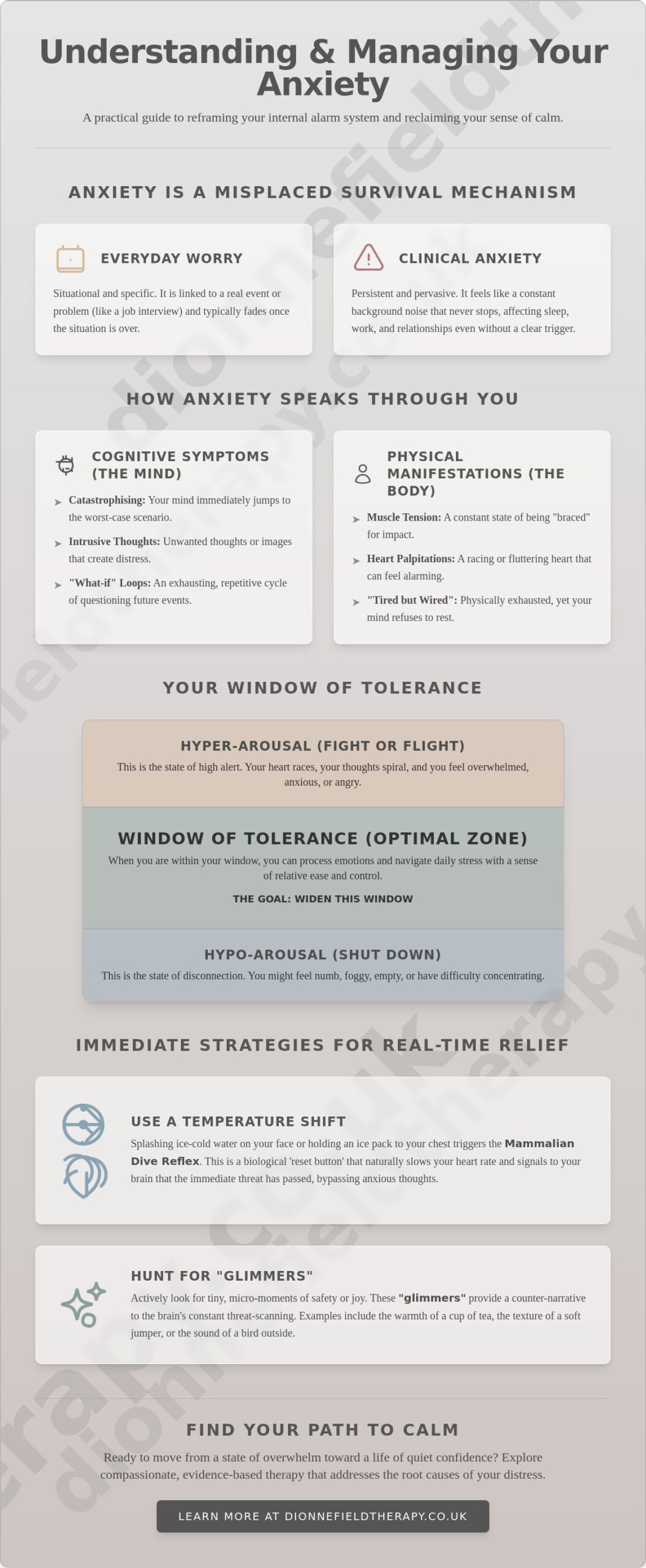
It is a heavy weight to carry, that persistent feeling that something is about to go wrong. You might describe it as being “on edge” or “constantly on guard”. This isn’t a failure of character. In truth, Understanding Anxiety requires us to look at it as a misplaced survival mechanism. Your brain is simply doing its job too well, scanning for threats to keep you safe, even when the environment is actually secure. This internal alarm system was designed to protect us from physical danger, but in our modern lives, it often reacts to emotional stress or uncertainty with the same intensity.
There is a distinct difference between situational worry and clinical anxiety. We all feel “normal” worry before a big event or a difficult conversation; it usually fades once the situation passes. Clinical anxiety, however, is more like a background noise that never quite stops. It lingers, affecting your sleep, your work, and your relationships. Recognising this distinction is the first step toward finding a path that works for you. When you begin to explore how to overcome anxiety, you start by acknowledging that your body is trying to communicate something important, even if the message feels overwhelming.
Anxiety often speaks through both the mind and the body. You might recognise these common experiences:
- Cognitive symptoms: Catastrophising, where your mind jumps to the worst-case scenario, intrusive thoughts, and the exhausting loop of “what-if” scenarios.
- Physical manifestations: Constant muscle tension, digestive discomfort, heart palpitations, and the “tired but wired” phenomenon where you are physically exhausted yet your mind refuses to rest.
The Window of Tolerance: Your Internal Safety Zone
The “Window of Tolerance” is a helpful framework for emotional regulation. When you are within your window, you can process emotions and navigate daily stress with a sense of relative ease. However, anxiety often pushes you into hyper-arousal. This is the state of fight or flight, where your heart races and your thoughts spiral. Conversely, you might slip into hypo-arousal, feeling numb, foggy, or disconnected. Learning how to overcome anxiety involves expanding this window so you can stay grounded even when life feels turbulent.
The Role of the Autonomic Nervous System
Your nervous system is like an internal thermostat. The sympathetic branch acts as the accelerator, preparing you for action, whilst the parasympathetic branch acts as the brake, allowing for rest and digestion. For many, past experiences or prolonged stress can “re-wire” the brain to stay stuck on the accelerator. Neuroceptivity is the brain’s subconscious scanning for safety or danger. When this internal scanner becomes overly sensitive, it perceives threats in everyday situations, keeping your body in a state of high alert and making it difficult to find a true sense of peace.
Immediate Strategies to Calm an Anxious Nervous System
When you are in the grip of a panic attack or a high-anxiety spiral, being told to “just take a deep breath” can feel incredibly dismissive. For some individuals, focusing intensely on the breath actually heightens anxiety. It can lead to a hyper-fixation on the chest or throat, making you feel as though you aren’t getting enough air, which only fuels the alarm. If you want to know how to overcome anxiety in the heat of the moment, you need tools that talk directly to your physiology rather than your thoughts. One of the most powerful ways to do this is through a temperature shift. Splashing ice-cold water on your face or holding a frozen gel pack to your chest triggers the mammalian dive reflex. This is a biological reset button that naturally slows your heart rate and redirects blood flow to your vital organs, signalling to your brain that the immediate threat has passed.
Whilst we often focus on “triggers,” it is equally vital to look for “glimmers.” These are tiny micro-moments of safety or joy that signal to your nervous system that you are okay. It might be the warmth of a cup of tea, the texture of a soft jumper, or the sound of a bird outside. These glimmers don’t delete the anxiety, but they provide a counter-narrative to the brain’s threat-scanning. Understanding how to overcome anxiety involves building a personal toolbox of these sensory anchors. If you find these techniques difficult to navigate alone, exploring somatic therapy can help you safely explore your body’s responses with professional guidance.
Somatic Grounding Techniques for Real-Time Relief
Grounding is about pulling your mind out of a future-based “what-if” loop and back into the physical present. The 5-4-3-2-1 technique is a classic for a reason. By naming five things you can see, four you can touch, three you can hear, two you can smell, and one you can taste, you force your brain to re-engage with the environment. Proprioceptive input is also incredibly anchoring. Try pressing your back firmly against a wall or using a weighted blanket; these “firm” sensations help your brain map where your body ends and the world begins. If you feel a surge of restless energy, try “shaking” your hands or swaying gently from side to side to discharge the sympathetic energy stored in your muscles.
The 4-7-8 Breath and Beyond
Whilst some find breathwork challenging, specific patterns can be transformative once you are within your “Window of Tolerance” discussed earlier. The 4-7-8 technique involves inhaling for four seconds, holding for seven, and exhaling forcefully for eight. That long, controlled exhale is the key; it engages the parasympathetic “brake” on your nervous system. Box breathing, often used by high-stress professionals, involves inhaling, holding, exhaling, and holding again for four seconds each. These structured patterns provide a sense of control and predictability. Integrating these habits alongside Cognitive and Behavioural Shifts ensures you are supporting both your mind and your body on the path to recovery.
Cognitive and Behavioural Shifts for Long-Term Recovery
Whilst somatic tools provide a vital “reset” for the body, sustainable relief often requires us to look at the stories our minds tell us. It isn’t about “policing” your thoughts or forcing yourself to think positively. Rather, it’s about developing a different relationship with your internal monologue. When you explore how to overcome anxiety, you eventually encounter the “hamster wheel” of rumination. This is unproductive worry… the kind that circles without ever reaching a solution. Productive worry, by contrast, leads to a concrete action. If you can’t take a step to solve the problem right now, the thought is likely just noise, and learning to recognise this distinction is a powerful act of self-preservation.
Building self-compassion is the foundation of this work. We are often far harsher to ourselves than we would ever be to a friend. If you can meet your anxious thoughts with a sense of “I see you’re trying to protect me, but I’m safe right now,” you lower the emotional stakes. This gentle approach creates the internal safety needed for deeper therapeutic work, whether through online therapy or face-to-face sessions.
Cognitive Restructuring: Challenging the Inner Critic
Cognitive Behavioural Therapy (CBT) offers a structured way to look at “cognitive distortions.” These are common mental traps, such as all-or-nothing thinking or emotional reasoning… where we believe that because we *feel* a certain way, it must be the reality. One effective tool is the “Courtroom” technique. When a catastrophic thought arises, imagine you are a judge. What is the actual, verifiable evidence for this thought? What is the evidence against it? For a deeper look at this process, you might find it helpful to read How Does CBT Work for Anxiety? to see how these shifts happen in a clinical setting.
ACT and Values-Based Living
Sometimes, the more we fight a thought, the louder it becomes. Acceptance and Commitment Therapy (ACT) suggests a different path. It teaches “cognitive defusion,” which is the ability to see a thought as just a string of words rather than an absolute truth. Instead of trying to delete the anxiety, you learn to carry it with you whilst moving toward what truly matters. What are your values? Perhaps it’s connection, creativity, or courage. How to overcome anxiety in the ACT framework means taking small, brave steps toward those values, even when the “what-if” thoughts are present. You aren’t waiting for the anxiety to vanish before you start living; you are reclaiming your life in spite of it.
Navigating Professional Support: NHS vs Private Therapy
Seeking professional support is a courageous step. It is also a confusing one. When you are trying to understand how to overcome anxiety, the path often splits between the NHS and private practice. NHS Talking Therapies are an invaluable resource, being free at the point of access and allowing for self-referral without a GP. However, the reality of the current climate in Cheshire and across the UK means that whilst an initial assessment might happen within a few weeks, the wait for actual treatment to begin can stretch between three and six months. For someone feeling “on edge” every day, that time can feel like an eternity.
Private therapy offers a different rhythm. It provides the opportunity for an immediate start, consistency with the same practitioner, and, crucially, a choice in who you work with. Unlike the typically limited blocks of 6 to 20 sessions offered by the NHS, private work can evolve at your own pace. When looking for a therapist, ensure they hold professional accreditation, such as with the BACP, and have specific trauma-informed training. This ensures your safety and the ethical rigour of the support you receive. If you are ready to move beyond waiting lists and begin your recovery, you can enquire about private psychotherapy here.
Choosing the Right Modality for Your Anxiety
The type of therapy you choose depends on your unique experience. Cognitive Behavioural Therapy (CBT) is highly effective for specific phobias or health-related anxieties, focusing on the practical link between thoughts and actions. Psychotherapy, however, often looks deeper, exploring long-standing patterns or the impact of past experiences on your current well-being. If you are unsure which path fits your needs, you can explore the nuances in this guide on CBT vs Psychotherapy: Choosing the Right Support.
What to Expect in Your First Session
It is natural to feel a flutter of nerves before your first appointment. Whether you are meeting for face-to-face therapy in Sandbach or connecting via online therapy, the first session is simply a conversation. It is an “intake” process where you can share what has been happening and, just as importantly, see how it feels to talk to your therapist. This “therapeutic rapport” is the most significant predictor of success. You need to feel safe, heard, and respected. It isn’t an interrogation; it is the beginning of a partnership. Preparing for your first session is as simple as allowing yourself to be exactly as you are in that moment.
Finding Your Path to Calm with Dionne Field Therapy
Finding your way through the fog of anxiety doesn’t have to be a solitary journey. At Dionne Field Therapy, the work is centred on an integrated approach that honours both the mind and the body. By blending the structured insights of Cognitive Behavioural Therapy (CBT) with the values-based acceptance of ACT and the gentle regulation of Somatic Therapy, we create a bespoke path tailored to your specific needs. Understanding how to overcome anxiety isn’t just about managing symptoms; it is about exploring the “why” behind your distress through a trauma-informed lens. This approach ensures that we aren’t just applying a temporary fix to the surface, but are instead tending to the roots of your unease in a safe, unhurried environment.
You deserve a space where you can explore your challenges at your own pace, without judgment or the pressure to reach a pre-determined conclusion. Every individual’s experience of anxiety is unique, and your therapy should reflect that. Whether you are struggling with a specific phobia or a general sense of being “on edge,” the focus remains on empowering you with practical tools whilst building a foundation of internal safety. It’s about moving from a state of potential overwhelm to a state of structured, calm support.
Local Support for Cheshire Residents
For those seeking face-to-face therapy, the practice is conveniently located for adults in Sandbach, Tarporley, Chester, and the surrounding Cheshire areas. There is a unique comfort in working with a local therapist who understands the community and can offer a steady, physical presence. If travelling is a barrier or you simply prefer the comfort of your own home, secure online therapy provides a flexible alternative that maintains the same level of professional intimacy and safety. You can find more details in this guide to Anxiety Therapy in Cheshire.
Taking the First Step Toward Relief
Reaching out for support can feel like the most daunting part of the process. I strive to make this initial contact as simple and gentle as possible, ensuring you feel no pressure to have all the answers straight away. My practice is grounded in BACP-accredited ethical standards, providing you with the peace of mind that your care is held with professional rigour and deep respect for your individual boundaries. Choosing to prioritise your mental health is a significant transition toward reclaiming your life. Remember that seeking help is an act of profound courage, not a sign of weakness. You have already taken the first step by being here; let’s discover how to overcome anxiety together, one breath at a time.
Reclaiming Your Sense of Calm
Living with anxiety often feels like an exhausting, full-time job. However, by understanding your nervous system and learning to identify “glimmers” of safety, you’ve already begun the transition toward relief. We’ve explored how somatic grounding and cognitive shifts like CBT and ACT can help you expand your window of tolerance. You now know that how to overcome anxiety isn’t about fighting your thoughts; it is about building a compassionate, body-honouring relationship with yourself. Whether you seek face-to-face therapy in Cheshire or online sessions, the most important step is moving toward a space where you feel truly heard.
As a BACP-accredited therapist specialising in trauma-informed care, I’m here to act as your steady companion through this process. My approach integrates somatic tools with clinical expertise to ensure your path to well-being is both academically rigorous and deeply human. You don’t have to navigate these complexities alone. Begin your journey to calm with Dionne Field Therapy and discover the structured, gentle support you deserve. Relief isn’t just a distant hope. It’s a path we can walk together, one step at a time.
Frequently Asked Questions
Is it possible to fully overcome anxiety or just manage it?
You can certainly overcome the debilitating grip of an anxiety disorder, though the biological capacity for worry remains a part of the human experience. Therapy helps you move from being controlled by fear to a place where you can observe your thoughts without being overwhelmed by them. It is about reclaiming your life and ensuring that your internal alarm system no longer dictates your daily choices or your peace of mind.
How long does it typically take to see results from anxiety therapy?
The timeline for seeing results is unique to every individual and depends on the complexity of your experiences. Some people notice a shift in their physical symptoms within four to six sessions as they learn immediate grounding tools. For long-term recovery and deeper cognitive shifts, many people choose to engage in psychotherapy for several months to ensure lasting change and emotional resilience.
What is the difference between a panic attack and general anxiety?
A panic attack is a sudden, intense surge of physical symptoms that usually peaks within ten minutes; it often feels like a physical emergency. Generalised anxiety, however, is a persistent, low-level hum of worry that lingers throughout the day. Whilst both are exhausting, understanding the difference is key to learning how to overcome anxiety in its various forms.
Can I have therapy online if I am too anxious to leave the house?
Yes, Online Therapy is an excellent option if leaving the house feels too overwhelming at this stage. It allows you to begin your therapeutic journey from the safety of your own environment, removing the initial barrier of travel. As you build confidence and learn new tools, the focus can eventually shift toward navigating the world outside with greater ease and security.
What should I do if I feel an anxiety attack coming on right now?
If you feel an attack approaching, try to anchor yourself in the present moment immediately. Use the 5-4-3-2-1 grounding technique or splash your face with cold water to signal safety to your nervous system. Remember that whilst the sensations are incredibly uncomfortable, they are not dangerous; your body is simply trying to protect you from a perceived threat that is not actually there.
Do I need a GP referral to see a private therapist in Cheshire?
You do not need a GP referral to access private therapy in Cheshire or elsewhere in the UK. Many people choose to self-refer to a private practitioner to avoid long waiting lists and to have more control over the therapist they work with. This direct path allows you to start your journey toward relief as soon as you feel ready to reach out.
How much does private anxiety therapy cost in the UK?
The cost of private therapy in the UK varies depending on the location and the specific expertise of the practitioner. It is an investment in your long-term mental health and overall quality of life. Whilst prices are not fixed across the industry, choosing a BACP-accredited professional ensures you are receiving care that meets high ethical and clinical standards.
Is anxiety therapy confidential?
Yes, individual counselling and psychotherapy are strictly confidential spaces. Your therapist is bound by professional ethical frameworks to protect your privacy, creating a safe environment where you can speak honestly. There are very rare exceptions to this, such as if there is a serious risk of harm to yourself or others, which your therapist will discuss with you during your first session.

Article by
Dionne Field
Dionne Field is an integrative psychotherapist. She's passionate about helping clients understand themselves with greater compassion and clarity. With experience in both NHS mental health services & private practice, her work combines trauma-informed, person-centred therapy, ACT, CBT, DBT, 'parts work' & somatic therapy. Dionne believes that meaningful change happens when people feel safe, understood and empowered to reconnect with who they truly are.
Disclaimer
The information provided in this blog is intended for educational and informational purposes only and should not be considered a substitute for professional mental health advice, diagnosis, or treatment.
Whilst every effort is made to ensure the information shared is accurate and up to date, the content reflects general therapeutic knowledge and perspectives and may not be applicable to your individual circumstances.
Reading this blog does not create a therapeutic relationship between you and Dionne Field Therapy. If you are currently experiencing emotional distress, mental health difficulties, or require support specific to your situation, please seek advice from a qualified healthcare professional or mental health practitioner.
If you are in crisis, experiencing thoughts of self-harm, or feel unable to keep yourself safe, please contact your GP, NHS 111, emergency services, or an appropriate crisis support service immediately.
Any external links provided are for convenience and informational purposes only. Dionne Field Therapy is not responsible for the content, accuracy, or availability of third-party websites.
By using this website and blog, you acknowledge and accept this disclaimer.
Leave a Reply