

Imagine waking up to a day where the very thought of opening your front door feels like a mountain you aren’t prepared to climb. For many, intrusive thoughts aren’t just background noise; they’re a physical barrier to the very help they need. It’s a heavy irony that the symptoms making it hard to leave the house often prevent people from attending traditional appointments. You might worry that a screen will create a clinical distance, making the experience feel technical or cold when what you truly need is warmth. However, online CBT for anxiety has evolved into a deeply human, trauma-informed experience that meets you exactly where you are.
Research indicates that CBT is 50 to 75 per cent effective for overcoming anxiety after 5 to 15 modules, and these results are just as achievable through a screen as they are in a traditional office. This guide explores how you can build a transformative partnership with a professional from the safety of your own living room. We’ll look at the ways virtual therapy combines clinical rigour with a gentle, supportive presence, ensuring your path to emotional freedom feels both structured and safe.
Key Takeaways
- Understand the core philosophy of how your thoughts and behaviours interact, providing a clear foundation for your emotional recovery.
- Explore why online CBT for anxiety offers a professional, trauma-informed alternative that maintains the warmth and depth of face-to-face sessions.
- Learn how to navigate common hesitations and prepare your physical space to ensure your virtual therapy feels safe, focused, and effective.
- Discover the benefits of an integrative approach that goes beyond standard digital programmes by incorporating somatic and emotion regulation techniques.
Understanding Online CBT for Anxiety: A Modern Path to Healing
Seeking help for anxiety shouldn’t be an ordeal that adds to your existing burden. In the UK, many people find themselves caught in a difficult cycle; they recognise they need support but are faced with lengthy NHS waiting lists that can stretch for months. This delay often leaves individuals feeling adrift, watching their symptoms intensify whilst they wait for a letter or a phone call. Choosing to work with a private practitioner through online CBT for anxiety provides a more immediate, compassionate alternative. It isn’t just a digital version of a textbook; it’s evidence-based Cognitive Behavioral Therapy (CBT) delivered via secure, private video platforms that prioritise your comfort and confidentiality.
The core philosophy of this approach is rooted in the understanding that our internal world is a delicate ecosystem. It suggests that what we think, how we feel, and how we behave are all intrinsically linked. When one part of this system is out of balance, it ripples through the others. Online therapy serves as a unique bridge for those whose anxiety makes the very act of leaving the house feel insurmountable. It meets you where you are, literally and emotionally, allowing the healing process to begin without the requirement of a stressful journey to a clinical setting.
The Interconnected Cycle of Anxiety
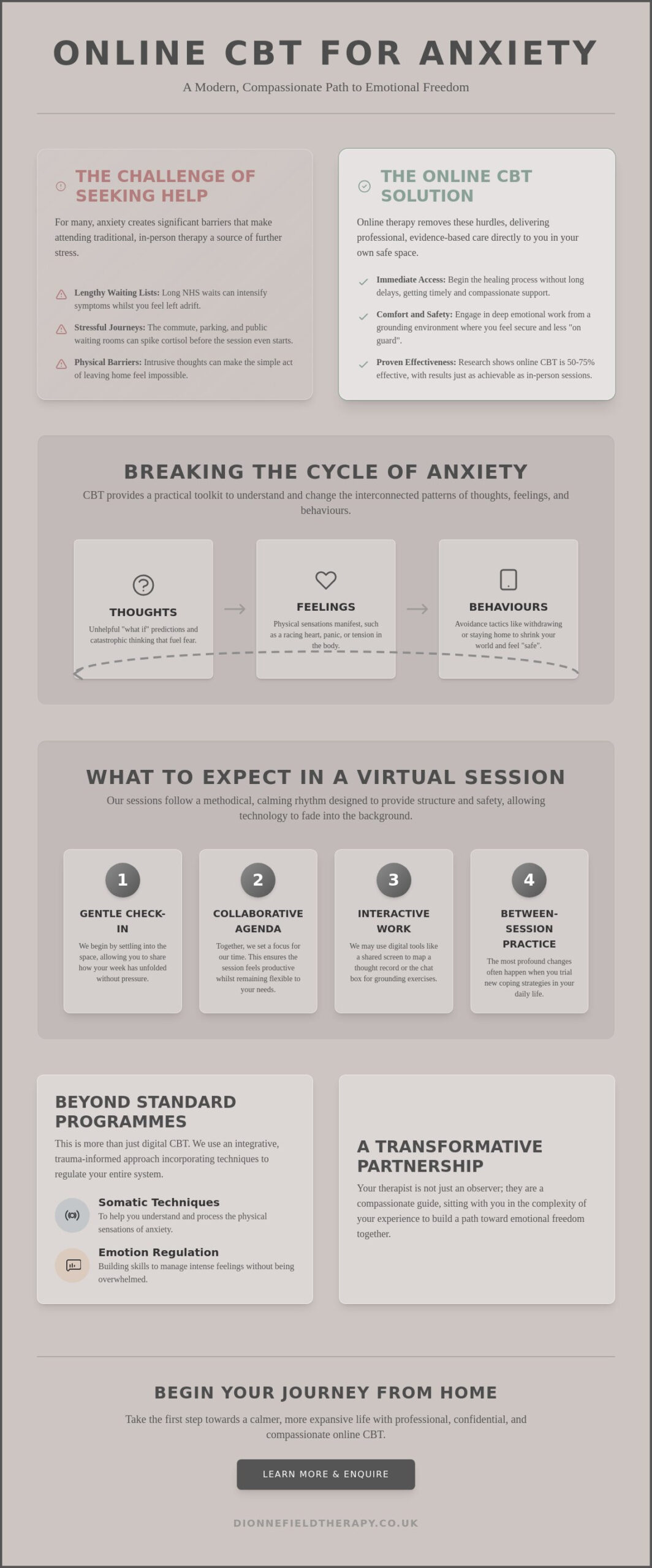
When anxiety takes hold, it often operates in a predictable, yet exhausting, loop. It might start with a fleeting, unhelpful thought about a future event. This thought quickly triggers a physical sensation, perhaps a racing heart or a tightening in the chest. To find relief, you might resort to an avoidant behaviour, such as withdrawing from a social commitment or staying in a “safe” room. Cognitive restructuring is the process of gently challenging these thought patterns to break that restrictive loop. Rather than being a space solely for venting, CBT focuses on building a practical toolkit you can use in your daily life to manage these moments as they arise.
- Thoughts: Identifying the “what ifs” that fuel your fear.
- Feelings: Recognising how these thoughts manifest as physical tension or panic.
- Behaviours: Noticing the small ways you might be shrinking your world to stay safe.
Why Online Therapy is Particularly Effective for Anxiety
For many, the most daunting part of therapy is the journey to the clinic itself. The stress of navigating traffic, finding parking, or sitting in a public waiting room can spike your cortisol levels before the session even begins. Online CBT for anxiety removes these barriers entirely. It allows you to engage in deep emotional work from the safety of your own home, using your own space as a grounding foundation for growth. This environment often helps people feel more open and less “on guard” than they might in a formal office.
This flexibility is especially valuable for clients in Sandbach, Tarporley, or further afield in Cheshire. You don’t have to worry about the logistics of a commute or the exhaustion of a round trip. Instead, you can transition from your session directly into a period of rest or reflection. It’s a methodical, patient way to integrate therapy into a busy lifestyle without sacrificing the professional rigour you deserve.
How Cognitive Behavioural Therapy Works in a Virtual Space
A typical session of online CBT for anxiety follows a methodical, calming rhythm designed to provide both structure and safety. We begin with a gentle check-in, allowing you to settle into the space and share how your week has unfolded. Does a screen really allow for a deep connection? Many find that once the call begins, the technology fades into the background, leaving room for a purposeful dialogue. We set an agenda together; this ensures our time feels productive and prevents the session from drifting into aimless conversation whilst still allowing space for your immediate feelings. Your therapist acts as a compassionate guide, sitting with you in the complexity of your experience rather than simply observing from a distance.
The collaborative nature of our work is enhanced by digital tools that make the process interactive and visual. We might share a screen to map out a thought record together or use the chat box for a quick grounding exercise if things feel overwhelming. It’s vital to remember that the most profound changes often happen in the quiet moments between our calls. The practice you do at home, such as trialling a new coping strategy or observing a specific thought pattern, is what truly builds your resilience. This blend of live support and independent practice makes online CBT for anxiety a flexible, powerful choice for a modern lifestyle.
Breaking the Vicious Cycle of Worry
Central to our work is a process called behavioural activation. When anxiety feels heavy, our world tends to shrink; we stop doing the things that bring us joy or a sense of achievement. We’ll work together to identify small, manageable actions that help you re-engage with your life at a pace that feels safe. We also look closely at “safety behaviours”. These are the subtle things you might do to cope, like checking your phone constantly or avoiding certain routes, which actually keep the anxiety alive. Learning how to overcome anxiety involves gently loosening the grip of these behaviours, replacing them with a genuine sense of internal security.
The Importance of the Therapeutic Alliance Online
Perhaps you’ve wondered… can a virtual connection ever be as strong as sitting in the same room? Recent research on the efficacy of online CBT confirms that the digital format does not diminish the clinical outcome or the quality of the relationship. Eye contact and presence work beautifully across the screen, provided there is a foundation of mutual trust. All sessions adhere to BACP standards, ensuring the same ethical rigour and professional boundaries you would expect in person. A trauma-informed approach is especially important here; it means your therapist is trained to recognise the physical signs of distress and can help you regulate your nervous system in real-time, even through a screen.
If you’re ready to explore this partnership and begin your journey toward lasting relief, I invite you to learn more about my online therapy services.
Is Online Therapy Right for You? Addressing Common Objections
It is entirely natural to feel a flutter of hesitation. When your nervous system is already on high alert, the prospect of navigating a new digital platform can feel like one step too many. You might wonder if the connection will feel “thin” or if your deepest worries will be lost in translation. These feelings are valid. Choosing online CBT for anxiety isn’t about settling for a lesser version of care; it’s about making an empowered choice to prioritise your mental health in a way that fits your life. As the American Psychological Association explains, Cognitive Behavioral Therapy (CBT) focuses on the relationship between thoughts and actions. This transformative work is not confined to the four walls of a traditional clinic.
The flexibility of a virtual session allows you to create a sanctuary of your own making. You don’t have to face the public gaze on a difficult day. You don’t have to navigate a stressful commute. However, we must be honest about the practicalities. Technical glitches can occur. A delivery driver might ring the bell. Perhaps your Wi-Fi signal wavers at an emotional moment. We handle these small interruptions with patience and a plan. By acknowledging these “cons” upfront, we take the power away from the uncertainty, turning the screen into a reliable gateway for healing.
Privacy, Security, and Your Digital Safe Space
One of the most frequent concerns involves the safety of your personal information. Professional therapists use encrypted, GDPR-compliant platforms such as Zoom for Healthcare to ensure our conversations remain strictly confidential. This is far more secure than a standard video call you might use for socialising. To enhance your sense of privacy at home, many clients find that wearing headphones creates a helpful “bubble.” This ensures that my voice stays with you, and no one else in your household can overhear our work. We also establish a clear contract from the start, setting out boundaries and emergency protocols so you always feel held and secure.
Online vs In-Person: Making the Choice
For some, the physical presence of a therapist is a vital part of the grounding process. If you feel that you truly need that shared physical space, you might prefer face to face therapy in Cheshire. However, it’s worth asking yourself a gentle question. Is your preference for in-person work based on a genuine need, or is the anxiety trying to “avoid the journey” by making therapy feel like a distant, difficult chore? If you’re unsure which format truly suits your needs, exploring the key differences between online therapy vs in person support can help you make a more informed, empowered decision. For many Cheshire residents, a hybrid model offers the best of both worlds. You can enjoy the intimacy of occasional face-to-face sessions whilst relying on online CBT for anxiety for your weekly check-ins. This balance ensures your support remains consistent, regardless of what life throws your way.
Setting the Stage for Success: A Step-by-Step Guide to Your Online CBT Journey
Starting a new therapeutic chapter is a significant step toward emotional freedom. To make the most of online CBT for anxiety, it helps to approach the process with a sense of gentle preparation. This isn’t about achieving perfection; it’s about creating the right conditions for your healing to flourish. When you’re ready to begin, following a few simple steps can help ground you in the process.
- Step 1: Finding the right therapist. Look for a professional with BACP accreditation, which ensures they meet high ethical standards. Beyond qualifications, pay attention to their tone and style. Does their approach resonate with you?
- Step 3: Preparing your technology. A few minutes before your call, check your connection and audio. Reducing technical friction helps you stay focused on the work rather than the screen, allowing the relationship to take centre stage.
- Step 3: Creating your sanctuary. Find a quiet spot where you won’t be interrupted. This physical boundary is essential for feeling safe enough to be vulnerable.
- Step 4: The Initial Consultation. Use this time to share your goals and ask questions. It’s an opportunity to see if the partnership feels right for your specific needs.
- Step 5: Engaging with the process. CBT is an active therapy. Being honest about your struggles and committing to “homework” tasks between calls is where the real shifts happen.
Creating Your Physical and Emotional Sanctuary
Your environment plays a vital role in how your nervous system responds to the work. You might consider lighting a favourite candle or having a comforting drink nearby to signal to your brain that it’s “therapy time.” These small sensory cues help you transition out of your daily routine and into a reflective state. We often talk about the “Window of Tolerance;” this is the emotional zone where you can process difficult feelings without becoming overwhelmed or shutting down. Taking five minutes before and after the call to simply sit and breathe helps you stay within this window, ensuring you don’t rush back into a busy day immediately after a deep conversation.
What to Ask During Your First Consultation
When you meet a therapist for the first time, you’re the one in the driving seat. Don’t be afraid to ask about their experience with specific anxiety types, such as GAD or social anxiety. It’s also helpful to ask if they work in a trauma-informed way. Trauma-informed care means the therapist understands how past experiences shape your current nervous system responses, ensuring that online CBT for anxiety remains a safe space that doesn’t inadvertently cause re-traumatisation. Remember, you’re always in control of the pace. A good therapist will never rush you through a process you aren’t ready for.
If you’re feeling ready to take that first step, I invite you to view my online therapy options and see how we might work together to reclaim your calm.
Personalised Care with Dionne Field Therapy: Beyond the Digital Screen
While we have explored the practicalities of setting up your space, the true heart of therapy lies in the relationship that develops through the screen. At Dionne Field Therapy, online CBT for anxiety is never treated as a rigid checklist or a series of generic digital worksheets. Instead, it is a fluid, human experience designed to meet the unique contours of your life. By choosing a trauma-informed approach, we acknowledge that your anxiety isn’t just a set of symptoms to be fixed; it’s often a protective response from your nervous system that deserves respect and understanding. It requires a steady companion who can sit with the complexity of your experience without rushing toward easy answers.
This perspective is what separates a professional, one-to-one therapeutic relationship from the automated mental health apps that have become so common. Those programmes often miss the nuance of your personal history and the subtle physical cues that a trained therapist observes. Here, the work is grounded in a deep sense of community. Although the sessions take place virtually, there is a steady connection to my roots in Sandbach and the wider Cheshire area; this provides a local, familiar anchor for those who value a sense of place and professional integrity in their healing journey.
An Integrative Approach to Anxiety Recovery
To provide truly lasting relief, I often move beyond traditional Cognitive Behavioural Therapy to include other supportive frameworks that address the whole person. Acceptance and Commitment Therapy (ACT) is a wonderful companion to CBT. It helps you pivot away from the exhausting struggle with your thoughts and toward a life built on your core values. We also incorporate elements of Somatic Therapy. Why? Because anxiety doesn’t just live in your mind. It lives in the shallow breath, the tight shoulders, and the restless legs. By addressing both the mind and the body, we create a more holistic path toward regulation. This is my non-judgmental invitation into a safe space where you can finally put down the heavy burden of “trying to cope” alone.
Starting Your Journey Today
Taking that first step towards a calmer, more regulated nervous system is an act of profound strength. It isn’t a sign that you have failed; it’s a sign that you are ready to reclaim your life from the grip of intrusive thoughts. The process of starting online CBT for anxiety is intentionally simple. We begin with an initial chat to ensure you feel comfortable and understood. There is no pressure to have all the answers right away. If you are ready to move from a state of overwhelm to a state of structured, calm support, I am here to walk alongside you. You are invited to book a consultation with Dionne Field Therapy whenever you feel the time is right.
Reclaiming Your Calm from the Comfort of Home
Anxiety can make your world feel small and restrictive; however, it doesn’t have to stay that way. You now understand that online CBT for anxiety is more than just a digital convenience. It’s a sophisticated, evidence-based partnership that combines clinical rigour with the unique safety of your own environment. By bridging the gap between professional expertise and personal comfort, virtual therapy allows you to dismantle unhelpful cycles without the added stress of travel or public waiting rooms.
Choosing to work with a BACP-accredited therapist ensures that your journey is guided by high ethical standards and a deeply trauma-informed perspective. Whether we’re using cognitive restructuring or integrating somatic techniques to soothe your nervous system, the focus remains entirely on your individual evolution. Your privacy is always protected on a secure, GDPR-compliant platform, allowing you to speak freely and settle into the work.
If you’re ready to move toward a life defined by values rather than fear, the path is open to you. Begin your journey to a calmer life with a free consultation today. You have the strength to start this chapter, and I’m here to walk alongside you as a steady companion on the road to recovery.
Frequently Asked Questions
Is online CBT as effective as face-to-face therapy for anxiety?
Yes, virtual sessions are proven to be just as effective as traditional in-person appointments for managing various anxiety disorders. Clinical evidence consistently shows that the digital format does not diminish the therapeutic outcome. You can expect to develop the same robust coping strategies and cognitive tools as you would in a clinic, all whilst benefitting from the comfort and safety of your own home environment.
What technology do I need for an online CBT session?
You simply need a reliable internet connection and a device equipped with a camera and microphone, such as a laptop, tablet, or smartphone. Most online CBT for anxiety sessions take place via a secure, private link sent directly to your email. There is no need for complicated software installations or advanced technical knowledge; a quiet space and a functioning device are all that’s required to begin.
How many sessions of online CBT will I need for my anxiety?
The duration of therapy varies based on your unique needs, but many individuals find significant relief within 6 to 20 weekly sessions. Cognitive Behavioural Therapy is designed to be a structured, goal-oriented process. We work collaboratively to set these objectives at the start, and we’ll regularly review your progress together to ensure the pace and length of treatment feel supportive of your recovery.
Can I do online CBT if I have a history of trauma?
Yes, you can safely engage in therapy even with a complex history, provided you work with a professional who uses a trauma-informed approach. This perspective ensures the work is paced carefully to keep your nervous system regulated and within your “window of tolerance.” We focus on building internal safety and grounding techniques first, ensuring that addressing your anxiety doesn’t lead to feelings of overwhelm.
What happens if I have a technical problem during my session?
If a technical glitch or a lost connection occurs, we simply follow a pre-arranged backup plan that we establish during our first meeting. This usually involves moving to a telephone call to finish the session or waiting a few moments to reconnect. Having these “what if” protocols in place ensures that technology remains a helpful tool rather than a source of further anxiety.
Is online therapy private and confidential?
Your sessions are strictly confidential and conducted using encrypted, GDPR-compliant platforms that are specifically designed for healthcare use. These systems offer significantly higher security than common social video apps, ensuring that your data and conversations remain protected. We also discuss privacy boundaries at the start of our work, such as ensuring you are in a space where you won’t be overheard or interrupted by others.
Can I switch between online and face-to-face sessions?
Many clients find that a hybrid model offers the perfect balance of flexibility and connection. You might choose to have most of your sessions online for convenience whilst visiting the clinic for occasional face-to-face work. This is a popular option for residents in Cheshire who want the benefits of online CBT for anxiety without losing the option of physical presence when they need it.
How do I know if my therapist is properly qualified?
You can confirm a therapist’s qualifications by searching the public register of a recognised professional body, such as the BACP. This search provides peace of mind that your therapist has met extensive training requirements and remains committed to high ethical standards. It also ensures they have the necessary insurance and supervision in place to provide you with a safe, professional, and high-quality therapeutic experience.

Article by
Dionne Field
Dionne Field is an integrative psychotherapist. She is passionate about helping clients understand themselves with greater compassion and clarity. With experience in both NHS mental health services & private practice, her work combines trauma-informed, person-centred therapy, ACT, CBT, DBT, 'parts work' & somatic therapy. Dionne believes that meaningful change happens when people feel safe, understood and empowered to reconnect with who they truly are.
Disclaimer
The information provided in this blog is intended for educational and informational purposes only and should not be considered a substitute for professional mental health advice, diagnosis, or treatment. Whilst every effort is made to ensure the information shared is accurate and up to date, the content reflects general therapeutic knowledge and perspectives and may not be applicable to your individual circumstances. Reading this blog does not create a therapeutic relationship between you and Dionne Field Therapy. If you are currently experiencing emotional distress, mental health difficulties, or require support specific to your situation, please seek advice from a qualified healthcare professional or mental health practitioner. If you are in crisis, experiencing thoughts of self-harm, or feel unable to keep yourself safe, please contact your GP, NHS 111, emergency services, or an appropriate crisis support service immediately. Any external links provided are for convenience and informational purposes only. Dionne Field Therapy is not responsible for the content, accuracy, or availability of third-party websites. By using this website and blog, you acknowledge and accept this disclaimer.
Leave a Reply