

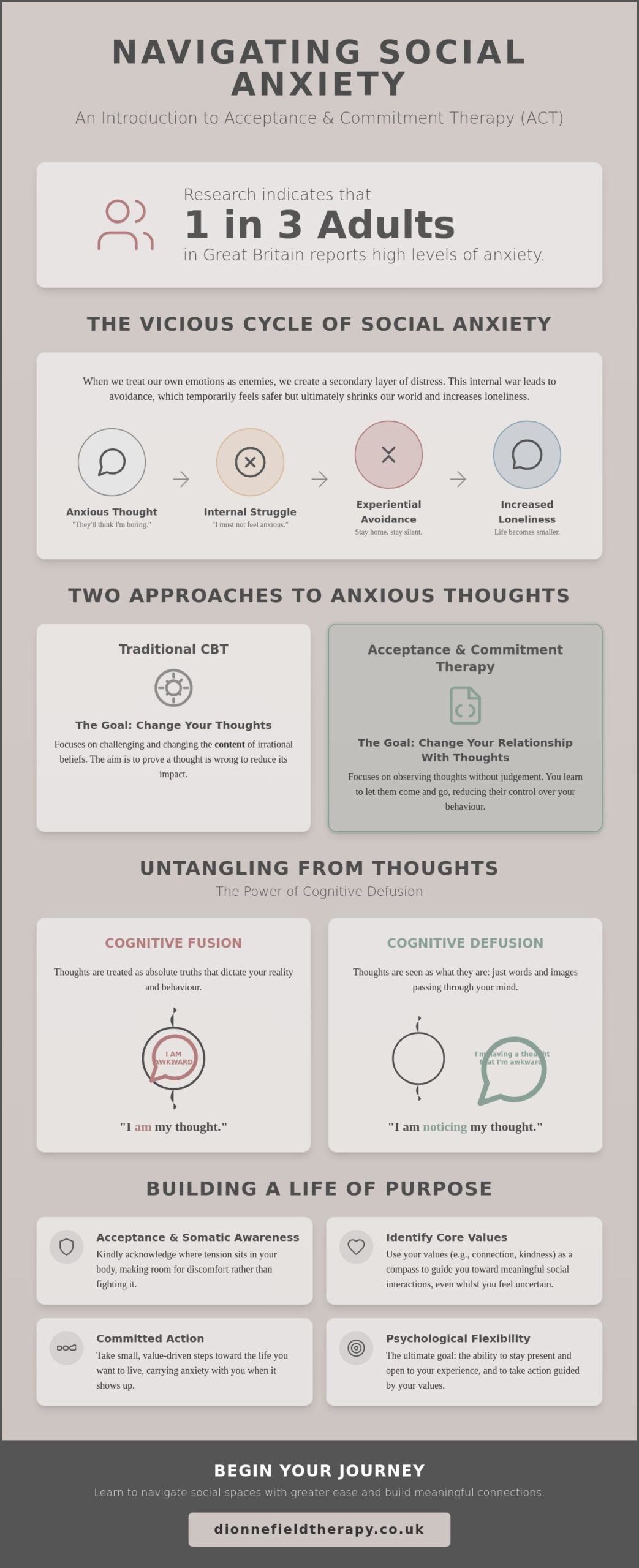
What if the secret to social ease isn’t about silencing your inner critic, but learning to listen to it differently? It’s a heavy burden to carry the weight of negative self-talk, especially when it leaves you feeling like a prisoner in your own mind or causes that painful “freeze” response the moment you step into a crowded room. You’re certainly not alone in this experience. In early 2026, research indicated that 33% of adults in Great Britain reported high levels of anxiety. Many of these people are now exploring ACT for social anxiety as a way to step out of the shadows of avoidance and loneliness.
Choosing this approach isn’t about forcing yourself to be “normal” or “fixing” a part of you that feels broken. Instead, it’s a compassionate invitation to change your relationship with your thoughts and move toward a life guided by what truly matters to you. In this guide, we’ll explore how Acceptance and Commitment Therapy can help you stop the exhausting struggle with anxious feelings. You’ll discover how to navigate social spaces with greater ease, allowing your personal values to be your steady guide whilst you build the meaningful connections you’ve been longing for.
Key Takeaways
- Learn how to shift your focus from exhausting symptom control toward building psychological flexibility and a life of genuine purpose.
- Master the art of cognitive defusion to observe your anxious thoughts without being defined by them, a central part of ACT for social anxiety.
- Develop somatic awareness to kindly acknowledge where tension sits in your body, allowing you to make room for discomfort rather than fighting it.
- Identify your core values to act as a steady compass, guiding you toward meaningful social interactions even whilst you feel uncertain.
- Discover the benefits of working with a BACP-accredited therapist for individual counselling, providing the professional support needed to navigate your recovery.
Navigating Social Anxiety with Acceptance and Commitment Therapy (ACT)
Social anxiety often feels like an uninvited guest that refuses to leave. It’s loud, persistent, and draining. Traditional approaches often suggest we need to argue with these thoughts or “fix” our feelings before we can truly participate in life. However, Acceptance and Commitment Therapy (ACT) offers a different path. It’s a mindfulness-based behavioural therapy that doesn’t aim to eliminate anxiety. Instead, it focuses on building psychological flexibility. This means learning to carry your anxiety whilst still doing the things that matter to you. This approach recognises that your anxiety is often a signal of what you care about. You wouldn’t feel anxious about a social gathering if you didn’t value connection. When we use ACT for social anxiety, the goal shifts from symptom reduction to valued living. We stop waiting to feel “better” and start living better right now.
The six core processes of ACT provide a steady roadmap, helping you move from a state of “freeze” to one of meaningful action. It’s about opening up to the full range of human experience, even the parts that feel uncomfortable. By doing so, you reclaim your power from the fear that has kept your world small.
The Difference Between ACT and Traditional CBT
Whilst both are evidence-based, they look at your internal world through different lenses. Traditional CBT often focuses on changing the content of your thoughts, helping you challenge beliefs that feel irrational. In contrast, ACT focuses on changing your relationship with those thoughts. You don’t need to prove a thought is wrong to stop it from controlling your actions. Acceptance, in this context, isn’t about liking the anxiety or giving up. It’s an active, courageous choice to make room for discomfort so you can move toward what you love. You can read more about how these approaches differ in our guide on CBT vs Psychotherapy.
Why Social Anxiety Feels So Persistent
Have you ever noticed that the harder you try not to feel anxious, the louder the anxiety becomes? We call this the “struggle switch.” When we fight against our internal experience, we create a secondary layer of distress. It’s a deeply human response to want to push away pain. However, when we treat our own emotions as enemies, we end up in a constant state of internal war. This often leads to experiential avoidance, where we stay home or remain silent to avoid the “threat” of social judgement. Whilst this provides temporary relief, it ultimately shrinks our world and increases loneliness. Using ACT for social anxiety helps you gently flip that switch. By acknowledging the racing heart or the negative self-talk without trying to force it away, you lower your internal defences. It’s a process of coming home to yourself, acknowledging the pain, and choosing to walk forward anyway.
Untangling from Anxious Thoughts through Cognitive Defusion
When social anxiety takes hold, it often feels as though we are fused with our thoughts. You might find yourself trapped in a “social script” that whispers you are boring, awkward, or unwelcome. In these moments, the thought and the person become one. You don’t just have a thought about being awkward; you are awkward. This state is what we call cognitive fusion. It’s like looking through a pair of glasses painted with dark streaks. You don’t realise you’re wearing them; you simply believe the whole world is dark. Practising ACT for social anxiety teaches us to take those glasses off and look at them, rather than through them.
Cognitive defusion is a therapeutic technique that helps individuals observe their thoughts as passing mental events rather than absolute truths. By creating this tiny bit of distance, your self-critical thoughts lose their power to dictate your behaviour. You begin to see that a thought is just a collection of words or a fleeting image, not a command you must follow or a fact you must believe. It’s about noticing the process of thinking rather than getting caught up in the content of the thoughts themselves.
Practical Defusion Techniques for Social Situations
Creating mental space doesn’t require hours of meditation. It can happen in the middle of a conversation. One of the most effective ways to do this is by slightly altering your internal language. Instead of saying “I’m making a fool of myself,” try saying “I am having the thought that I’m making a fool of myself.” This simple phrasing reminds you that you are the observer of the thought, not the thought itself. You might also find it helpful to give your inner critic a name, perhaps labelling it as “The Anxious Narrator” or “The Judge.” When a harsh criticism arises, you can gently acknowledge it by thinking, “Thank you, mind, for trying to protect me, but I’ve got this.” These small shifts help lower your defences and build immediate emotional trust with yourself.
Stepping Back from the “Social Spotlight”
Many people struggling with social anxiety experience the “Spotlight Effect,” the persistent feeling that every move they make is being intensely scrutinised by others. This creates a loud internal monologue that drowns out the actual conversation. Defusion helps you step back from this perceived spotlight. When you stop fighting the internal chatter, your attention is freed to move outward. You can focus on the warmth of the room, the rhythm of the music, or the actual words the person in front of you is saying. If you find yourself becoming overwhelmed by these internal scripts, exploring individual counselling can help you develop a more curious and gentle stance toward your mind’s protective chatter.
Embracing Discomfort: The Role of Acceptance and Somatic Awareness
Anxiety is rarely just a mental event. It lives in the body. You might feel it as a fluttering in your chest, a tightening in your throat, or a sudden heat rising to your face. When we use ACT for social anxiety, we learn that acceptance isn’t about liking these sensations. It’s about making room for them. Instead of trying to suppress the physical symptoms, which often only makes them more intense, we practise being a kind host to them. We acknowledge the discomfort without judging it as “wrong” or “dangerous.” This shift in perspective allows you to remain present in social spaces, even whilst your body is signalling a sense of threat.
Understanding how your body responds to stress is a vital part of the process. For many, social fear is deeply rooted in past experiences. This is where trauma-informed therapy becomes so valuable. It provides a framework for regulating the nervous system, helping you understand that your racing heart is a protective response that simply isn’t needed in this moment. One practical way to manage this is through the “Expansion” technique. You begin by noticing where the tension is most concentrated. Instead of tensing against it, you breathe into that space, imagining your breath creating a soft cushion around the tightness. You aren’t trying to change the feeling; you’re simply giving it more room to exist.
The “Struggle Switch” and Physical Anxiety
Imagine your brain has a “struggle switch.” When it’s on, you don’t just feel anxious; you feel anxious about being anxious. This secondary layer of panic is what often leads to the urge to flee. By turning the switch off, you allow the initial anxiety to be present without the added weight of judgement. It’s helpful to use the “passenger on the bus” metaphor. You are the driver, and your anxious physical sensations are just rowdy passengers. They might be loud and unpleasant, but they don’t have to take the wheel. You can still drive the bus toward the social gathering you planned to attend. Gentle grounding exercises, such as pressing your feet firmly into the floor, can help you stay in the driver’s seat when the urge to leave feels strong.
Mindfulness in the Moment
Staying present in a social environment requires shifting your focus from internal “threat monitoring” to external connection. You can use your five senses to ground yourself. Notice the texture of your glass, the colour of the walls, or the specific pitch of a friend’s voice. This isn’t a distraction technique; it’s a way of re-engaging with the world around you. Shifting your attention in this way helps you move from a state of internal overwhelm to one of outward curiosity. It’s important to remember that staying present is a skill. It takes practice and a great deal of self-compassion. Some days the rowdy passengers will be louder than others, and that’s okay. You’re still the one driving.
Moving Toward What Matters: Values-Based Social Action
When anxiety is in the driver’s seat, it usually steers us toward safety and isolation. It tells us that the safest path is the one where we don’t risk judgement or awkwardness. However, ACT for social anxiety encourages us to look at a different guide: our values. Think of values as a compass rather than a destination. Whilst a goal is something you can achieve and tick off a list, a value is a chosen direction for your life. For example, “attending a wedding” is a goal, but “being a supportive and connected friend” is a value. You can read more about this distinction in our pillar article on Values-Based Living in ACT. Values provide the “why” that makes the “how” of socialising feel worth the effort, even when your heart is racing.
By focusing on your values, you change the purpose of your social interactions. You’re no longer there to “not look anxious” or to “perform perfectly.” Instead, you’re there to be the person you want to be. This shift doesn’t necessarily make the anxiety disappear, but it makes the experience feel more meaningful and less like a performance you’re destined to fail.
Identifying Your Social Values
Finding your compass begins with a few quiet moments of reflection. It can be helpful to break this down into small, manageable steps:
- Reflect on your roles: What kind of friend, partner, or colleague do you genuinely want to be? Forget about what you think you should be and focus on what feels authentic to your heart.
- The Magic Wand exercise: If I could wave a wand and make your social anxiety disappear tomorrow, what would you do differently? Would you join a local club, host a dinner, or simply speak up more in meetings? Your answers often reveal your hidden values.
- Choose one small action: Once you’ve identified a value, such as “Connection,” pick one tiny step that aligns with it. This might be as simple as sending a text to a friend you haven’t spoken to in a while.
Committed Action: Taking Small, Brave Steps
Committed action is the process of taking steps toward your values, even whilst you are carrying discomfort. It’s not about waiting for the fear to go away; it’s about bringing the fear along with you. To help with this, you can use the “Willingness” scale. Ask yourself: on a scale of one to ten, how much of this specific social anxiety am I willing to carry to move toward my value of connection? If the answer is a five, you might start with a “low-stakes” social experiment. This could be asking a barista how their day is or making brief eye contact with a neighbour. These experiments allow you to practice your skills in real-time without the pressure of a high-stress event. If you’re ready to start this journey with professional support, exploring Acceptance and Commitment Therapy (ACT) can provide the structure you need to move forward with confidence.
Beginning Your Journey: ACT Therapy in Cheshire and Online
Taking the first step toward professional support can feel like the most significant hurdle of all. It’s natural to feel a flicker of hesitation. You’ve spent so long navigating these social waters alone, perhaps feeling like you’re constantly bracing against a wave. At Dionne Field Therapy, we provide a warm, grounding space to begin your transition from overwhelm to structured, calm support. By offering individual counselling in Cheshire, we help you translate the principles of Acceptance and Commitment Therapy into tangible, everyday changes.
Our approach is both deeply human and professionally rigorous. We don’t just rely on standard talk therapy; instead, we integrate trauma-informed and somatic practices to help you regulate your nervous system in real-time. Whether you prefer face-to-face sessions in the peaceful settings of Sandbach or Tarporley, or the convenience of secure online therapy, the focus remains on your agency and personal pace. Working with a BACP-accredited therapist means you’re guided by a steady companion who understands the intricate nuances of ACT for social anxiety, ensuring your journey is ethically sound and emotionally intuitive.
Finding the Right Support for You
How does a professional therapist help you move beyond the theory of ACT? They act as a seasoned guide whilst you explore the ACT matrix and practice those vital defusion exercises we’ve discussed. They help you untangle from the sticky social scripts that have kept you feeling like a prisoner to your thoughts. When looking for a therapist, prioritising accreditation and specific experience with social fears is vital. You deserve a safe, non-judgemental space where your internal monologue is heard with sensitivity and professional reassurance.
Next Steps Toward a Richer Life
Are you ready to discover what’s on the other side of your fear? Reaching out for a consultation is a brave act of committed action in itself. It’s a signal to yourself that your values are finally taking the lead. Remember, social anxiety doesn’t have to disappear entirely for your life to become rich and meaningful. You can carry your history and your occasional heart-flutters whilst still showing up for the connections that matter most to you. You don’t have to do this alone; support is available right here in Cheshire.
If you feel ready to explore how this partnership can empower you, please feel free to reach out to us. We are here to sit with the complexity of your experience and help you navigate toward a life of greater ease and purpose.
Reclaiming Your Life Beyond the Fear
The journey toward social ease isn’t about the absence of anxiety; it’s about the presence of purpose. By learning to untangle from self-critical thoughts and making room for physical sensations, you reclaim the energy once spent on internal struggle. You’ve explored how ACT for social anxiety provides a roadmap for this transition, moving you away from avoidance and toward the connections that truly matter. Whether it’s through cognitive defusion or identifying your core values, every small step you take is a brave act of self-compassion.
You don’t have to navigate this path alone. Working with a BACP-accredited therapist offers a safe, trauma-informed space to explore these techniques with somatic expertise and professional care. Whether you choose flexible face-to-face sessions in Cheshire or secure online therapy, the focus remains on your unique pace and perspective. If you’re ready to step toward a richer, more connected life, begin your journey toward social confidence with a compassionate therapist in Cheshire. Your life is waiting for you to arrive, exactly as you are.
Frequently Asked Questions
Is ACT better than CBT for social anxiety?
Neither approach is objectively superior, as both are evidence based and highly effective. Whilst traditional CBT focuses on challenging and changing the content of your thoughts, ACT focuses on changing your relationship with them. Many people find this particularly helpful if they’ve felt exhausted by the constant internal debate of trying to prove their anxious thoughts wrong.
How long does it take for ACT therapy to work?
The timeline is unique to every individual, though many people begin to notice a shift in their perspective within 8 to 12 sessions. Because the focus is on building psychological flexibility rather than immediate symptom removal, you might find yourself engaging in social activities more quickly, even whilst the anxiety is still present. It’s about building a life alongside the feelings.
Can I practise ACT techniques for social anxiety on my own?
You can certainly begin to explore mindfulness and defusion exercises independently through reputable self help resources. Many people find these tools useful for daily grounding. However, a therapist provides a safe, external perspective to help you navigate the deeper “stuck” points. They can help you tailor the exercises to the specific social scripts that feel most restrictive in your life.
What is the main goal of Acceptance and Commitment Therapy?
The primary goal is to increase psychological flexibility so you can live a life guided by your values rather than your fears. Instead of trying to eliminate “bad” feelings, ACT for social anxiety aims to help you be present and open to your experience. This allows you to take meaningful action in social settings, even when your mind is being particularly loud or critical.
Does ACT involve exposure therapy like traditional anxiety treatments?
ACT uses a concept called “committed action,” which shares some similarities with exposure but has a different underlying purpose. In traditional exposure, you face a fear to make the anxiety go away. In ACT, you engage with social situations because they are important to you. You aren’t waiting for the fear to vanish; you’re learning that you can socialise whilst the fear is there.
Will I ever be completely free from social anxiety with ACT?
ACT views anxiety as a natural, protective part of the human experience, so it doesn’t aim for total “freedom” from the feeling itself. Instead, it aims for freedom from the struggle with anxiety. You may still feel nervous before a big event, but that nervousness will no longer have the power to dictate your choices or keep you isolated at home.
Is ACT therapy available online for those in the UK?
Yes, online therapy is a highly effective and accessible option for those across the UK. Secure video sessions allow you to work with a specialist from the comfort of your own home, which can be a gentle way to start if your social anxiety makes travelling to a new clinic feel overwhelming. It offers the same professional standards and ethical rigor as face to face work.
How do I know if ACT is the right therapeutic approach for me?
You might find ACT for social anxiety is a good fit if you feel tired of trying to “fix” yourself or if you’ve found that avoiding social situations has made your world feel too small. If you’re looking for a compassionate way to move toward your goals without needing to win an argument with your inner critic first, this approach offers a steady and respectful path.

Article by
Dionne Field
Dionne Field is an integrative psychotherapist. She's passionate about helping clients understand themselves with greater compassion and clarity. With experience in both NHS mental health services & private practice, her work combines trauma-informed, person-centred therapy, ACT, CBT, DBT, 'parts work' & somatic therapy. Dionne believes that meaningful change happens when people feel safe, understood and empowered to reconnect with who they truly are.
Disclaimer
The information provided in this blog is intended for educational and informational purposes only and should not be considered a substitute for professional mental health advice, diagnosis, or treatment. Whilst every effort is made to ensure the information shared is accurate and up to date, the content reflects general therapeutic knowledge and perspectives and may not be applicable to your individual circumstances. Reading this blog does not create a therapeutic relationship between you and Dionne Field Therapy. If you are currently experiencing emotional distress, mental health difficulties, or require support specific to your situation, please seek advice from a qualified healthcare professional or mental health practitioner. If you are in crisis, experiencing thoughts of self-harm, or feel unable to keep yourself safe, please contact your GP, NHS 111, emergency services, or an appropriate crisis support service immediately. Any external links provided are for convenience and informational purposes only. Dionne Field Therapy is not responsible for the content, accuracy, or availability of third-party websites. By using this website and blog, you acknowledge and accept this disclaimer.
Leave a Reply