

What if the reason you feel so exhausted isn’t that you’re failing, but that you’ve been climbing a ladder leaning against the wrong wall? It’s a heavy burden to carry. That quiet, nagging sense that life is passing you by whilst you’re stuck in a cycle of fighting anxiety and chasing goals that never quite satisfy. This is where values-based living ACT (Acceptance and Commitment Therapy) offers a different path. You might feel caught between societal expectations and your own personal desires, leaving you feeling weary and adrift.
You deserve a life that feels like yours again. We agree that the constant pressure to perform often masks what we truly care about. In this guide, you will discover how to use your deepest beliefs as a compass for your nervous system, providing safety even amongst the storms of anxiety. We will explore practical tools to gain clarity on your priorities and reduce emotional overwhelm through purposeful action. It’s time to move toward a life that feels authentic, steady, and profoundly meaningful.
Key Takeaways
- Learn to distinguish between rigid goals and enduring values, ensuring your daily actions lead to genuine fulfilment rather than temporary achievement.
- Understand why anxiety often creates a disconnect from your true self and how a compassionate, trauma-informed perspective can help you find your way back.
- Discover practical exercises to identify what truly matters to you, helping you move from a state of overwhelm to one of structured, calm support.
- Explore how values-based living ACT provides a reliable internal compass, allowing you to navigate life’s complexities with authenticity and quiet confidence.
- Recognise the benefit of a professional, steady guide in individual therapy to help you navigate the transition from surviving to thriving.
Understanding Values-Based Living: Your Internal Compass in ACT
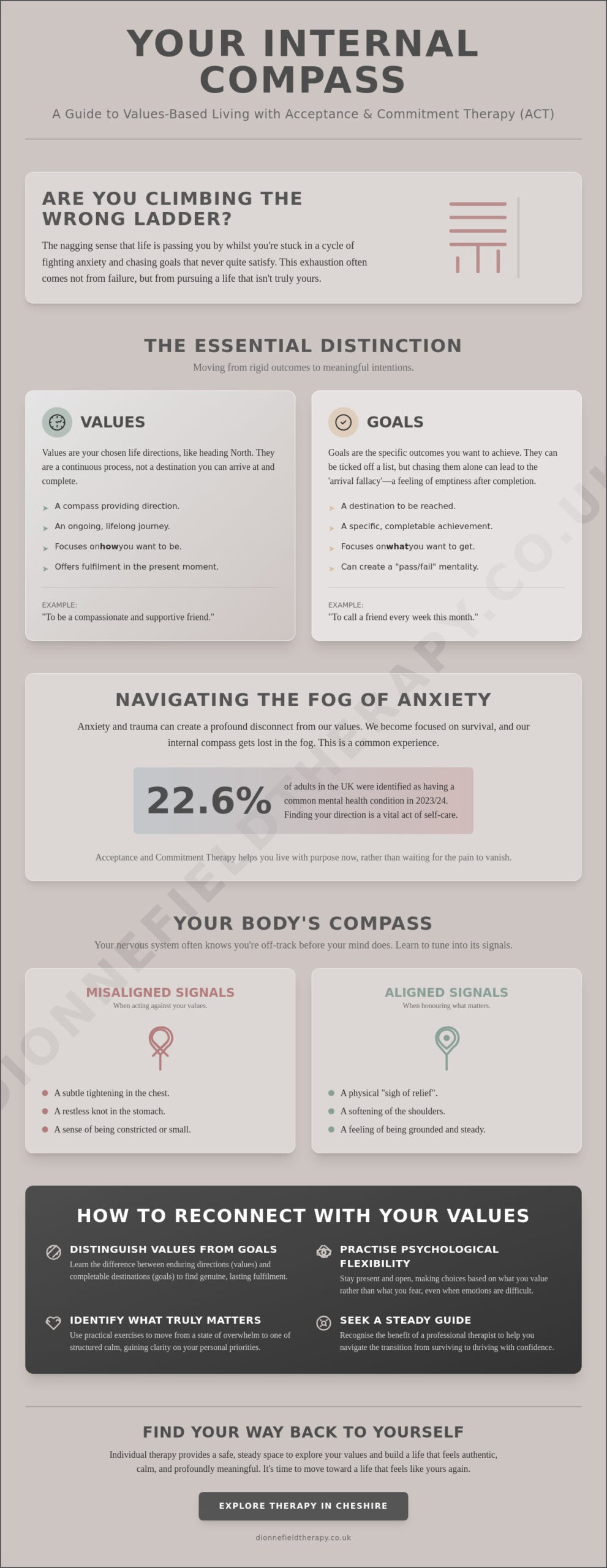
Imagine standing at a crossroads. One path is paved with the expectations of others; the other is a narrow, perhaps slightly overgrown trail that feels right in your bones. Choosing that second path is the essence of values-based living ACT. It isn’t a final destination or a trophy to be won. Instead, think of your values as a compass. A compass doesn’t tell you that you’ve “arrived” at North; it simply ensures you’re still heading in that direction, even when the fog of anxiety rolls in. With 22.6% of adults in the UK identified as having a common mental health condition in 2023/24, finding this internal sense of direction is more vital than ever. It provides a steadying influence during life transitions, where old landmarks have vanished and you’re left wondering who you are now.
Psychological flexibility is the tool that keeps you connected to your centre during these storms. It’s the ability to stay present and open, making choices based on what you love rather than what you fear. When you lead with your values, personal growth becomes less about “fixing” yourself and more about expanding your capacity to live fully. You start to move with intention, even when the path ahead is unclear.
The Heart of Acceptance and Commitment Therapy
Traditional therapy often focuses on symptom reduction, trying to “fix” the anxiety before life can begin. Acceptance and Commitment Therapy shifts this perspective entirely. We stop waiting for the pain to vanish and start living with purpose right now. The “Commitment” part of the framework is a gentle promise to yourself. It’s an agreement to take action that reflects your heart, even whilst carrying the heavy weight of difficult emotions. It’s a move away from the “survival brain” and toward a life that feels deeply personal and chosen. This shift from “getting rid of pain” to “living with purpose” is the foundation of lasting change.
The Somatic Experience of Living Your Values
Your body often knows you’re off-track before your mind does. You might notice a subtle tightening in your chest or a restless knot in your stomach when you’re living for someone else’s approval. These are somatic cues, quiet signals from your nervous system that you’ve drifted from your centre. Conversely, there’s a specific physical “sigh of relief” that occurs when a value is honoured. It’s a softening of the shoulders and a grounding through the feet. By tuning into these sensations, you can identify what truly matters amongst the noise of daily life. In individual therapy, we often explore these physical sensations to map out your internal landscape. This somatic awareness acts as an anchor, helping you stay connected to your authentic self during times of change.
Values versus Goals: The Essential Distinction for Long-term Growth
Have you ever spent months, perhaps years, chasing a specific achievement only to find that the moment of victory felt hollow? This experience is often called the “arrival fallacy.” It’s the mistaken belief that once we reach a certain destination, our anxiety will vanish and we will finally feel complete. In the framework of values-based living ACT, we learn that goals are simply the things we want to achieve, whilst values are the way we choose to live our lives. Goals can be ticked off a list. Values, however, are like the sunset; you can move toward them, but you never actually “arrive” and finish them. They are a continuous way of being.
When we focus solely on goals, we often feel like we are failing until the very moment the goal is reached. If the goal isn’t met due to circumstances beyond our control, we are left feeling defeated. Values-based intentions change this dynamic. They allow us to find success in the present moment, regardless of the outcome. If you value being a “supportive person,” you can succeed in that value every time you listen to a friend, even if you don’t achieve a specific social goal. This shift helps reduce the emotional overwhelm that comes from rigid expectations. If you feel the weight of unmet expectations, working with a professional through Psychotherapy can help you shift your focus from rigid outcomes to meaningful intentions.
Why Living by Goals Alone Can Increase Anxiety
Living purely by goals creates a “pass or fail” mentality that can be incredibly taxing on the nervous system. This pressure of perfection often turns our deepest desires into heavy “shoulds” that weigh us down. We become so focused on the finish line that we miss the actual experience of our lives. By contrast, values-based living ACT teaches us that our worth is not tied to our achievements. When we live by values, we find a sense of freedom. Even if a plan goes wrong, our value remains intact. We can still choose how to respond with integrity and care, keeping us grounded amongst the uncertainty of 2026.
Examples of Goals vs. Values in Everyday Life
Understanding the difference becomes easier when we look at common areas of life where we feel stuck. Here are a few ways to reframe rigid goals into enduring values:
- Goal: “Get a promotion” vs. Value: “Being industrious, creative, or contributing my skills.”
- Goal: “Losing weight” vs. Value: “Caring for my physical well-being and respecting my body.”
- Goal: “Getting married” vs. Value: “Cultivating intimacy, connection, and kindness in my relationships.”
By focusing on the value rather than just the goal, you ensure that you can live a meaningful life today, rather than waiting for a future that may or may not arrive. It’s about the quality of the journey, not just the points on the map.
Overcoming the ‘Stuckness’: Why Anxiety and Trauma Make Values-Based Living Difficult
If you’ve ever felt that your heart is a locked room and you’ve lost the key, you’re not alone. Many people who seek values-based living ACT find that their history of trauma or chronic anxiety has made the very idea of “meaning” feel distant. It’s as if the “survival brain” has taken over the controls. When we’re in a state of constant threat, our biology focuses entirely on the present moment to keep us safe. The future becomes a luxury we can’t afford to think about. This is why you might struggle with the objection: “I don’t know what I value anymore.” It isn’t that your values have disappeared; it’s that your nervous system has prioritised survival over exploration.
Anxiety often creates powerful avoidance patterns. We spend so much energy trying to quiet the alarm bells of panic that we have little left for the activities we actually care about. We might avoid a social gathering we value because the “noise” of anxiety is too loud. For those who find that social situations trigger particularly intense avoidance, exploring ACT for social anxiety can offer a compassionate framework for stepping out of isolation and back toward the connections you care about. Over time, these choices can leave us feeling hollow and disconnected from our true selves. This “stuckness” is a common reason people seek Trauma-Informed Therapy, as it helps to gently unpick these patterns in a safe environment.
The Window of Tolerance and Values-Based Action
When our nervous system is pushed outside its “window of tolerance,” we enter a state of hyper-arousal (fight or flight) or hypo-arousal (shutdown). In these states, the prefrontal cortex, the part of the brain responsible for complex decision-making and values, essentially goes offline. You cannot choose a direction whilst you’re drowning. This is why grounding techniques are essential before we even begin to talk about what matters most. Safety in the nervous system is the prerequisite for meaningful choice. By returning to a state of calm, we create the internal space needed to listen to our own heart again.
Differentiating Your Values from Societal Expectations
Sometimes, what we think are our values are actually “scripts” we’ve inherited from family, culture, or the pressure of 2026 social standards. These “shoulds” can feel incredibly heavy. In values-based living ACT, we use a tool called “cognitive defusion” to help you step back from these thoughts. Instead of being tangled up in the belief that you “should” be a certain way, you learn to see the thought for what it is: just words. This distance gives you the courage to choose a path that feels authentic to you, even if it differs from what others expect. It’s about finding your own voice amongst the noise of the world.
Steps to Clarify Your Values: Practical ACT Tools for Everyday Life
Clarifying what truly matters can feel daunting when you’ve spent years in survival mode. However, values-based living ACT provides structured, gentle tools to help you reconnect with your heart’s desires. One of the most evocative exercises is the “80th Birthday” reflection. Imagine you are celebrating eight decades of life amongst your dearest friends and family. What would you want them to say about the way you lived? This isn’t about your achievements or the status you reached. It’s about the qualities you brought to the world. Were you kind? Were you courageous? This perspective often cuts through the static of daily anxiety and reveals your true North.
Another useful tool is the “Values Bullseye”. Picture a target divided into four domains: Relationships, Work and Education, Personal Growth and Health, and Leisure. You place a mark in each area to show how close you are to living your values right now. If you’re far from the centre, it’s not a reason for self-criticism. It’s simply information that helps us navigate. To avoid the exhaustion of goal-chasing, we suggest selecting just 3 to 5 core values to focus on initially. This prevents the feeling of being overwhelmed and allows for more intentional, steady progress in your daily life.
The “Values Card Sort” Technique
This practical method involves categorising a list of potential values into three piles: “Very Important,” “Important,” and “Not Important.” The real magic happens during the “forced choice” phase. When you’re asked to choose between two values you love, such as “honesty” and “harmony,” you begin to see which one truly anchors you. Reflecting on why these specific values carry more weight can be a profound experience. It uncovers the unique blueprint of your character and helps you understand why certain situations feel so deeply uncomfortable whilst others feel right.
Translating Values into Committed Action
Knowing your values is a beautiful first step, but living them requires movement. We often use SMART goals to ground these abstract ideas into reality. For example, if you value “connection,” a tiny habit might be to send one thoughtful text to a friend each Tuesday morning. These small, intentional acts are more sustainable than grand resolutions that often lead to burnout. Committed action is the bridge between knowing your values and actually doing the things that honour them. If you’re ready to start this journey, exploring Acceptance and Commitment Therapy can provide the steady support and professional guidance you need to make these changes last.
Finding Your Way: How Individual Therapy in Cheshire Supports Your Journey
Walking the path of values-based living ACT can feel like learning a new language whilst trying to find your way through a thick mist. It is rarely a journey meant to be taken alone. A professional therapist acts as a steady guide, helping you sift through the static of daily anxiety to hear the quiet resonance of your own heart. In the safe, non-judgmental environment of Individual Counselling, you can explore deep questions of meaning without the pressure of having all the answers right away. This partnership is built on trust and a mutual respect for your unique boundaries.
As we explored in earlier sections, trauma and chronic stress can make it difficult to feel safe in your own skin. Integrating values-based living ACT with Somatic Therapy allows us to address the physical sensations of “stuckness” alongside the philosophical questions of purpose. This holistic approach ensures you aren’t just thinking about your values; you are feeling the grounding reality of them in your nervous system. You move from a state of scattered overwhelm into a state of structured, calm support, where every choice feels like an authentic expression of who you are.
Counselling in Sandbach and Tarporley
Building emotional trust often happens most naturally in person. Having a consistent physical anchor for your growth can be incredibly stabilising amongst the uncertainties of life. Whether you are looking for support in Sandbach, Tarporley, or Chester, local Face to Face Therapy provides a dedicated sanctuary to focus entirely on your evolution. It’s a space where you can sit with complexity and find your own pace, supported by a professional who is comfortable with the “not-knowing” until the path becomes clear.
Flexible Support: Online Therapy for Values-Based Living
Life in 2026 is often fast-paced and demanding. For many, Online Therapy offers a way to prioritise your mental fitness without the added stress of travel or rigid scheduling. Research confirms that ACT is highly effective when delivered through secure digital platforms, providing the same warmth and professional rigor as in-person sessions. This flexibility ensures that your commitment to a meaningful life fits into your actual schedule. You don’t have to wait for the “perfect” moment to begin. The first step is simply reaching out. Whether you prefer the quiet presence of a therapy room in Cheshire or the convenience of a screen, the invitation remains the same: come as you are, and let’s find the way forward together.
Your Path Toward a Purposeful Life
The journey toward a life of meaning doesn’t require you to wait until your anxiety has completely vanished. By understanding the distinction between rigid goals and enduring values, you can begin to make choices that feel authentic today. We’ve explored how your values act as a reliable compass, guiding you through the fog of survival mode and toward a sense of genuine fulfilment. This process of values-based living ACT is about taking small, intentional steps that honour your heart’s deepest desires, even whilst you navigate difficult emotions.
If you feel ready to move from a state of overwhelm to steady ground, professional support can provide the anchor you need. As a BACP-accredited therapist specialising in trauma-informed ACT and Somatic Therapy, I offer a safe, gentle space to explore these complexities. Whether you prefer face-to-face sessions in Sandbach, Tarporley, or across Cheshire, or the flexibility of online support, we can work together to build your internal resilience. Book a compassionate consultation with Dionne Field to begin your journey toward values-based living. You don’t have to navigate this transition alone; there is a way to find your centre again.
Frequently Asked Questions
What is the main goal of values-based living in ACT?
The primary aim of values-based living ACT is to help you build a life that feels vital and meaningful, even whilst you carry difficult thoughts or anxiety. It isn’t about “fixing” your internal experience or waiting for the pain to stop. Instead, it focuses on empowering you to take action that reflects your heart’s deepest desires. This shift allows you to move from a state of constant struggle into a life of purpose.
Can my values change over time?
Absolutely. Your values are not static rules; they are a reflection of what you find important in your current life stage. As you grow and encounter new experiences, your priorities may naturally shift. A value that felt central during your career-building years might soften as you move toward a season of rest or connection. This evolution is a healthy sign of a life that is being lived with awareness and flexibility.
How do I know if a value is mine or someone else’s?
A personal value usually feels like an invitation, whilst a societal expectation feels like a heavy “should.” When you act in alignment with your own values, there is often a sense of internal quiet or vitality. If you feel a sense of pressure, guilt, or the need to please others, you might be following an inherited script. Values-based living ACT helps you distinguish between these external pressures and your authentic self.
Is living by values the same as being “moral”?
Whilst they often overlap, they are distinct concepts. Morality is frequently tied to external codes of conduct or rules about what is “right” or “wrong.” Values are more about the personal qualities you choose to bring to your behaviour. You might value “adventure,” which isn’t necessarily a moral rule, but it is a vital way of being that makes your life feel rich and worth living.
What happens if two of my values conflict, like family and career?
Value conflicts are a natural part of the human experience. Instead of seeing them as a problem to be solved, ACT encourages us to see them as a need for balance. You might choose to prioritise your value of “contribution” at work during the day and your value of “connection” with family in the evening. It’s about making conscious, intentional choices in each moment rather than being pulled by whichever demand feels loudest.
How long does it take to see the benefits of values-based living?
You can experience a physical sense of alignment the very moment you make a choice that honours your centre. However, the deeper benefits of a life of meaning usually emerge through consistent, small actions over time. It’s helpful to view this as a lifelong practice of mental fitness. Much like physical exercise, the results build steadily as you refine your ability to stay connected to your internal compass.
Can ACT therapy help if I feel completely disconnected from my values?
Yes, feeling disconnected is a common experience, especially if you have faced trauma or chronic stress. A therapist acts as a steady companion to help you gently uncover what has been buried by survival instincts. Through individual psychotherapy, you can use somatic cues and specific ACT tools to reconnect with your heart. This process is patient and respectful, allowing your values to emerge at their own pace.
How do I start living by my values when I feel overwhelmed by anxiety?
The key is to start with actions that are so small they feel manageable even amongst the noise of anxiety. You don’t need to wait for the panic to subside before you can honour a value. If you value “creativity,” simply doodling for five minutes is a value-aligned act. These tiny movements help to lower the nervous system’s defences and build the confidence needed for larger changes as you progress.

Article by
Dionne Field
Dionne Field is an integrative psychotherapist. She's passionate about helping clients understand themselves with greater compassion and clarity. With experience in both NHS mental health services & private practice, her work combines trauma-informed, person-centred therapy, ACT, CBT, DBT, 'parts work' & somatic therapy. Dionne believes that meaningful change happens when people feel safe, understood and empowered to reconnect with who they truly are.
Disclaimer
The information provided in this blog is intended for educational and informational purposes only and should not be considered a substitute for professional mental health advice, diagnosis, or treatment. Whilst every effort is made to ensure the information shared is accurate and up to date, the content reflects general therapeutic knowledge and perspectives and may not be applicable to your individual circumstances. Reading this blog does not create a therapeutic relationship between you and Dionne Field Therapy. If you are currently experiencing emotional distress, mental health difficulties, or require support specific to your situation, please seek advice from a qualified healthcare professional or mental health practitioner. If you are in crisis, experiencing thoughts of self-harm, or feel unable to keep yourself safe, please contact your GP, NHS 111, emergency services, or an appropriate crisis support service immediately. Any external links provided are for convenience and informational purposes only. Dionne Field Therapy is not responsible for the content, accuracy, or availability of third-party websites. By using this website and blog, you acknowledge and accept this disclaimer.
Leave a Reply