

Making the decision to seek therapy is a significant, deeply personal step. Yet, after taking that step, you can find yourself facing a new challenge: the wait. If you are considering private therapy instead of the NHS, it is likely because you are caught in this difficult space—knowing you need support but finding that immediate, accessible help feels just out of reach. You are not alone in this feeling.
This is not a criticism of the dedicated professionals within the NHS, who do incredible work under immense pressure. It is, however, a compassionate acknowledgement of the system’s current reality. This guide is here to help you navigate the differences between the two paths, validating your frustrations and empowering you to make an informed, confident choice about your mental health journey in Cheshire.
Understanding the NHS Waiting List Reality in 2026
When you are struggling, hearing that support is available can bring a wave of relief. But the reality of NHS Talking Therapies in Cheshire, and across the UK, is often more complex. There is a crucial difference between “accessing” a service—making that first call or self-referral—and actually beginning the therapeutic work. For many, this gap can last for months, a period where feelings of anxiety or the weight of trauma can intensify.
- The Pressure on Services: The demand for mental health support has grown exponentially, and NHS services are stretched. This often leads to a triage system where those in acute crisis are prioritised, whilst those with moderate anxiety or depression face longer waits.
- The Triage System: After an initial assessment, you are placed on a waiting list. This process, while necessary for the system, can feel impersonal and leave you feeling like your struggles are not “serious enough” for immediate attention.
- The Emotional Cost of Waiting: Being on a waiting list whilst navigating difficult emotions can be incredibly challenging. It can feel like you are treading water, trying to stay afloat without a life raft in sight, which can be particularly dysregulating when dealing with the echoes of past trauma.
The “Postcode Lottery” of Mental Health Care
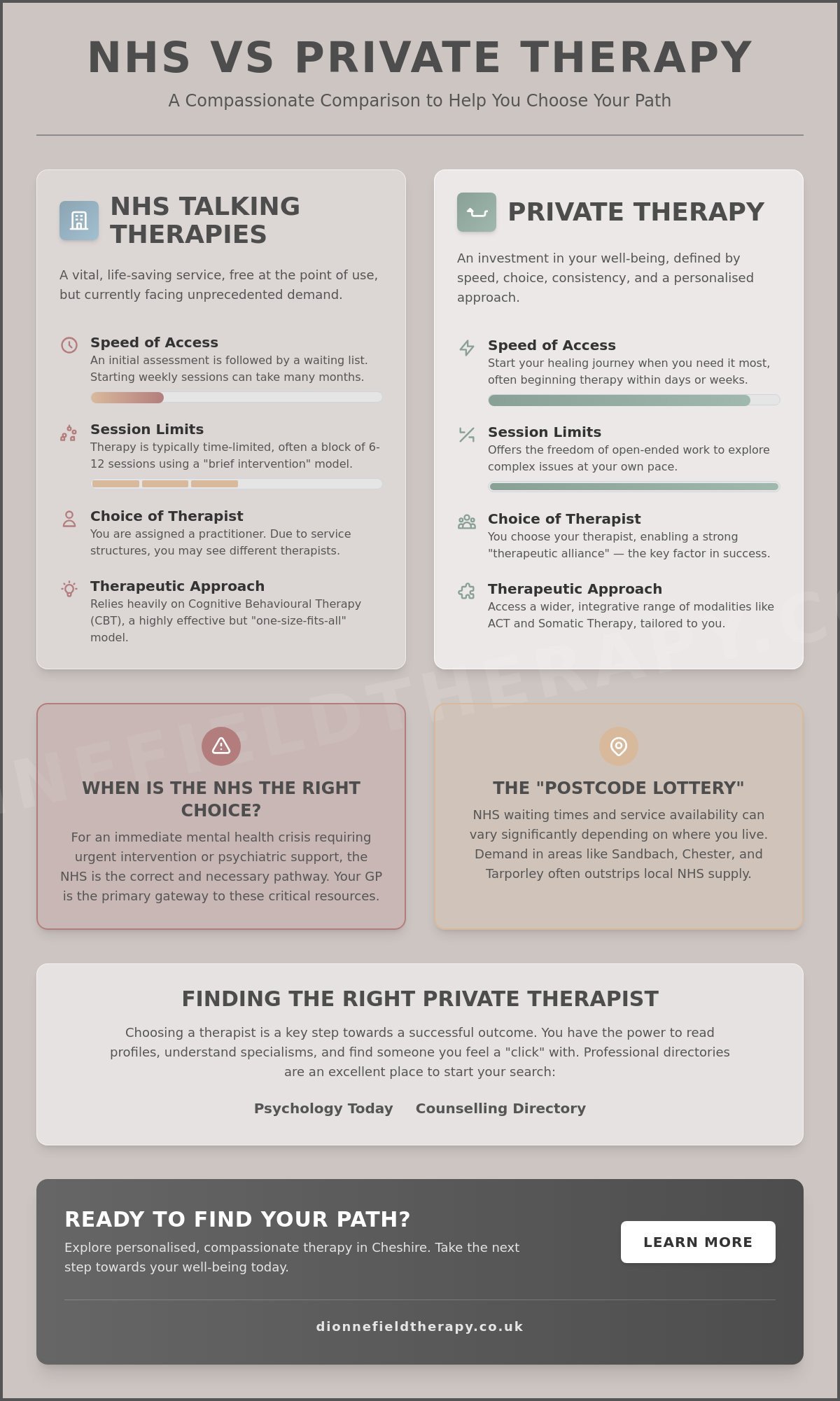
Access to care can vary significantly depending on where you live. Waiting times in Sandbach might differ from those in Chester or Northwich, dictated by local funding, staffing levels, and the specific demands on that area’s services. This “postcode lottery” means that the care you receive is often influenced more by logistics than by your individual needs.
Furthermore, many NHS trusts operate on a “brief intervention” model. This typically involves a block of 6-8 sessions of a specific therapy, like Cognitive Behavioural Therapy (CBT). Whilst helpful for some, it may not provide the depth or time needed to explore more complex, long-standing issues.
When is the NHS the Right Choice?
It is vital to recognise the immense strengths of the NHS. For individuals experiencing a severe mental health crisis, it provides an essential, life-saving service. Your GP is the primary gateway to this free support and plays a crucial role in assessing your needs and referring you to the appropriate team, such as crisis intervention or psychiatric services.
NHS therapy is a valuable, important resource. The challenge lies not in the quality of its practitioners, but in the overwhelming demand that limits its capacity, speed, and flexibility.
Private Therapy vs NHS: A Comparison of Care
When you feel stuck on a waiting list, exploring private therapy opens up a different set of possibilities. The comparison isn’t about one being “better” than the other, but about which model best fits your personal circumstances and therapeutic needs right now.
- Speed of Access: The most significant difference is time. Instead of waiting months for an initial appointment, you can often begin private therapy within days or a week of your first enquiry.
- Session Limits: Private therapy is not typically time-limited. You and your therapist decide the length of your work together, whether that is for a few months or a longer, open-ended period, allowing you to go at a pace that feels right for you.
- Continuity of Care: In a private setting, you will see the same therapist for every session. This consistency is the foundation of a strong therapeutic relationship, which is one of the most significant predictors of a positive outcome.
- Your Environment: Private therapy offers a choice of environment, from the comfort of a dedicated practice room in a location like Tarporley to the convenience of secure online sessions from your own home.
The Power of the Therapeutic Alliance
Research consistently shows that the single most important factor in successful therapy is the “therapeutic alliance”—the relationship of trust, respect, and collaboration you build with your counsellor. Private practice puts the power of choice in your hands.
You have the freedom to read therapists’ profiles, understand their specialisms, and get a sense of their approach before you even make contact. This ability to find someone you feel a “click” with is invaluable. It is the first step in building a relationship where you feel truly seen, heard, and understood. If you are beginning this process, finding a private counsellor in Cheshire who feels like the right fit is a journey worth taking with care.
Flexibility and Convenience
Life is busy, and fitting therapy into a demanding schedule can be a barrier to getting help. Private therapists often offer greater flexibility, with evening and weekend appointments that work around your professional and personal commitments. You can choose between face-to-face sessions in a convenient location like Sandbach or the accessibility of online therapy, all with minimal “red tape” involved in booking and managing your appointments.
The Benefit of Choice: Selecting Your Therapeutic Modality
The NHS, due to its need to provide care at scale, relies heavily on Cognitive Behavioural Therapy (CBT). CBT is an evidence-based and effective tool for many conditions, but a “one size fits all” approach does not always suit the nuances of complex trauma, deep-rooted anxiety, or a general feeling of being “stuck”.
Private therapy allows for a more integrative and specialised approach. It gives you the autonomy to choose a therapeutic modality that resonates with your unique history and nervous system. Beyond CBT, you can explore powerful approaches such as:
- Acceptance and Commitment Therapy (ACT): A mindfulness-based therapy that helps you stop struggling with difficult feelings and instead build a rich, full, and meaningful life guided by your core values.
- Somatic Therapy: A body-centred approach that helps release trauma and stress stored in the body, recognising that the mind and body are intrinsically linked in healing.
Moving Beyond CBT: ACT and Somatic Approaches
Why might these approaches be a better fit? ACT is less about eliminating “bad” thoughts and more about learning to live alongside them without letting them run your life. It is a deeply compassionate and empowering way to navigate emotional pain. If you’re curious about this, you can learn more about what Acceptance and Commitment Therapy is and how it can help.
Somatic therapy, meanwhile, is essential for processing trauma. Trauma is not just a memory; it is a physiological experience held in the nervous system. Body-based techniques help you gently and safely process these stored sensations, leading to a deeper and more integrated form of healing.
Trauma-Informed Care: A Deeper Level of Support
For survivors of trauma, time-limited therapy can sometimes feel rushed or even re-traumatising. A core principle of trauma-informed care is moving at the speed of safety. A private therapist who specialises in this area understands the importance of sitting with complexity without rushing towards a “cure.” They can offer a more holistic, sensitive environment where you have the time and space needed to truly heal.
Is Private Therapy Worth the Investment? Calculating the Value
It is understandable to hesitate at the cost of private therapy. In a country with a National Health Service, paying for healthcare can feel counterintuitive. However, it can be helpful to reframe the fee not as a “cost,” but as an “investment” in your long-term well-being.
Consider the hidden costs of waiting for support: the impact on your productivity at work, the strain on your relationships, and the toll on your physical and emotional health. Early, consistent intervention can prevent struggles from escalating into more serious issues, ultimately saving you significant emotional and financial cost down the line. You are investing in a dedicated, BACP-accredited professional who is wholly committed to supporting you.
Understanding Private Therapy Fees in the UK
What are you actually paying for? The session fee covers far more than the 50 minutes you spend in the room. It includes the therapist’s extensive training (often at a Master’s level or higher), ongoing mandatory clinical supervision, professional insurance, accreditation body fees, and the costs of providing a safe, confidential, and comfortable therapeutic space. When compared to other lifestyle expenditures—a gym membership, a weekend away, regular meals out—investing in your mental health often provides a far greater and more lasting return.
Evaluating Your Personal Needs
To decide if this investment is right for you, you might ask yourself: How much is my anxiety impacting my life right now? What is the cost of things staying as they are for another six months?
Therapists often talk about the “Window of Tolerance,” a term for the optimal zone of arousal where we can effectively manage our emotions and navigate life’s challenges. When we are struggling, we can easily be pushed outside this window into states of hyper-arousal (anxiety, panic) or hypo-arousal (numbness, shutdown). Waiting for therapy can keep you stuck outside this window, making daily life feel like a constant battle. Private therapy can be the tool that helps you gently guide yourself back into it.
Finding Your Path with Dionne Field Therapy in Cheshire
If you have decided that the immediacy, choice, and depth of private therapy is the right path for you, I am here to help. At Dionne Field Therapy, I offer a compassionate, professional alternative to the NHS waiting list for adults in Sandbach and the wider Cheshire area.
My approach is not to offer a quick fix, but to build a genuine therapeutic relationship where you feel safe to explore your challenges. I draw upon a range of evidence-based modalities, including CBT, ACT, and Somatic techniques, to create a truly holistic and integrative therapy that is tailored to you and your unique story.
Supporting the Cheshire Community
I am proud to support our local community by offering:
- Face-to-face therapy in calm and confidential settings in Sandbach and Tarporley, for those who value that personal, in-person connection.
- Secure online therapy for clients across Cheshire, including Middlewich, Nantwich, and Northwich, providing flexibility and accessibility from the comfort of your home.
My focus is on providing individual counselling in Cheshire that empowers you on your path to recovery and growth.
Your Next Steps Toward Healing
Taking the first step is often the hardest, and I aim to make it as gentle as possible. The process begins with a simple, no-obligation initial consultation. This is a chance for us to speak, for you to ask any questions you may have, and for us both to see if we feel like a good fit to work together.
In your first session, you can expect a warm, non-judgmental space where you can simply be heard. You have the agency to take control of your mental health journey today. You do not have to wait any longer to feel better.
You can verify my professional credentials and approach on trusted third-party directories such as the Counselling Directory and Psychology Today. When you are ready, I invite you to reach out and begin your journey to recovery.

Article by
Dionne Field
Dionne Field is an integrative psychotherapist. She's passionate about helping clients understand themselves with greater compassion and clarity. With experience in both NHS mental health services & private practice, her work combines trauma-informed, person-centred therapy, ACT, CBT, DBT, 'parts work' & somatic therapy. Dionne believes that meaningful change happens when people feel safe, understood and empowered to reconnect with who they truly are.
Disclaimer
The information provided in this blog is intended for educational and informational purposes only and should not be considered a substitute for professional mental health advice, diagnosis, or treatment.
Whilst every effort is made to ensure the information shared is accurate and up to date, the content reflects general therapeutic knowledge and perspectives and may not be applicable to your individual circumstances.
Reading this blog does not create a therapeutic relationship between you and Dionne Field Therapy. If you are currently experiencing emotional distress, mental health difficulties, or require support specific to your situation, please seek advice from a qualified healthcare professional or mental health practitioner.
If you are in crisis, experiencing thoughts of self-harm, or feel unable to keep yourself safe, please contact your GP, NHS 111, emergency services, or an appropriate crisis support service immediately.
Any external links provided are for convenience and informational purposes only. Dionne Field Therapy is not responsible for the content, accuracy, or availability of third-party websites.
By using this website and blog, you acknowledge and accept this disclaimer.
Leave a Reply