

Considering private therapy is a significant step, and it’s natural that one of the first questions to surface is a practical one: how much does it actually cost? The search for clarity around fees can feel overwhelming, especially when you are already navigating difficult emotions. It’s a question of budget, but it’s also a question of value, and understanding what you are investing in is key.
This guide is designed to gently walk you through the landscape of private therapy costs in the UK. We will explore the typical price brackets, explain why those fees vary, and help you shift the focus from a simple hourly rate to the profound, long-term value of dedicated, professional support for your mental well-being.
Understanding the Landscape: The Cost of Therapy in the UK
The UK has a dual system for mental health support: the free-at-the-point-of-use NHS and the independent private sector. Whilst the NHS provides an essential service, accessing it often involves significant trade-offs, which is why many people explore private options. Understanding the differences is the first step in making an informed choice.
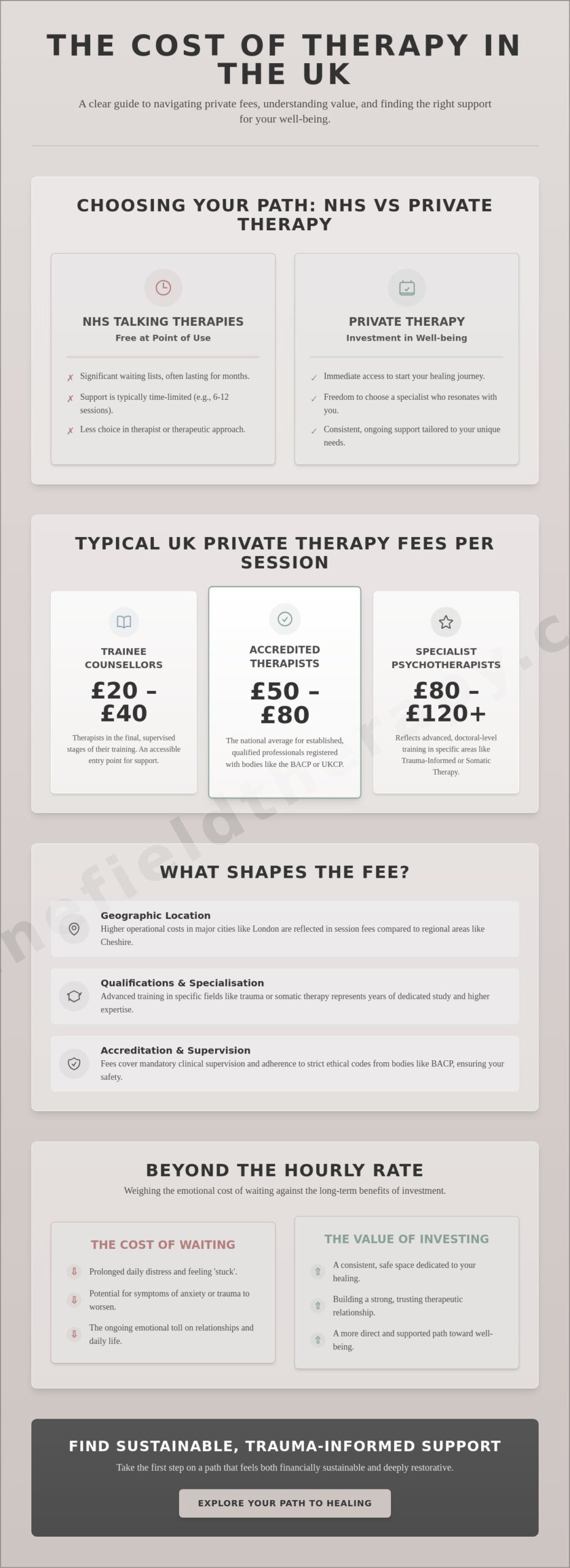
- The distinction between NHS and private: NHS services are free, but this often comes with long waiting lists and limited choice over the type of therapy or therapist you see. Private practice offers immediate access and a bespoke approach.
- General price brackets: Costs can range from as little as £20 for a session with a trainee to over £120 for a highly specialised psychotherapist in a major city.
- “Low-cost” therapy considerations: While options offered by trainees or charities are invaluable, they may not be equipped to handle complex or specific issues like deep-rooted trauma, which often requires more advanced training.
- The importance of accreditation: Regardless of the fee, always ensure your therapist is registered with a professional body like the BACP (British Association for Counselling and Psychotherapy) or UKCP (UK Council for Psychotherapy). This is your guarantee of their professional standards and ethical commitment.
NHS vs Private: The Balance of Cost and Time
The primary appeal of the NHS is that its services are free. However, this benefit is often weighed against the reality of access. In 2026, waiting lists for NHS Talking Therapies can still stretch for many months, a period during which symptoms can worsen. Furthermore, the support offered is typically time-limited, often restricted to a set number of sessions of a specific modality like CBT. In the private sector, you have the freedom to choose a therapist whose specialisms align with your needs, begin work almost immediately, and decide on the duration of your therapy in collaboration with them.
Average Price Brackets for Private Counselling
Private therapy fees in the UK generally fall into three main tiers. These are not rigid rules but serve as a helpful guide to what you can expect to pay for a standard 50-minute session:
- Trainee or Student Counsellors: £20 – £40. These practitioners are in the final stages of their training and working under close supervision. They can provide excellent support for general issues.
- Qualified, Accredited Therapists: £50 – £80. This is the most common price bracket. It represents a fully qualified professional with significant experience and accreditation from a body like the BACP.
- Specialist or Consultant-Level Psychotherapy: £80 – £120+. Therapists in this range often have extensive post-graduate training in specific areas (like trauma or somatic therapy), decades of experience, or are based in high-demand locations like London.
Why Prices Vary: Factors Influencing Private Therapy Fees
You might wonder why two accredited therapists can charge such different rates. The cost is not arbitrary; it reflects a combination of professional and practical factors that contribute to the quality and depth of the care provided.
- Geographic location: A therapist in Central London will invariably have higher overheads than a practitioner in regional hubs like Chester or Sandbach, and their fees will reflect this.
- Experience and training: A therapist with decades of experience and advanced, postgraduate qualifications in specialised modalities will command a higher fee than someone more recently qualified.
- Specialised modalities: Advanced approaches such as Somatic Therapy or Acceptance and Commitment Therapy (ACT) require intensive, often expensive, additional training that goes far beyond a core counselling qualification.
- Professional overheads: The session fee also covers essential costs the public rarely sees, such as professional indemnity insurance, mandatory clinical supervision, room hire, and continuous professional development (CPD) to stay current with the latest research and ethical best practices.
The Role of Therapist Qualifications and Accreditation
Seeing “BACP Accredited” next to a therapist’s name is more than just a title; it’s a mark of quality and safety. It signifies that the therapist has completed a substantial level of training and practical hours, and that they adhere to a strict ethical framework. Maintaining this accreditation involves ongoing costs for clinical supervision (where they discuss their work with a more senior practitioner to ensure best practice) and continuous training. This commitment to ethical excellence, especially in complex areas like trauma-informed care, is a core component of the fee you pay.
How Modalities Impact Pricing
Not all therapy is the same. Whilst standard talk therapy is incredibly valuable, evidence-based models like CBT and ACT involve structured protocols and specific techniques that require dedicated training. More complex, body-based approaches like Somatic Therapy, which help process trauma held in the nervous system, demand an even greater level of specialised skill from the practitioner. Ultimately, investing in a therapist with these specialised tools often leads to more efficient, long-term healing, as the work can address root causes rather than just managing symptoms.
Beyond the Hourly Rate: Evaluating the Value of Private Care
Focusing solely on the session fee can obscure the true value of private therapy. It is an investment in your well-being, and its returns are measured in restored calm, improved relationships, and a greater capacity to navigate life’s challenges.
- The “cost of waiting”: How much is your well-being, work performance, or personal relationships suffering whilst you wait for support? Delayed treatment can allow anxiety or trauma symptoms to become more entrenched and harder to resolve.
- Consistency of care: Private therapy provides the stability of seeing the same professional every week, allowing a deep and trusting therapeutic relationship to develop.
- Bespoke treatment plans: Your therapy is tailored specifically to you, rather than following a standardised, “one-size-fits-all” protocol that may not fit your unique history or needs.
- A dedicated space: The fee secures a safe, confidential, and dedicated therapeutic space—whether physical or online—where you can be entirely focused on your own healing and growth.
The Hidden Costs of Long Waiting Lists
When you are struggling, every week can feel like a lifetime. The emotional toll of waiting for help is a hidden cost that is rarely discussed. Unresolved anxiety or trauma can seep into every corner of your life, impacting your ability to focus at work, connect with loved ones, and simply enjoy your day. Early intervention through private therapy can be crucial in preventing a difficult period from escalating into a mental health crisis. It provides immediate tools and a supportive space to begin processing your experiences, allowing you to start your recovery without delay. For those seeking this kind of dedicated support, exploring individual counselling in Cheshire can be a powerful first step.
Bespoke Support: Choosing Your Own Therapist
Research consistently shows that the single most important factor in successful therapy outcomes is the quality of the “therapeutic alliance”—the relationship of trust and collaboration between you and your therapist. The private sector empowers you to choose someone you feel a genuine connection with. This allows for a truly bespoke approach, where a skilled therapist can draw from different modalities, perhaps combining the practical tools of ACT with the body-awareness of Somatic Therapy, to create a plan that resonates deeply with you. This flexibility extends to practicalities like session timing and delivery, offering a choice between face-to-face and online sessions to fit your life.
Practical Considerations: Budgeting for Your Mental Well-being
Making a financial plan for therapy can reduce anxiety and help you feel in control of the process. It’s about viewing the cost not as a never-ending drain, but as a structured, time-limited investment in yourself.
- See it as an investment: Most people do not stay in therapy forever. View it as a focused period of work with a clear purpose.
- Assess session frequency: Whilst weekly sessions are often recommended at the start to build momentum, you may be able to move to fortnightly sessions as you progress, making it more manageable financially.
- Check your insurance: Some private health insurance policies (often through an employer) provide cover for a set number of counselling sessions. It is always worth checking your policy details.
Frequency and Duration: Managing Your Investment
The standard therapeutic model is a weekly 50-minute session, but this is not the only option. The right frequency and duration depend on your goals. Are you looking for short-term, solution-focused work to tackle a specific issue, or longer-term psychotherapy to explore deeper patterns? A good therapist will discuss this with you from the outset, helping you set clear goals to measure your progress. Understanding the differences between approaches can also help; for instance, learning more about CBT vs psychotherapy can clarify what kind of timeline might be involved.
Questions to Ask About Fees During Your Consultation
Your initial consultation is the perfect time to ask direct questions about costs. A professional therapist will be transparent and open about their fee structure. Consider asking:
- Do you offer a reduced rate for booking a block of sessions?
- What is your cancellation policy? (This is typically 24–48 hours’ notice).
- Does the session fee include any between-session resources or brief email support?
Finding Sustainable Support with Dionne Field Therapy
Navigating the path to mental well-being requires a guide who is not only professionally qualified but also compassionate and attuned to your individual needs. At Dionne Field Therapy, the focus is on providing professional, trauma-informed care for adults across Cheshire, with a transparent and ethical approach to pricing.
- Specialised care: Providing expert Individual Counselling and Psychotherapy for anxiety, trauma, and personal growth.
- Transparent pricing: Clear communication about fees for specialised support, ensuring you can invest in your well-being with confidence.
- Local Cheshire therapist: Serving the communities of Sandbach, Tarporley, Chester, Middlewich, Nantwich, and Northwich with both local and online availability.
- A compassionate approach: A non-judgmental, safe space is the foundation for all therapeutic work.
Individualised Counselling in Sandbach and Cheshire
Support is tailored to your unique journey, drawing on powerful, evidence-based modalities including CBT, ACT, and Somatic Therapy. This integrated approach is designed to help clients navigate the complexities of anxiety, process trauma, and manage difficult life transitions with greater resilience and self-awareness. You can view verified credentials and professional standing on the Counselling Directory profile, which confirms adherence to the highest professional standards.
Flexible Delivery: Face-to-Face and Online
Understanding that life is busy, therapy is offered in a way that suits you. For some, the convenience and accessibility of secure online therapy is the perfect fit. For others, the grounding presence of in-person sessions in a calm, safe environment provides the ideal container for their therapeutic work. Whichever you choose, the quality of care remains the same. If you are ready to explore how compassionate, professional support could help you, please contact Dionne Field to discuss your needs and current fees.

Article by
Dionne Field
Dionne Field is an integrative psychotherapist. She's passionate about helping clients understand themselves with greater compassion and clarity. With experience in both NHS mental health services and private practice, her work combines trauma-informed, person-centred therapy, ACT, CBT, DBT, 'parts work' and somatic therapy. Dionne believes that meaningful change happens when people feel safe, understood and empowered to reconnect with who they truly are.
Disclaimer
The information provided in this blog is intended for educational and informational purposes only and should not be considered a substitute for professional mental health advice, diagnosis, or treatment. Whilst every effort is made to ensure the information shared is accurate and up to date, the content reflects general therapeutic knowledge and perspectives and may not be applicable to your individual circumstances. Reading this blog does not create a therapeutic relationship between you and Dionne Field Therapy. If you are currently experiencing emotional distress, mental health difficulties, or require support specific to your situation, please seek advice from a qualified healthcare professional or mental health practitioner. If you are in crisis, experiencing thoughts of self-harm, or feel unable to keep yourself safe, please contact your GP, NHS 111, emergency services, or an appropriate crisis support service immediately. Any external links provided are for convenience and informational purposes only. Dionne Field Therapy is not responsible for the content, accuracy, or availability of third-party websites. By using this website and blog, you acknowledge and accept this disclaimer.
Leave a Reply