

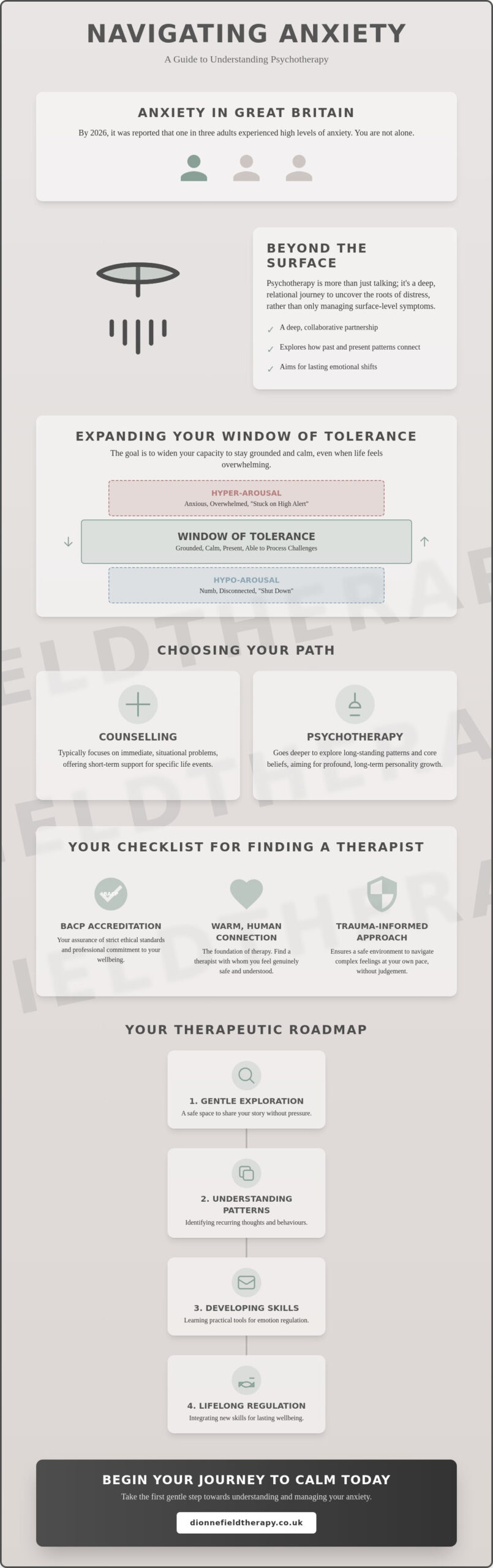
Did you know that by February 2026, one in three adults across Great Britain reported experiencing high levels of anxiety? If you feel as though your mind is constantly racing, or you’re stuck in a loop of "what-ifs" that refuse to quieten down, you’re certainly not alone. Seeking psychotherapy for anxiety doesn’t have to be another source of stress or a confusing journey through clinical jargon. It’s about finding a safe, local space where your experiences are validated and your pace is always respected.
It’s exhausting to live in a state of high alert, wondering if you’ll ever feel truly grounded again. You likely want a therapeutic relationship that offers more than just a listening ear; you need practical tools and a clear map forward. This article will help you discover how specialised support can transform your relationship with worry. We’ll demystify the therapeutic process, explore the benefits of approaches like CBT and Somatic therapy, and guide you toward finding a compassionate therapist who truly understands the unique rhythm of life in our Cheshire community… step by gentle step.
Key Takeaways
- Understand that psychotherapy is a deep, relational journey designed to uncover the roots of distress rather than just managing surface-level symptoms.
- Discover how integrative tools like Cognitive Behavioural Therapy (CBT) can help you regain control over intrusive thoughts and the physical sensations of worry.
- Learn the essential criteria for choosing psychotherapy for anxiety, focusing on the reassurance of BACP accreditation and the value of a warm, human connection.
- Gain a clear perspective on the therapeutic roadmap, moving from a gentle initial exploration to the development of practical, lifelong skills for emotion regulation.
- Explore how a trauma-informed and compassionate approach allows you to navigate complex feelings at your own pace within a safe, professional environment.
Table of Contents
What is Psychotherapy for Anxiety and Why Seek it in Sandbach?
When anxiety takes hold, it often feels like a constant background noise, a humming tension that never quite settles. You might find yourself searching for psychotherapy for anxiety Tarporley because you’ve realised that surface-level solutions aren’t reaching the core of your distress. Psychotherapy is far more than a simple chat; it’s a deep, relational process. It’s a partnership where we work together to understand the intricate roots of your worry, exploring how past experiences and current patterns shape your internal world. For those seeking a comprehensive overview of anxiety disorders, it’s clear that these conditions are complex, affecting both the mind and the body in profound ways.
In our sessions, we often talk about the "Window of Tolerance." This is the emotional zone where you feel grounded and able to process life’s challenges. Anxiety often pushes you out of this window into a state of hyper-arousal, where your nervous system feels "stuck" on high alert. Within the safety of a therapeutic relationship, we work to expand this window, helping you stay present and calm even when life feels overwhelming. Choosing private care in Sandbach allows for a level of consistency and depth that general NHS options often cannot provide. There are no rigid time limits or impersonal waiting lists; instead, there is a steady, dedicated space held just for you.
Safety is the foundation of this work. This is why I place such high importance on BACP accreditation. It’s your assurance that I adhere to a strict ethical framework and maintain the highest professional standards. It means you’re in the hands of a practitioner who is committed to your well-being and ongoing professional development.
The Difference Between Counselling and Psychotherapy
It’s common to feel confused by the various terms used in mental health. Counselling typically focuses on immediate, situational problems, offering short-term support for specific life events. Psychotherapy, however, tends to go deeper. It explores long-standing patterns, childhood trauma, and the fundamental ways you’ve learned to navigate the world. If you’re curious about which path suits you best, you might find it helpful to read more about CBT vs Psychotherapy: Choosing the Right Support. Both paths are valuable, but psychotherapy offers the space for long-term personality growth and profound emotional shifts.
Why Local Sandbach Support Matters
There is something uniquely grounding about seeking support within your own community. Finding a therapist who understands the pace and lifestyle of Cheshire can make the process feel more intuitive. When you choose face-to-face sessions in a familiar, calm environment, you’re creating a geographic "safe zone." This physical proximity reduces the logistical stress of travel, allowing you to arrive at your session with a sense of ease. It’s about building a consistent, reliable relationship in a place that feels like home, ensuring your journey toward calm is as seamless as possible.
Effective Therapeutic Modalities for Anxiety Relief
Anxiety rarely shows up in the same way for everyone. For some, it’s a frantic mental checklist that refuses to stop; for others, it’s a heavy, physical tightness in the chest that makes it hard to breathe. This is why a rigid, one-size-fits-all approach often fails to provide lasting relief. When seeking psychotherapy for anxiety, you’ll find that an integrative model is often the most effective path forward. This approach blends different evidence-based tools to create a bespoke experience tailored to your specific needs. The World Health Organization identifies several effective treatments for anxiety disorders, highlighting the importance of psychological interventions that address the complexity of these conditions.
Cognitive Behavioural Therapy (CBT) is perhaps the most well-known modality. It focuses on the "thinking" part of the anxiety cycle. By identifying and challenging distorted thought patterns, you can begin to uncouple your emotions from irrational fears. It’s about learning to see your thoughts as just that, thoughts, not necessarily facts. Whilst CBT is powerful for managing the mental chatter, it’s often most effective when integrated with other approaches that address the emotional and physical aspects of your experience.
ACT Therapy: Moving Toward Your Values
Acceptance and Commitment Therapy (ACT) offers a refreshing perspective. Instead of trying to eliminate anxious thoughts, ACT teaches you "cognitive defusion." This is the art of unhooking from your worries so they no longer dictate your choices. You might find it helpful to explore What is Acceptance and Commitment Therapy? to understand how this works in practice. By identifying your core values, you can learn to take meaningful action even whilst anxiety is present. It’s about building a life that feels rich and purposeful, regardless of the internal weather. It helps you develop the psychological flexibility needed to navigate life’s inevitable ups and downs.
Somatic and Trauma-Informed Approaches
Sometimes, talking isn’t enough because anxiety lives in the body. If you’ve ever felt a sudden surge of panic or a sense of being "frozen," your nervous system is responding to perceived threats. Somatic therapy addresses these physical symptoms directly. It helps you understand how your body stores past trauma and provides practical techniques for grounding yourself when you feel overwhelmed or dissociated. Trauma-informed care is the gold standard for long-term well-being. It ensures that the pace of therapy is always safe, preventing your system from being re-traumatised. By learning to regulate your nervous system, you gain a sense of agency over your physical responses.
Finding the right combination of these modalities is a collaborative process between you and your therapist. If you’re ready to explore how these approaches can work for you, learning more about my therapeutic approach could be your first step toward a calmer, more regulated life.
Choosing the Right Psychotherapist in Sandbach: A Checklist
Making the decision to move from an overstretched NHS waiting list to private care is a significant act of self-compassion. In the Cheshire area, many people find that whilst general support is available, it lacks the depth and consistency required for true recovery. Searching for psychotherapy for anxiety is the first step toward a more personalised, unhurried experience. However, the process of selecting the right person can feel overwhelming when you’re already struggling with worry. It’s not just about finding a qualified professional; it’s about finding a steady companion for your journey.
Your safety should always be the priority. Start by verifying that the therapist holds accreditation with a major professional body, such as the BACP or UKCP. These organisations ensure that practitioners adhere to strict ethical codes and maintain regular supervision. Beyond the certificates on the wall, look for someone who projects the image of a "compassionate expert." This is a therapist who uses their clinical training to empower you, rather than simply dictating a path. They should offer a space that feels warm, non-judgemental, and profoundly safe. Does their approach resonate with your specific experience of anxiety, whether that’s health-related worry, social fears, or the persistent hum of Generalised Anxiety Disorder?
Questions to Ask During Your First Contact
Most therapists offer a brief initial consultation, which is a perfect time to gauge the "therapeutic alliance." This relationship is often the most important factor in how well therapy works for you. Don’t be afraid to ask direct questions to see if their style aligns with your needs:
-
"Do you have specific experience working with the type of anxiety I’m experiencing?"
-
"What does trauma-informed care look like in your day-to-day practice?"
-
"How do you integrate different tools, such as CBT and somatic work, to suit my individual pace?"
Evaluating the ‘Feel’ of the Practice
The environment where you do this deep work matters immensely. Whether you’re meeting face-to-face in a quiet Tarporley room or connecting through online therapy, the space should feel like a sanctuary. Pay attention to the therapist’s communication rhythm. Do they seem patient and unhurried, or do you feel a pressure to "get to the point"? Trust your intuition. That sense of a "click" or a natural ease during your first conversation is a vital indicator. It’s okay to take your time to ensure the person you choose is someone you can truly open up to without fear of judgement.
What to Expect from Your Therapy Journey
Starting therapy can feel like standing on the edge of a significant, albeit slightly daunting, change. When you begin psychotherapy for anxiety , the first few steps are intentionally slow and gentle. We start with an initial assessment, which is really just a quiet, unhurried exploration of where you’ve been and where you’d like to go. This isn’t about ticking boxes or providing "right" answers. Instead, it’s about beginning to sketch out a shared roadmap. We’ll identify the triggers that pull you out of your window of tolerance and the specific goals that matter to you, ensuring the process feels collaborative from the very first hour.
Progress in therapy rarely follows a straight line. There will be weeks where you feel a profound sense of relief and clarity, and others where the old patterns feel frustratingly familiar. This ebb and flow is a natural part of the healing process. We aren’t just looking for quick fixes; we’re building a foundation for lasting change. By acknowledging that recovery has its own rhythm, we can remove the pressure to "be better" by a certain date. This patient approach allows us to sit with the complexity of your experience without rushing toward easy answers.
The First Session: Lowering the Defences
The primary goal of our first meeting is simply to establish safety. Many people arrive feeling they need to "perform" or explain their entire life story in sixty minutes. You don’t have to do that here. My role is to help you navigate the natural vulnerability that comes with opening up to someone new. We focus on building a foundation of trust… a steady ground where you feel seen and heard. By lowering these internal defences, we create the space necessary for honest reflection and genuine connection.
Developing Long-Term Resilience
As we move beyond managing immediate symptoms, the work shifts toward a deeper understanding of the self. We explore how you relate to your thoughts and practise new behaviours that align with your values. A vital part of this journey involves Building Self-Compassion in Therapy. Learning to treat yourself with the same kindness you’d offer a dear friend is a foundational skill. It transforms the way you handle anxiety, moving you from a place of self-criticism to one of gentle curiosity and strength.
If you feel ready to take that first step toward understanding your anxiety in a deeper way, booking an initial introductory session can help you begin this journey in a safe and supportive environment.
Psychotherapy for Anxiety with Dionne Field Therapy
Choosing to engage in psychotherapy for anxiety is a profound investment in your future self. At Dionne Field Therapy, I provide a space where clinical expertise meets a deeply human, compassionate presence. As a BACP-accredited therapist, I am committed to maintaining the highest ethical standards whilst ensuring you feel truly seen and understood. My work focuses on supporting adults across Cheshire who are navigating the complexities of modern anxiety, providing a steady hand as you move through the fog of worry toward a place of clarity and calm. Searching for psychotherapy for anxiety often leads people to seek a more integrated path, and that is exactly what I offer.
My approach is intentionally integrative because I don’t believe a single framework can capture the entirety of your experience. Instead, I blend the structured thought-work of Cognitive Behavioural Therapy (CBT) with the values-based perspective of Acceptance and Commitment Therapy (ACT) and the body-focused wisdom of Somatic techniques. This holistic integration ensures we are addressing your anxiety from every angle: the mind, the heart, and the nervous system. Whether you prefer the grounding presence of face-to-face therapy in our Cheshire rooms or the convenience of secure online therapy from your own home, the quality of care remains consistent, unhurried, and deeply personal.
A Safe Space for Adult Counselling in Sandbach
In the heart of our community, I offer more than just professional guidance; I offer a sanctuary. Adult life often demands that we keep moving, regardless of how we feel inside. Here, that pressure dissolves. My practice is built on a foundation of trauma-informed care, meaning your boundaries are always respected and the pace of our work is dictated by you. We move toward long-term emotional wellness by creating a relationship that feels safe enough for you to explore the roots of your distress. Is it time to allow yourself the space to breathe? I invite you to take that first step toward reclaiming your calm in a space where you are never judged, only supported.
How to Start Your Recovery Today
Beginning this journey is an act of immense courage. It’s often the hardest step, but it’s also the most rewarding. To start, simply reach out via an initial enquiry on my website. This first contact is a gentle way for us to see if we’re a good fit for one another, with no pressure to commit until you feel entirely ready. Remember, seeking help isn’t a sign that you’ve failed; it’s a profound act of self-care and resilience. You’ve carried this burden for long enough… perhaps today is the day you start letting it go. I am here to walk alongside you as you find your way back to yourself.
Discover how Dionne Field Therapy can help you navigate anxiety and begin your path toward a more regulated, peaceful life.
Step Forward Into a Life Defined by Calm
Navigating the persistent waves of anxiety can feel isolating, but as we’ve explored, the path to recovery is paved with understanding and specialised support. By choosing an integrative approach that honours both your thoughts and your physical sensations, you move beyond mere coping. You begin to build a foundation of genuine resilience. Finding the right psychotherapy for anxiety is a deeply personal process, one that requires a therapist who is not only a BACP-accredited professional but also a steady companion who truly "gets it."
Whether we’re unhooking from intrusive thoughts through ACT, challenging patterns with CBT, or grounding your nervous system via somatic work, the goal is always your long-term emotional wellness. My practice is built on these evidence-based foundations and is recognised by trusted platforms like the Counselling Directory and Psychology Today. You deserve a space where your pace is respected and your voice is heard. If you’re ready to explore how we can work together, please begin your journey to calm with Dionne Field Therapy. You’ve already taken the most difficult step by being here today; the next one doesn’t have to be taken alone.
Frequently Asked Questions
How many sessions of psychotherapy will I need for anxiety?
The number of sessions you’ll need depends entirely on your personal goals and the complexity of your experience. Whilst some people find relief in 6 to 12 sessions of focused work, others choose to engage in longer-term psychotherapy for anxiety to address deeper, long-standing patterns. We’ll regularly review our progress together to ensure the pace and duration of our work feel right for you.
Is private psychotherapy in Sandbach better than the NHS?
Private therapy isn’t necessarily better, but it offers a different level of flexibility and consistency than the NHS. You’ll avoid long waiting lists and have the freedom to choose a therapist who truly resonates with you. This allows for a deeper, unhurried relational process that isn’t restricted by rigid time limits or specific clinical pathways, ensuring your care is truly bespoke.
Can I have therapy for anxiety online if I live in Sandbach?
Yes, you can absolutely choose online therapy even if you live locally. Many people in the Tarporley area appreciate the flexibility of a hybrid model, switching between face-to-face and video sessions to suit their weekly schedule. Online therapy is just as effective as in-person work, provided you have a quiet, private space where you feel safe and won’t be interrupted.
What is the difference between a psychotherapist and a psychologist?
The main difference lies in their training and clinical focus. Psychologists often have a background in clinical research, assessment, and diagnosis, whilst psychotherapists focus on the relational and emotional journey. Psychotherapy is a deep, conversational process designed to help you understand the roots of your distress, rather than just identifying and categorising a set of symptoms.
Will I have to talk about my childhood in anxiety therapy?
You’re never forced to talk about anything you aren’t ready for, though childhood experiences often provide vital clues about your current anxiety patterns. We explore your past only when it feels relevant to your healing today. The focus remains on helping you feel safer in the present, using your history as a map to understand your current internal world.
How do I know if my anxiety is ‘bad enough’ for psychotherapy?
If your anxiety is impacting your sleep, your relationships, or your ability to enjoy daily life, then it’s certainly "bad enough" to seek support. You don’t need to be in a crisis to benefit from psychotherapy for anxiety Tarporley. Many people find that early, preventative care helps them build emotional resilience before their feelings of worry escalate into total burnout.
What happens if I don’t feel a ‘click’ with my therapist?
Feeling a sense of safety and connection with your therapist is the most important factor in how well therapy works. If you don’t feel that "click," it’s perfectly okay to say so. A professional therapist will always respect your perspective and can even help you find another practitioner who might be a better fit for your specific personality and needs.
How much does a private therapy session in Sandbach typically cost?
Fees for private therapy in the Cheshire area vary depending on the practitioner’s experience and their specific area of expertise. Most therapists list their rates clearly on their own websites or professional directories. It’s helpful to view these sessions as a dedicated investment in your long-term mental health, providing you with tools for regulation that last a lifetime.

Article by
Dionne Field
Dionne Field is an integrative psychotherapist. She's passionate about helping clients understand themselves with greater compassion and clarity. With experience in both NHS mental health services & private practice, her work combines trauma-informed, person-centred therapy, ACT, CBT, DBT, 'parts work' & somatic therapy. Dionne believes that meaningful change happens when people feel safe, understood and empowered to reconnect with who they truly are.
Disclaimer
The information provided in this blog is intended for educational and informational purposes only and should not be considered a substitute for professional mental health advice, diagnosis, or treatment. Whilst every effort is made to ensure the information shared is accurate and up to date, the content reflects general therapeutic knowledge and perspectives and may not be applicable to your individual circumstances. Reading this blog does not create a therapeutic relationship between you and Dionne Field Therapy. If you are currently experiencing emotional distress, mental health difficulties, or require support specific to your situation, please seek advice from a qualified healthcare professional or mental health practitioner. If you are in crisis, experiencing thoughts of self-harm, or feel unable to keep yourself safe, please contact your GP, NHS 111, emergency services, or an appropriate crisis support service immediately. Any external links provided are for convenience and informational purposes only. Dionne Field Therapy is not responsible for the content, accuracy, or availability of third-party websites. By using this website and blog, you acknowledge and accept this disclaimer.
Leave a Reply