

What if the constant feeling of being “on edge” isn’t a sign that you’re broken, but a sign that your nervous system is working exactly as it should to protect you? It’s exhausting to live in a state of high alert or to feel completely shut down and distant from the world. You may have even avoided seeking help because the fear of being re-traumatised by traditional talk therapy feels too great. This is why trauma informed therapy has become such a vital standard of care in 2026. It moves away from asking “what is wrong with you” and instead asks “what happened to you,” acknowledging that your current struggles are often deeply rooted survival strategies.
We understand that building trust takes time and a specific kind of professional presence. This article will show you how trauma-informed therapy creates a safe, compassionate space for your nervous system to heal and regain its natural balance. You’ll discover why your body reacts with such intensity to certain triggers and how to find a therapist who prioritises your emotional safety over clinical checklists. We’ll also look at practical tools for emotional regulation that you can use to feel more grounded and secure in your daily life.
Key Takeaways
- Learn how to shift your perspective from feeling “broken” to understanding how your past experiences have shaped your current survival responses.
- Discover how trauma informed therapy prioritises emotional safety and transparency to help you build a trusting therapeutic partnership at your own pace.
- Understand the profound connection between your mind and body, and why your nervous system may still be reacting to events that are long over.
- Gain insight into the therapeutic process, from the importance of relational safety to the “why” behind your emotional behaviours and triggers.
- Explore the benefits of personalised psychotherapy and somatic approaches, whether you’re seeking face to face support in Cheshire or the flexibility of online therapy.
What is Trauma-Informed Therapy? Beyond the Clinical Definition
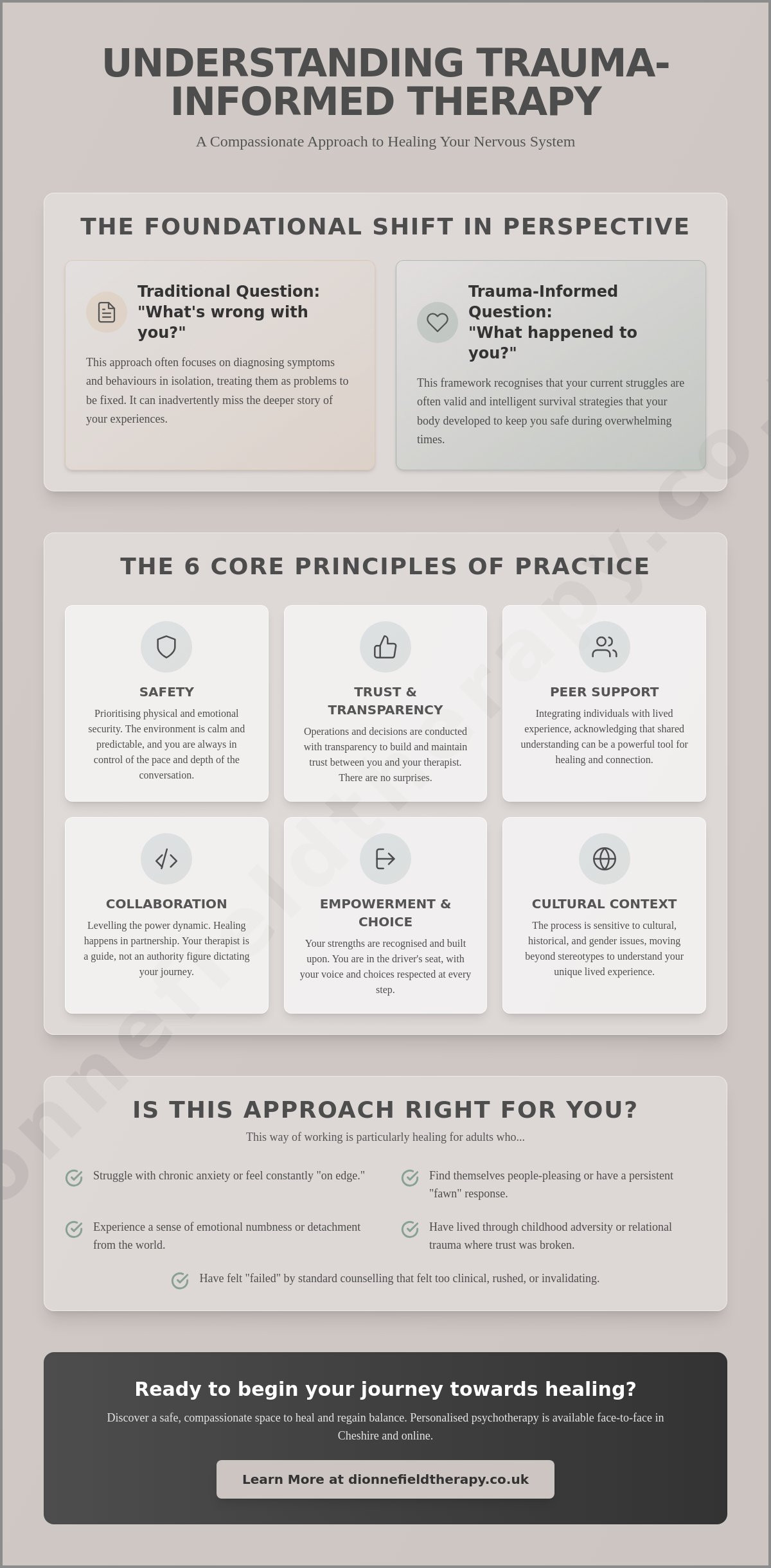
When you walk into a therapy room, the traditional approach often focuses on symptoms. You might be asked about your sleep patterns, your mood, or your ability to concentrate. Whilst these details matter, they often miss the deeper story. The most significant shift in modern psychotherapy is the move from asking “What is wrong with you?” to “What happened to you?” This isn’t just a change in wording; it’s a complete paradigm shift that recognises your struggles as valid, intelligent responses to difficult experiences. It validates that your current “symptoms” are actually survival strategies that your body developed to keep you safe during times of overwhelm.
At its heart, trauma-informed care is a framework that prioritises your emotional safety above all else. It acknowledges that trauma isn’t just a memory of a past event; it’s a lasting physiological legacy that lives in your nervous system. For many in the UK, seeking help can feel daunting. You might worry about being judged or forced to relive painful memories before you’re ready. BACP-accredited therapists who specialise in trauma informed therapy work differently. They understand that healing cannot happen if your body feels under threat, so they move at your pace, ensuring you feel grounded and in control of the process from the very first session.
The Difference Between Trauma and “Stress”
We all experience stress. It’s the pressure of a deadline or the temporary anxiety of a busy week. Trauma, however, is different. It occurs when an experience, or a series of experiences, completely overwhelms our internal capacity to cope. “Big T” traumas are the major, life-altering events like accidents or loss. “Little t” traumas are often less obvious but just as impactful; they are the persistent, cumulative experiences of being ignored, shamed, or chronically stressed. Both types can leave your nervous system stuck in a state of high alert. Trauma-informed therapy is a commitment to client safety and empowerment.
Who Can Benefit from This Approach?
This way of working is particularly healing for adults who feel they’ve reached a plateau in traditional talk therapy. If you find yourself struggling with chronic anxiety, a persistent “fawn” response like people-pleasing, or a sense of emotional numbness, this approach offers a new path forward. It’s designed for those who have lived through childhood adversity or relational trauma where trust was broken. If you’ve ever felt “failed” by standard counselling because it felt too clinical or rushed, a trauma-informed perspective provides the gentle, unhurried space you need to finally feel heard and understood.
The Core Principles of Trauma-Informed Practice
Understanding the philosophy behind this work is one thing. Experiencing it in the therapy room is quite another. How does a practitioner actually translate these high-level concepts into a session that feels different from anything you’ve tried before? Most specialists rely on a specific framework known as The Six Principles of Trauma-Informed Care. These guidelines include:
- Physical and emotional safety
- Trustworthiness and transparency
- Peer support and mutual help
- Collaboration and mutuality
- Empowerment, voice, and choice
- Cultural, historical, and gender considerations
In the context of trauma informed therapy, these values ensure that every interaction is predictable and transparent. We work to remove the “power over” dynamic often found in traditional medical settings. The goal isn’t just to talk about what happened; it’s to build a foundation where your nervous system can finally let down its guard and feel truly secure.
Safety is the Foundation of Healing
Safety isn’t just the absence of threat. It is the active presence of security. In a trauma-informed session, the physical or online environment is carefully organised to promote a sense of calm. This might mean soft lighting, a clear view of the door, or a consistent start and end time. We prioritise pacing. Many people fear that therapy means being forced to dive into their darkest memories immediately. This is never the case here. You are always in control of the direction and depth of the conversation. If a topic feels too “loud” or overwhelming, we pause. We breathe. We wait until your system feels ready to proceed. This way of working, often referred to as trauma informed therapy, ensures you never feel pushed beyond your capacity to cope.
Empowerment through Choice
Trauma is, at its core, an experience of powerlessness. Healing, therefore, must involve the restoration of your agency. This is why Individual Counselling within this framework is inherently collaborative. You are the expert on your own life; the therapist acts as a steady companion and guide rather than a distant authority figure who dictates your path. Every step involves a choice. From deciding which topics to explore to choosing the specific grounding tools that work for you, these small acts of autonomy help to “unlearn” the helplessness that trauma often leaves behind.
Focusing on your strengths is just as vital as understanding your struggles. We look for the resilience you’ve already shown whilst navigating difficult times. By highlighting your existing coping skills, we empower you to build new ones that feel sustainable. If you’re ready to explore how this collaborative approach could help you regain your sense of self, you might find it helpful to view our psychotherapy services to see how we prioritise your comfort and pace. Trust isn’t demanded; it’s earned through consistency, transparency, and a deep respect for your boundaries.
Trauma and the Nervous System: Why Your Body Remembers
Does it ever feel like your body is reacting to a ghost? Perhaps your heart races at a certain sound, or you feel a sudden, heavy exhaustion that you can’t quite explain. This happens because, as the famous phrase suggests, the body keeps the score. When we experience something overwhelming, the memory isn’t just stored as a story in our minds; it’s etched into our physiology. Traditional talk therapy can sometimes struggle to reach these deep-seated imprints because the language of the nervous system isn’t made of words. It’s made of sensations, rhythms, and survival impulses.
This is why trauma informed therapy is so essential. It acknowledges that your symptoms aren’t just “mental” issues. They are physical signals that your nervous system is stuck in a loop of past distress. Research shared by the National Center for PTSD highlights how trauma-informed approaches integrate this understanding of physiology into every session. Instead of just talking through the narrative of what happened, we look at how that experience is currently manifesting in your body. We honour the fact that your body’s reactions are intelligent attempts to protect you, even if they no longer serve your current life.
The Window of Tolerance Explained
We often talk about the “Window of Tolerance.” This is the zone where you can manage your emotions effectively and feel present in the world. When trauma dysregulates the nervous system, this window can become very narrow. You might find yourself pushed into hyper-arousal, feeling like you’re in a “fight or flight” state of constant anxiety. Alternatively, you might slip into hypo-arousal, where you feel numb, “frozen,” or shut down. Our work together helps to gently widen this window. By expanding your capacity to stay grounded, you can begin to navigate daily life without being constantly thrown into extremes of emotion.
Somatic Awareness in Practice
So, how do we reach the parts of you that words can’t touch? This is where somatic therapy in Cheshire plays a vital role. It’s a way of learning to listen to the “quiet whispers” of your body’s survival responses. In a session, we might notice the way your shoulders tighten or how your breath becomes shallow. We use simple grounding techniques, such as noticing the feeling of your feet on the floor or the weight of your body in the chair, to help you stay present. These tools aren’t just clinical exercises. They are practical ways to signal to your nervous system that you are safe in the here and now, allowing the healing process to begin from the inside out.
The Therapeutic Journey: What to Expect in a Session
Stepping into a therapy room for the first time can feel like a heavy undertaking. You might wonder if you’ll be expected to share things you’re not ready for or if the process will feel like an interrogation. In trauma informed therapy, the first session is less about clinical history-taking and more about building relational safety. This is the foundation of everything we do. It’s about ensuring you feel seen, heard, and, most importantly, secure in the presence of your therapist. We often begin with psychoeducation. This is the process of learning the “why” behind your reactions. When you understand that your brain is simply trying to protect you, the shame you may have carried often begins to lift.
A Gentle, Non-Judgmental Invitation
The rhythm of our sessions is intentionally measured. We allow for breath and pause; there is never any rush to fill the silence. You might notice the use of reflective questions that mirror your internal monologue, helping you to feel understood without being judged. There is no pressure to “perform” or “get it right” in this space. If you find yourself struggling to find words, that’s okay. We sit with the complexity together. This unhurried cadence is designed to lower your defenses and build the emotional trust necessary for deeper work to begin.
Integrating ACT and CBT
Whilst we prioritise safety, we also use evidence-based tools to help you reclaim your life. Acceptance and Commitment Therapy (ACT) is particularly helpful in this regard. It doesn’t ask you to get rid of difficult feelings; instead, it helps you move toward your values whilst carrying those feelings with more ease. We may also integrate Cognitive Behavioural Therapy (CBT) to gently challenge the negative beliefs trauma often leaves behind. If you’re weighing up your options, understanding the key differences in CBT vs psychotherapy can help you choose the most effective path for your mental well-being. These aren’t quick, temporary fixes. They are ways to build long-term cognitive flexibility and mental well-being.
What happens if a session becomes too much? We have a plan for that. We identify potential “triggers” early on and develop “anchor” points to bring you back to the present moment. If you feel overwhelmed, we stop. We use the grounding tools we’ve practiced to ensure you leave the session feeling regulated and safe. You are never left to navigate a storm alone. If you’re ready to begin this supported journey, you can enquire about psychotherapy services to find a path that respects your pace and your boundaries.
Finding Trauma-Informed Therapy in Cheshire and Online
Choosing the right support is a deeply personal decision that requires a sense of safety from the very first interaction. In a private psychotherapy setting, the focus remains entirely on your individual needs without the pressure of time-limited clinical checklists or rigid session quotas. This allows for a truly unhurried experience. When searching for a practitioner, it’s vital to check for professional accreditation, such as being registered with the BACP (British Association for Counselling and Psychotherapy). This ensures your therapist adheres to strict ethical standards and has undergone rigorous training in trauma informed therapy. Verification of specific trauma-focused training is equally important; it confirms the therapist understands the physiological complexities of the nervous system and knows how to avoid re-traumatisation.
Local Care in Sandbach and Cheshire
For those who prefer the grounding presence of a physical room, Face to Face Therapy provides a dedicated, safe environment in our therapeutic centre. We proudly serve the local communities of Sandbach, Tarporley, and Chester, whilst providing accessible support for residents in Nantwich, Northwich, and Middlewich. Our local expertise means we understand the specific needs of the Cheshire community. If travelling is a barrier or if you simply feel more secure in your own environment, Online Therapy offers the same level of secure, compassionate care. These sessions are conducted via encrypted platforms, making expert support accessible to anyone across the UK whilst maintaining the highest levels of privacy.
Taking the first step often feels like the most significant hurdle. This is why we encourage booking an initial chat. This is a low-pressure opportunity to ask questions, share what you hope to achieve, and see if we are a “good fit” for your healing journey. Trust is something that is built over time, not something that should be demanded. This initial conversation is about your comfort and your agency.
Your Path Forward with Dionne Field Therapy
At Dionne Field Therapy, we believe that you deserve a space where your history is respected and your future is empowered. Our approach is rooted in quiet strength and a commitment to sitting with complexity. We don’t rush. We don’t dictate. Instead, we offer a steady partnership as you move through the path toward emotional regulation and safety. Healing from the lasting legacy of trauma is a gradual process, but it is entirely possible. You’ve spent so long surviving; now, you can begin the work of living. You do not have to move through this transition alone.
Reclaiming Your Sense of Safety and Self
Healing isn’t about erasing the past. It’s about changing how your body carries it. We’ve explored how understanding your nervous system and the physiological legacy of trauma can shift your perspective from shame to self-compassion. By choosing a path that prioritises safety and collaboration, you’re no longer just surviving; you’re actively reclaiming your agency. This journey is about finding the “why” behind your reactions and learning to navigate the world with a renewed sense of security.
As a BACP Accredited Therapist with specialist training in CBT, ACT, and Somatic Therapy, I provide a private, safe practice for those who need an unhurried, expert approach. trauma informed therapy offers more than just a clinical checklist; it provides a steady partnership designed to help you regain your natural balance. Whether we meet at my practice in Sandbach or through secure online sessions, your comfort remains the absolute priority. Begin your journey to healing with a compassionate, trauma-informed therapist in Cheshire. You’ve carried this weight for long enough. You don’t have to walk the rest of the way alone.
Frequently Asked Questions
How is trauma-informed therapy different from regular counselling?
Trauma-informed therapy differs from traditional counselling by focusing on the physiological legacy of past events rather than just the narrative or current symptoms. Whilst regular talk therapy might dive straight into a problem, this approach prioritises the stabilisation of your nervous system first. It assumes that your current behaviours are intelligent survival strategies. By creating a foundation of safety, we ensure that the therapeutic process does not become another source of overwhelm for your system.
Do I have to talk about my traumatic experiences in detail?
You don’t have to share every detail of your past to find relief. In fact, forcing a detailed narrative can sometimes lead to re-traumatisation. We focus on how those experiences currently live in your body and affect your emotional regulation. By working with sensations and current triggers, we can process the impact of the event without needing to relive the specifics. Your comfort and your boundaries always lead the way during our sessions.
How long does it take to see results from trauma-informed care?
The timeline for healing is unique to every individual and their specific history. Some clients begin to notice a shift in their ability to self-regulate after 8 to 12 sessions; others with more complex, long-term histories may find that a longer course of psychotherapy is necessary for sustainable change. We never rush the process. True healing happens when your nervous system feels safe enough to let down its guard at its own natural pace.
Can I receive trauma-informed therapy online, or is it better in person?
Both options provide high-quality care, so the choice depends on your personal preference. Online therapy allows you to remain in a space where you already feel secure, which can be a significant advantage when starting trauma informed therapy. Face to face sessions in a dedicated centre offer a grounded, physical presence that some find more reassuring. We can discuss which environment feels most supportive for your specific needs during our initial chat.
Is trauma-informed therapy suitable for anxiety even if I do not have a PTSD diagnosis?
Yes, this approach is deeply beneficial for anyone struggling with chronic anxiety or emotional numbness. You don’t need a formal PTSD diagnosis to benefit from a perspective that honours your nervous system’s survival responses. Many people experience “Little t” traumas or relational distress that leaves them feeling constantly “on edge.” This therapy helps you understand the “why” behind your anxiety and provides practical tools to help you feel more grounded in your daily life.
What should I look for when choosing a trauma-informed therapist in the UK?
Look for a practitioner who holds BACP or UKCP accreditation and has specialist training in trauma-focused modalities. It’s important to find someone who uses a variety of tools, such as somatic therapy in Cheshire and body-based healing approaches, or what is acceptance and commitment therapy and how it supports psychological flexibility, rather than a one-size-fits-all approach. In the UK, a qualified therapist will be transparent about their qualifications and will prioritise building a predictable relationship where your choice and agency are at the centre of the work.
What happens if I get overwhelmed or “triggered” during a session?
If you feel overwhelmed, we pause the session immediately to focus on your safety. We use grounding techniques, such as noticing your physical surroundings or adjusting your breathing, to bring you back to the “here and now.” We always identify your triggers and develop a “safety plan” early in our work together. This ensures that you never feel lost in a storm of emotion without a steady companion to help you navigate back to calm.
Is this approach suitable for childhood trauma that happened a long time ago?
This approach is specifically designed to address the lasting impact of early experiences. Childhood trauma often shapes the very foundation of our nervous system and how we perceive the world as adults. Trauma informed therapy helps you gently unpick these long-standing survival patterns. Even if the events happened decades ago, your body may still be responding as if the threat is present. We work to signal to your system that you are safe today.

Article by
Dionne Field
Dionne Field is an integrative psychotherapist. She's passionate about helping clients understand themselves with greater compassion and clarity. With experience in both NHS mental health services & private practice, her work combines trauma-informed, person-centred therapy, ACT, CBT, DBT, 'parts work' & somatic therapy. Dionne believes that meaningful change happens when people feel safe, understood and empowered to reconnect with who they truly are.
Disclaimer
The information provided in this blog is intended for educational and informational purposes only and should not be considered a substitute for professional mental health advice, diagnosis, or treatment.
Whilst every effort is made to ensure the information shared is accurate and up to date, the content reflects general therapeutic knowledge and perspectives and may not be applicable to your individual circumstances.
Reading this blog does not create a therapeutic relationship between you and Dionne Field Therapy. If you are currently experiencing emotional distress, mental health difficulties, or require support specific to your situation, please seek advice from a qualified healthcare professional or mental health practitioner.
If you are in crisis, experiencing thoughts of self-harm, or feel unable to keep yourself safe, please contact your GP, NHS 111, emergency services, or an appropriate crisis support service immediately.
Any external links provided are for convenience and informational purposes only. Dionne Field Therapy is not responsible for the content, accuracy, or availability of third-party websites.
By using this website and blog, you acknowledge and accept this disclaimer.

Leave a Reply