

What if the breathless racing of your heart and the endless loop of “what if” thoughts aren’t signs that you’re broken, but simply evidence of a nervous system that has forgotten how to feel safe? It’s exhausting to live in a state of constant high alert; especially when navigating the path to professional support can feel dauntingly long. You might be asking yourself, how does CBT work for anxiety, and whether a structured approach can truly quieten the noise of a mind that never seems to rest.
We understand that seeking help is a courageous step. You deserve to know exactly what that journey looks like. This guide explores the mechanics of Cognitive Behavioural Therapy by peeling back the clinical layers to reveal a process rooted in compassion and steady recovery. It isn’t about “fixing” you… it’s about building a partnership between your mind and your body.
We’ll look at how this evidence-based approach helps you navigate the connection between your thoughts and physical sensations. By understanding the cycle of anxiety, you can begin to move from a state of overwhelm into a structured, calm environment of support.
Key Takeaways
- Explore the “Hot Cross Bun” model to see how your thoughts, physical sensations, and behaviours are intricately linked in a cycle of distress.
- Move beyond the pressure of “positive thinking” by learning cognitive restructuring techniques that anchor your mind in objective, balanced evidence.
- Understand how does CBT work for anxiety by addressing the physiological “fight-flight-freeze” response and soothing your body’s internal alarm system.
- Gain clarity on the structure of a professional therapy session, from the initial assessment to the collaborative goals that guide your steady recovery.
- Discover why a tailored, compassionate approach to therapy provides the specific tools needed to navigate your unique experience of fear and worry.
The Architecture of Anxiety: Understanding the CBT Model
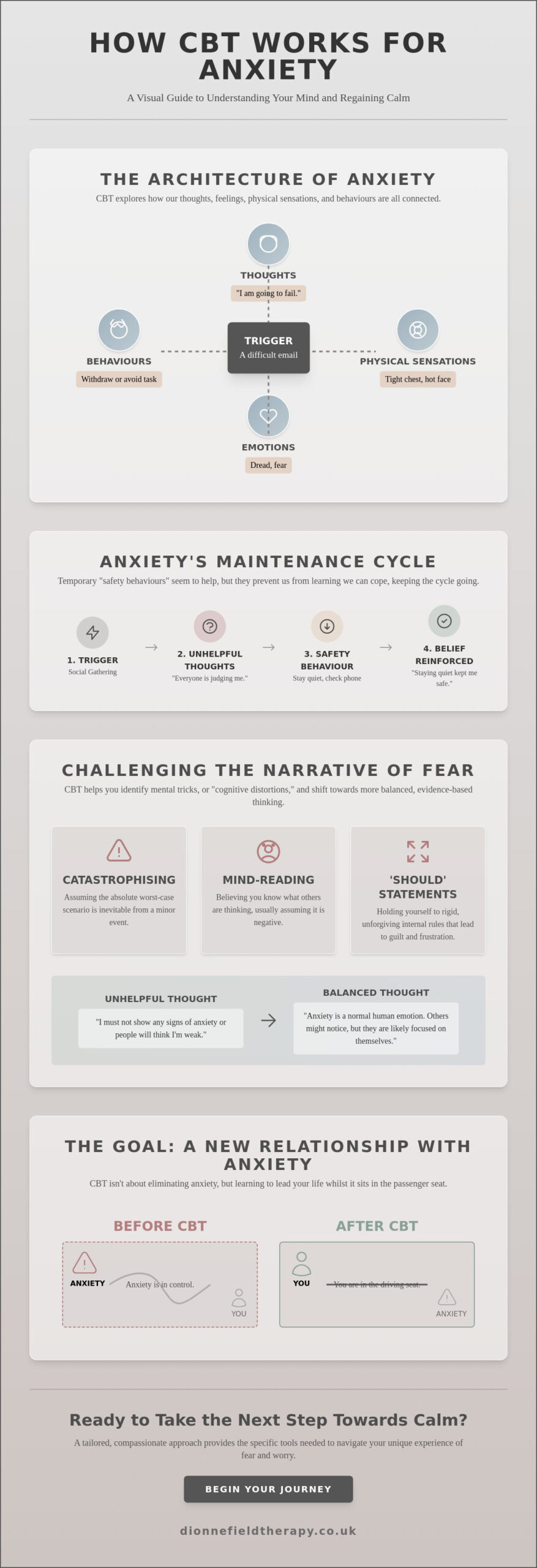
To understand how does CBT work for anxiety, we must first look at the blueprint of your internal experience. At its heart, Cognitive Behavioural Therapy is a practical, evidence-based talking therapy that examines the delicate threads connecting your thoughts, your physical feelings, and your actions. The CBT Model is often visualised through what therapists call the “Hot Cross Bun” diagram. Imagine a single, fleeting thought: “I am going to fail.” This thought immediately triggers a physical sensation, perhaps a tightening in your chest or a sudden heat in your face. That sensation leads to a feeling of dread, which might cause you to withdraw or avoid a task. Each element feeds the other, creating a self-sustaining loop of distress that can feel impossible to escape.
It is helpful to remember that anxiety is not your enemy. It is a biological survival mechanism, an ancient alarm system designed to keep you safe from predators. In our modern lives, however, this system can become “over-coupled” with triggers that aren’t actually life-threatening, such as a difficult email, a busy supermarket, or a social gathering. Your body reacts as if it’s facing a physical threat, even when the danger is purely internal. CBT doesn’t aim to delete this system or eliminate anxiety entirely. Instead, the goal is to change your relationship with these sensations. It’s about learning to lead a full, meaningful life whilst the anxiety sits quietly in the background, rather than allowing it to drive the car.
The Cycle of Maintenance
We often develop “safety behaviours” to cope with the discomfort of fear. You might avoid certain places, stay quiet in meetings, or constantly check your phone for reassurance. Whilst these actions provide temporary relief, they actually keep the anxiety alive in the long term because they prevent you from learning that the feared outcome is unlikely to happen. We also view the world through “cognitive distortions”, which are biased lenses that magnify threats and minimise your ability to cope. The maintenance cycle is the engine that powers persistent worry.
Breaking the Loop
Recovery begins when we introduce a “pause” between a trigger and your reaction. This space allows you to observe a thought without being swept away by it. A strong therapeutic alliance is essential here. You need a safe, non-judgmental space to explore these patterns without feeling exposed or “wrong”. Whilst we might acknowledge where these patterns began in your past, our work focuses on the present. We provide you with the tools to navigate today, helping you move from a state of overwhelm to one of structured, calm support through individual counselling tailored to your unique needs.
Cognitive Restructuring: Challenging the Narrative of Fear
Have you ever noticed how your mind seems to have a pre-written script for every “what if” scenario? For many, anxiety feels like a storyteller that only knows how to write tragedies. Cognitive restructuring is the therapeutic process of identifying, questioning, and eventually re-framing these unhelpful thought patterns. It is one of the most vital components in understanding how does CBT work for anxiety. Rather than forcing yourself to adopt “positive thinking”-which can often feel dismissive or fake when you’re in the middle of a panic attack-CBT encourages “balanced thinking.” This approach is rooted in objective evidence rather than the emotional intensity of the moment.
Anxiety often relies on specific “cognitive distortions,” which are essentially tricks the mind plays to keep us on high alert. You might recognise some of these in your own internal monologue:
- Catastrophising: Assuming the absolute worst-case scenario is inevitable.
- Mind-reading: Believing you know exactly what others are thinking about you, usually assuming it’s negative.
- ‘Should’ statements: Holding yourself to rigid, unforgiving rules that lead to guilt and frustration.
By keeping a structured “thought record,” you begin to step outside the storm. You become an observer of your own mind, noticing these patterns as they arise rather than being consumed by them. This distance is the first step toward Challenging the Narrative of Fear that has perhaps dominated your life for too long.
The Scientist’s Mindset
In our sessions, we often adopt the “Scientist’s Mindset.” This means treating your anxious thoughts as “hypotheses” rather than absolute truths. We use Socratic questioning to gently probe these ideas. You might ask yourself: “What is the evidence that this thought is 100% true?” or “What would I tell a dear friend who was thinking this way?” This process builds a layer of self-compassion that acts as a buffer against harsh self-criticism, allowing you to navigate your internal world with more kindness.
From Worry to Problem-Solving
It is important to distinguish between “productive worry,” which leads to a helpful action, and “unproductive rumination,” which simply keeps you trapped in a loop. Learning how does CBT work for anxiety involves building a toolkit of alternative perspectives that feel authentic to you. If you feel ready to start deconstructing these narratives, Individual Counselling in Cheshire offers a safe, professional space to begin that exploration. We work together to ensure these new perspectives aren’t just “nice ideas,” but practical tools that hold up under pressure.
Beyond the Mind: Integrating Somatic Awareness and Behaviour
Have you ever felt your heart hammer against your ribs or noticed your breath becoming shallow and tight before you’ve even had a conscious thought about what’s worrying you? Whilst we often talk about anxiety as a “mental” condition, it is a deeply physical experience. Your amygdala, the brain’s emotional smoke detector, doesn’t distinguish between a lion in the grass and a stressful deadline. It simply initiates the fight, flight, or freeze response. This is why understanding how does CBT work for anxiety must involve more than just “thinking differently.” It requires us to address the physiological alarm system that keeps your body in a state of high alert.
In our work, we bridge the gap between the mind and the body. By using somatic techniques such as grounding and intentional breathwork, we can send a message of safety back to the nervous system. This creates a foundation where Cognitive Behavioral Therapy can truly take root. When your body feels less threatened, your mind becomes more flexible. We also explore behavioural activation, which is the practice of changing what you DO to influence how you FEEL. It’s a gentle, methodical way of proving to your nervous system that you’re capable of navigating the world, even when fear is present.
Exposure and Habituation
One of the most powerful tools we use is graded exposure. This isn’t about throwing you into the deep end; instead, it’s a collaborative process of facing fears in a controlled, step-by-step manner. Through a process called habituation, your brain eventually learns that a feared situation is actually safe. We don’t force these steps. Every move is a choice we make together, ensuring you feel empowered rather than overwhelmed as you reclaim the parts of your life that anxiety has made smaller.
The Window of Tolerance
Effective therapy helps you stay within your “window of tolerance,” which is the range of emotional intensity where you can still process information without becoming flooded or shutting down. By integrating trauma-informed care, we ensure your body feels grounded whilst your mind explores difficult territory. If you’d like to understand more about this delicate balance, you might find our guide on Healing Trauma and the Nervous System helpful. Understanding how does CBT work for anxiety becomes much clearer when you see it as a partnership between your thoughts and your physical sensations.
What to Expect: The Anatomy of a CBT Session in Cheshire
Walking into a therapy room for the first time, whether it is a physical space in Sandbach or a digital one via online therapy, can feel like a daunting threshold to cross. You might wonder, how does CBT work for anxiety in the practical, minute-to-minute reality of a session? A typical session lasts for 50 minutes. It follows a structured but gentle agenda that we set together at the start of each hour. This ensures that the time feels productive and grounding, rather than aimless or overwhelming. We begin with an initial assessment. This is a patient exploration of your unique history, your current triggers, and the collaborative goals you wish to reach.
A distinctive feature of this approach is the “Home Practice” element. Whilst the session provides the map, the real transformation occurs in the days between our meetings. This is where you test out new tools and observations in the “real world” of your daily life. Because of this active, skill-building focus, CBT is generally a short-to-medium term intervention. Many people find they achieve significant shifts within 6 to 12 sessions, though the pace is always dictated by your individual comfort and the complexity of your experience.
The Collaborative Relationship
In our work, the traditional hierarchy of the “expert and the patient” is replaced by a compassionate partnership. You are the undisputed expert on your own life and internal world; I am the expert on the therapeutic tools that can help you navigate them. This tailored approach is often quite different from the high-volume NHS model. Whilst the NHS provides vital services, private therapy in Sandbach or Tarporley allows for a level of personalisation and pace that isn’t always possible in a system under immense pressure. If you’re weighing your options and looking for anxiety therapy in Cheshire, understanding the difference between private and NHS provision can help you make a more informed choice. It’s also vital to ensure your therapist holds BACP accreditation, which guarantees they adhere to the highest ethical and professional standards in the UK.
Tracking Your Progress
We don’t just hope things are getting better; we look for evidence of your steady recovery. We use clinical measures and regular personal reflections to track your journey, ensuring we can see the small victories that anxiety often tries to hide. If a particular technique feels stuck, we have the flexibility to adjust our approach. This is the benefit of working with an integrative therapist who can blend CBT with other evidence-based methods. You can find more details about my professional background on the Dionne Field on Counselling Directory profile. If you’re ready to begin this process, you can enquire about individual therapy to start your path towards calm.
Is CBT Right for You? Taking the Next Step Towards Calm
Deciding to start therapy is a significant moment of self-advocacy. You might still be wondering, after exploring the mechanics of the process, how does CBT work for anxiety in the context of your specific life? This approach is highly effective for a wide range of experiences, including Generalised Anxiety Disorder (GAD), social anxiety, panic disorder, and health anxiety. However, a “one-size-fits-all” model rarely provides the deep, lasting relief you deserve. The true value of private therapy lies in a tailored plan that respects your individual pace and history, rather than following a rigid, high-volume checklist.
The mechanics of how does CBT work for anxiety are most powerful when they meet a sense of readiness. This doesn’t mean you must feel “ready” to be cured or even feel particularly brave. It simply means being open to the possibility of trying new ways of thinking and behaving, even if it feels a little uncomfortable at first. We work together to ensure you never feel pushed beyond your limits. Whether you choose the grounding presence of face-to-face sessions in Cheshire or the accessibility of secure online therapy, the focus remains on creating a safe space for your evolution.
CBT for Health Anxiety
For those whose anxiety focuses on physical health, the cycle of scanning and checking can be particularly exhausting. We offer specific support for these concerns, helping you navigate the fine line between sensible health awareness and the distress of constant body-monitoring. In our sessions, CBT helps you distinguish between “helpful” health checks and “anxious” body checking that keeps your nervous system in a state of alarm. You can explore this further in our guide on CBT for Health Anxiety Myths.
Your Path to Recovery
The first step is often the hardest. It takes profound courage to acknowledge that you’ve been trapped in a cycle of “what if” thoughts and physical symptoms for too long. Seeking help isn’t a sign of weakness; it’s a sign that you’re ready to reclaim your life from the noise of anxiety. An initial consultation is a gentle, low-pressure way for us to meet and see if we are a good fit for your journey. We can discuss your goals and begin to map out a path that feels manageable and supportive. When you feel ready, Contact Dionne Field Therapy to begin your journey towards a more steady and peaceful way of being.
Beginning Your Journey to Steady Recovery
You don’t have to navigate the exhausting cycle of “what if” thoughts alone. By exploring how does CBT work for anxiety, you’ve already begun to deconstruct the fear that has held you back for too long. We have seen how your thoughts, physical sensations, and behaviours are intricately woven together; and how a compassionate, structured approach helps you untangle them. Whether we are soothing the physiological alarm of your nervous system or re-framing the narratives that keep you stuck, the focus remains on restoring your sense of safety and agency.
As a BACP Accredited therapist, I provide a trauma-informed space that prioritises your unique history and comfort. Real transformation occurs when you feel deeply understood in a secure environment. If you’re ready to move beyond overwhelm and into a path of steady recovery, I invite you to reach out for support. I offer flexible face-to-face sessions in Sandbach and secure online therapy to suit your needs.
Book a consultation for CBT in Sandbach or Online to start your journey. You’ve carried the weight of anxiety for long enough; it’s okay to let a steady companion walk beside you now.
Frequently Asked Questions
Is CBT just about positive thinking?
No, CBT is about developing “balanced thinking” rather than simply forcing a positive outlook. We don’t ignore the difficult aspects of your life; instead, we look at the objective evidence for your anxious thoughts. This process helps you move away from catastrophic “what if” scenarios towards a more grounded reality. It’s a way of navigating life’s complexities without being overwhelmed by a narrative of fear.
How many sessions of CBT will I need for anxiety?
Most people find that a course of 6 to 12 sessions provides significant relief and lasting change. Whilst the NHS often offers up to 15 sessions for generalised anxiety, private therapy allows us to tailor the duration to your specific needs. For more complex concerns, such as social anxiety, clinical guidelines suggest up to 16 sessions. We’ll regularly review your progress together to ensure the pace feels right.
Can CBT help with physical symptoms like chest pain or dizziness?
Yes, CBT is highly effective at addressing the physical sensations of panic and worry. Understanding how does CBT work for anxiety involves learning how your thoughts trigger the body’s “false alarm” system. By using somatic techniques and cognitive re-framing, you can learn to soothe your nervous system. This reduces the intensity of physical symptoms like breathlessness or heart racing as your body begins to feel safe again.
What is the difference between CBT and traditional counselling?
Traditional counselling is often more exploratory, providing a space to process feelings and past experiences. In contrast, CBT is highly structured and goal-oriented, focusing on the specific links between your current thoughts and behaviours. It’s a collaborative, skill-building process where we work together to develop practical tools for your daily life. Whilst both are valuable, CBT provides a specific framework for breaking the maintenance cycle of persistent worry.
Do I have to talk about my childhood in CBT?
We primarily focus on the “here and now” to provide you with tools for your current life. Whilst we might briefly explore your past to understand how certain thinking patterns or “cognitive distortions” developed, we don’t spend months dissecting childhood events. The goal is to understand your unique history just enough to help you navigate your present more effectively and build a path toward steady recovery.
What happens if I can’t do the ‘homework’ or home practice?
Home practice is a collaborative tool for your growth, not a school assignment you’ll be judged on. If you find it difficult to complete, we’ll gently explore the barriers together in our next session. Perhaps the task felt too large or triggered a specific fear we haven’t addressed yet. We’ll adjust the plan to ensure it feels manageable, as these small steps between sessions are where you build confidence.
Is online CBT as effective as face-to-face therapy?
Research consistently shows that online therapy is just as effective as face-to-face sessions for treating anxiety and stress-related disorders. It offers a secure and accessible way to receive professional support from the comfort of your own home, which can be particularly helpful if your anxiety makes travel difficult. The most important factor is the quality of the therapeutic relationship and the safety of the environment we create together.
How do I know if my therapist is properly qualified?
You should always verify that your therapist is registered with a recognised professional body in the UK. Look for accreditation from the British Association for Counselling and Psychotherapy (BACP) or the British Association for Behavioural and Cognitive Psychotherapies (BABCP). These organisations ensure that therapists meet high ethical standards and maintain their professional training, providing you with a safe, reliable, and academically rigorous environment for your therapy.

Article by
Dionne Field
Dionne Field is an integrative psychotherapist. She's passionate about helping clients understand themselves with greater compassion and clarity. With experience in both NHS mental health services & private practice, her work combines trauma-informed, person-centred therapy, ACT, CBT, DBT, 'parts work' & somatic therapy. Dionne believes that meaningful change happens when people feel safe, understood and empowered to reconnect with who they truly are.
Disclaimer
The information provided in this blog is intended for educational and informational purposes only and should not be considered a substitute for professional mental health advice, diagnosis, or treatment.
Whilst every effort is made to ensure the information shared is accurate and up to date, the content reflects general therapeutic knowledge and perspectives and may not be applicable to your individual circumstances.
Reading this blog does not create a therapeutic relationship between you and Dionne Field Therapy. If you are currently experiencing emotional distress, mental health difficulties, or require support specific to your situation, please seek advice from a qualified healthcare professional or mental health practitioner.
If you are in crisis, experiencing thoughts of self-harm, or feel unable to keep yourself safe, please contact your GP, NHS 111, emergency services, or an appropriate crisis support service immediately.
Any external links provided are for convenience and informational purposes only. Dionne Field Therapy is not responsible for the content, accuracy, or availability of third-party websites.
By using this website and blog, you acknowledge and accept this disclaimer.
Leave a Reply