

What if the secret to finding peace isn’t actually about getting rid of your painful thoughts at all? If you’ve spent years feeling exhausted by the constant struggle against anxiety, you might be asking yourself, what is acceptance and commitment therapy, and how does it differ from the traditional approach of trying to ‘fix’ your internal world? It’s a heavy burden to carry… that sense of being completely stuck whilst you wait for the ‘bad’ feelings to disappear before you can finally start living. You aren’t doing life wrong because you feel pain; you’re simply human.
You’ve likely tried every trick to silence your inner critic, only to find the volume stays just as loud. This guide will show you how ACT can help you coexist with difficult emotions without letting them take the lead. We’ll explore the core principles of psychological flexibility and how clarifying your true values can empower you to take small, purposeful steps towards a life that feels rich and meaningful. Backed by extensive research, including numerous meta-analyses comprising hundreds of studies, consistently confirming its effectiveness, we’ll see how this approach offers a steady, reliable path forward.
Key Takeaways
- Understand what is acceptance and commitment therapy and why viewing suffering as a natural human experience can help lower your emotional defences.
- Discover the six pillars of the ‘Hexaflex’ designed to help you unhook from intrusive thoughts and reclaim your sense of agency.
- Compare ACT with traditional CBT to see why changing your relationship with your feelings is often more sustainable than trying to control them.
- Learn how a trauma-informed approach to ACT can help you navigate anxiety whilst honouring your unique history and personal boundaries.
- Gain clarity on how to transition from feeling ‘stuck’ to taking small, value-led steps forward with the support of an accredited psychotherapist.
Table of Contents
-
Understanding the Heart of Acceptance and Commitment Therapy (ACT)
-
The Six Core Processes: Building Your Psychological Flexibility
-
Is ACT Right for You? Addressing Anxiety, Trauma, and Life’s Challenges
Understanding the Heart of Acceptance and Commitment Therapy (ACT)
When you first begin to wonder, what is acceptance and commitment therapy, it’s helpful to look past the clinical labels and see the human invitation at its core. ACT is a modern, evidence-based behavioural therapy that suggests a radical alternative to our usual struggle: instead of trying to ‘fix’ our difficult thoughts, we can learn to change our relationship with them. It provides a safe, grounded space to explore your internal world without the pressure of judgement or the need to immediately change how you feel.
In this therapeutic space, we start from the premise that suffering isn’t a ‘glitch’ in your system or a sign that you’re failing at life. It’s a natural, albeit painful, part of being human. The ultimate goal is to build psychological flexibility. This is the ability to stay present in the moment, even when things are difficult, and to take action that aligns with what truly matters to you. It’s about opening up to the full spectrum of your experience so you can move forward with purpose.
The Shift from ‘Fixing’ to ‘Flourishing’
Many of us spend a lifetime trying to delete ‘bad’ thoughts or suppress anxiety, but this often makes those very feelings more persistent and loud. In ACT, we call this ‘experiential avoidance’. It’s the natural instinct to run away from pain, yet it’s often the very thing that keeps us stuck. When we stop the exhausting work of trying to eliminate discomfort, we free up energy to focus on flourishing. You don’t have to wait for the anxiety to disappear before you start living a life of meaning; you can learn to carry it with you whilst you move towards what you love.
A Brief History of ACT and its Evidence Base
Originating in the 1980s, ACT is part of the ‘third-wave’ of behavioural therapies. It evolved from traditional Cognitive Behavioural Therapy by incorporating mindfulness and acceptance strategies into its framework. You can find a detailed overview of the development of Acceptance and Commitment Therapy on Wikipedia, which highlights its strong theoretical roots in functional contextualism.
The evidence supporting this approach is substantial and continues to grow. A 2026 meta-analysis of 263 studies, involving 21,830 participants, found that ACT interventions led to a significant reduction in depression symptoms. Research on ACT has grown significantly since 2015, with 799 articles from 52 countries identified in a 2022 bibliometric analysis. Whether you’re navigating anxiety, trauma, or the weight of everyday life, ACT offers a scientifically rigorous yet deeply compassionate path towards healing.
The Six Core Processes: Building Your Psychological Flexibility
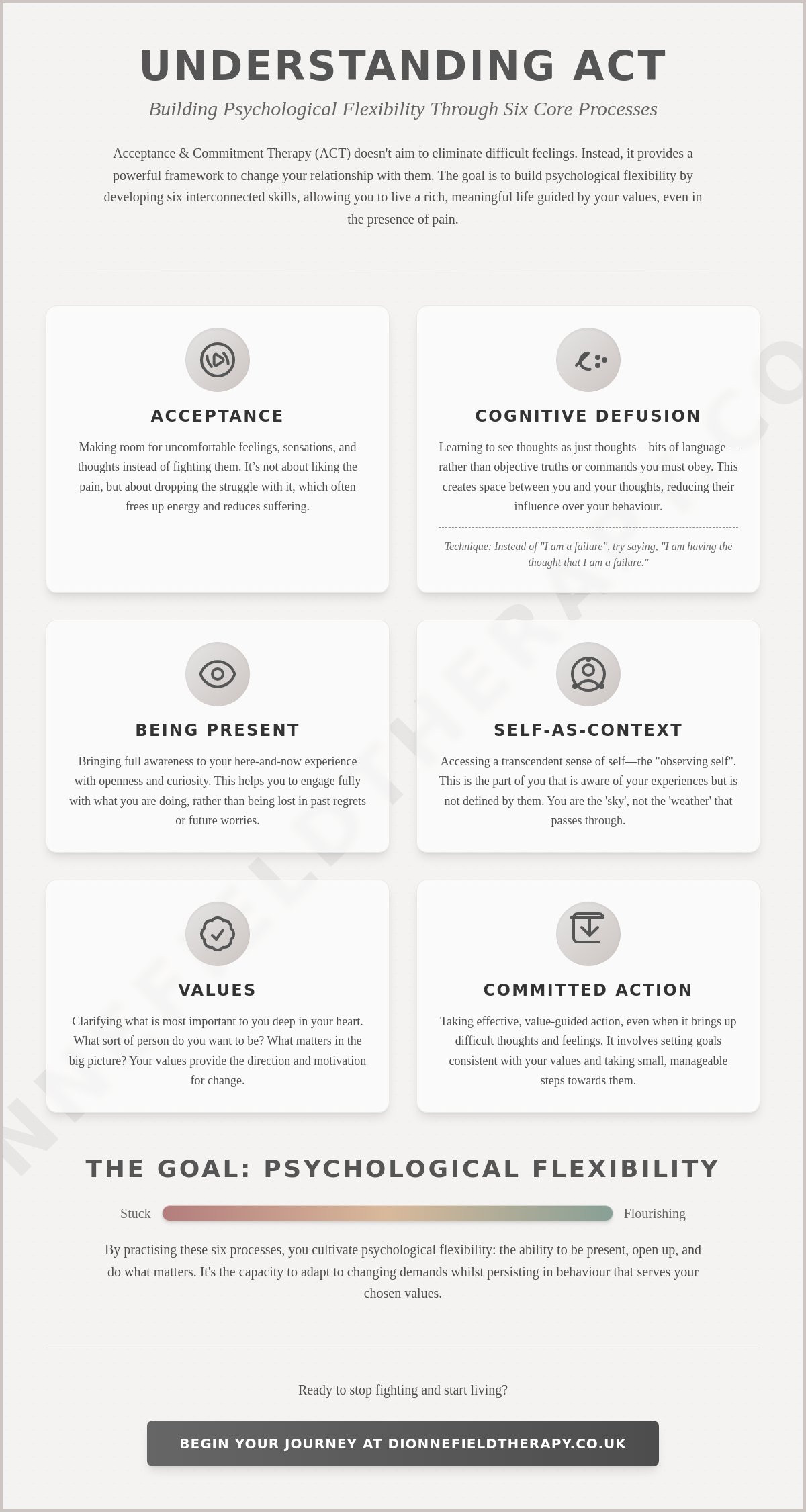
To truly understand what is acceptance and commitment therapy, we must look at the ‘Hexaflex’. This model represents six core processes that work in harmony to build your psychological flexibility. Think of these as six distinct skills you can develop to help you unhook from the internal struggles that keep you stuck. This model illustrates how Acceptance and Commitment Therapy works by targeting the way you interact with your internal world, rather than just the thoughts themselves. As your therapist, I act as a steady guide, helping you navigate these transformative skills until they become natural tools for your daily life.
Acceptance and Cognitive Defusion
Acceptance isn’t about liking your pain or resigning yourself to it. It’s about making room for uncomfortable feelings instead of fighting them. When you stop the struggle, the feeling often loses its power over you. Cognitive Defusion is the partner to this. It’s the art of seeing a thought as just a collection of words or a mental event, rather than an absolute truth. A simple but powerful technique is to preface a difficult thought with the phrase, "I am having the thought that…" This small shift creates the mental space needed to breathe and observe, rather than react.
Present Moment Awareness and Self-as-Context
Being present is about connecting with the ‘here and now’ through gentle mindfulness. It’s easy to get lost in worries about the future or regrets about the past; presence brings you back to the safety of the current moment. This helps regulate the nervous system during periods of intense overwhelm. Self-as-Context introduces you to the ‘observing self’. This is the part of you that remains steady and unchanged, even whilst your emotions and thoughts shift like the weather. It provides a grounding perspective that you are more than your current distress.
Values and Committed Action
Values are the compass for your life. They aren’t goals you can tick off a list; they are ongoing qualities of being. For instance, ‘being a supportive parent’ is a value, whereas ‘taking the kids to the park’ is a goal. Once you identify what truly matters to you, beyond your anxiety or trauma, you can begin ‘Committed Action’. This involves taking small, purposeful steps that align with those values, even when it feels difficult. If you’re looking to explore this process more deeply, our guide to values-based living ACT offers practical tools to help you gain clarity on your priorities and use your deepest beliefs as a compass for your nervous system. These aren’t just abstract concepts. They are practical tools for real life, whether you’re at home in Sandbach or navigating a busy career. If you feel ready to explore how these processes can support your well-being, you might consider individual counselling as a compassionate starting point for your journey.
ACT vs CBT: Choosing the Right Path for Your Well-being
Choosing a therapeutic path can feel like standing at a crossroads whilst you’re already feeling overwhelmed. You might have already heard of Cognitive Behavioural Therapy (CBT), which has long been a prominent evidence-based approach. But as you explore what is acceptance and commitment therapy, you’ll find a distinct shift in focus. Whilst CBT often encourages you to challenge, dispute, and eventually change the content of your negative thoughts, ACT takes a different stance. It suggests that the problem isn’t the thought itself, but how much power we give it.
Many people come to therapy feeling a sense of failure because they ‘can’t stop thinking this way’. If you’ve ever felt that your brain is simply stuck on a loop of anxiety, the idea of having to ‘fix’ those thoughts can feel like an impossible mountain to climb. When asking what is acceptance and commitment therapy, many are surprised to learn it doesn’t ask you to change the way you think; it asks you to change how you relate to those thoughts. You can find a deeper dive into the formal definitions of Acceptance and Commitment Therapy (ACT) through the Association for Contextual Behavioral Science, which highlights this functional approach.
When to Choose ACT Over Traditional CBT
For some, the process of constantly monitoring and challenging thoughts feels like a full-time job. It can be exhausting. This is often why ACT is preferred for deep-seated trauma or chronic conditions where thoughts might be very ‘sticky’ and resistant to change. Instead of fighting a war with your mind, we work on laying down the weapons. In some cases, your journey might involve elements of both, using CBT tools for specific symptom management whilst using ACT to build a broader sense of purpose. If you’re weighing up your options, our detailed guide on CBT vs psychotherapy can help you understand which approach might be the right map for your internal world.
The Action-Oriented Nature of ACT
ACT often feels less like a traditional ‘talking cure’ and more like a series of experiential discoveries. We use metaphors and practical exercises to help you ground yourself in the present. It’s a dynamic, lived process. It’s helpful to remember that ACT doesn’t require you to ‘feel better’ before you can ‘live better’. You don’t have to wait for the storm to pass to start moving towards what matters; you can learn to navigate the boat whilst the waves are still high.
Is ACT Right for You? Addressing Anxiety, Trauma, and Life’s Challenges
Are you wondering if this approach fits your specific struggle? When exploring what is acceptance and commitment therapy, it’s helpful to see how it applies to the messy, real-world challenges we face daily. Whether you’re dealing with a persistent sense of worry or the echoes of past experiences, ACT offers a framework that respects your limits. One key concept we often explore is the ‘Window of Tolerance’. This is the emotional zone where we can effectively manage our feelings without becoming overwhelmed or shutting down. ACT helps you stay within this window, or gently return to it when life feels like it’s becoming too much. For those seeking support in Cheshire, having a local, grounded space to explore these tools can make a significant difference to your recovery.
ACT for Anxiety and Perfectionism
Anxiety often stems from a desperate need for certainty. We want to know exactly how things will turn out before we take a single step. This can lead to the paralysis of perfectionism. By ‘unhooking’ from these demands for certainty, you can lower your anxiety levels and start moving again. In a workplace setting, this might mean accepting the thought "I might fail" whilst still completing a project. In relationships, it allows you to stay present with a partner even when you feel vulnerable. You learn that you don’t need to be certain to be brave. It’s about taking action despite the presence of doubt. This same principle applies powerfully to those who struggle in social situations; if you find that fear of judgement or the "freeze" response holds you back from connecting with others, exploring ACT for social anxiety can offer a compassionate, practical path towards stepping out of avoidance and loneliness. This resilience is also a cornerstone of healthy parenting; for example, Tracy Kimberg discusses how a parent’s journey towards self-esteem can significantly bolster a teenager’s confidence.
Healing from Trauma with Compassionate Acceptance
For those who have experienced trauma, traditional ‘exposure’ can sometimes feel too intense or even unsafe. This is where the intersection of ACT and trauma-informed therapy becomes so vital. It’s a gentle, safe approach that prioritises your sense of security above all else. We don’t rush into the pain. Instead, we build a foundation of compassionate acceptance. This approach complements somatic therapy by acknowledging how your body carries the weight of the past. The therapeutic relationship itself becomes a ‘secure base’ where you can slowly explore your history without being retraumatised. When considering what is acceptance and commitment therapy for trauma, think of it as a way to reclaim your life from the past.
If you find yourself stuck in a cycle of avoidance or feeling overwhelmed by your history, you don’t have to navigate it alone. ACT provides the map, but the journey is yours to take at your own pace. If you’re ready to find a way through the fog, you can book a face-to-face therapy session in Sandbach to begin your recovery in a safe, non-judgmental environment.
Beginning Your Journey: ACT Therapy in Cheshire and Beyond
Stepping into a therapy room for the first time can feel like a significant threshold to cross. You might find yourself wondering, what is the actual experience like once you move past the theory? When you explore what is acceptance and commitment therapy in a professional setting, the first thing you’ll notice is the atmosphere. It isn’t a place for clinical ‘correction’ or cold assessment; it’s a gentle invitation into a safe, non-judgmental space. Here, your internal struggle is met with sensitivity and a grounding presence designed to lower your defences. It’s a partnership where we move at your pace, ensuring that the process of looking inward feels supported and unhurried.
This is where having individual counselling in Cheshire becomes a truly transformative tool. By integrating the principles of ACT into our work, we focus on building long-term well-being that doesn’t rely on ‘feeling perfect’ before you can start living. We look at the practicalities of your life; your worries, your values, and the small, meaningful steps you can take today. Choosing a BACP-accredited therapist ensures that your journey is guided by ethical rigour and professional standards, providing you with the quiet confidence that you’re in safe hands.
Finding a Steady Companion in Your Therapist
Do you ever feel like you’ve been carrying your internal weight entirely on your own? The role of a therapist in ACT is that of a steady companion or a seasoned guide. It’s less about someone dictating a path for you and more about someone walking alongside you as you discover your own. The ‘fit’ between us is perhaps the most vital factor for your success. At Dionne Field Therapy, I prioritise building immediate emotional trust, creating a sanctuary where you can be truly seen and heard. When asking what is acceptance and commitment therapy, you’ll find the answer lies just as much in the relationship we build as it does in the techniques we use.
Flexible Options: Face-to-Face or Online Therapy
Your path to healing should fit into the rhythm of your life, not add to its pressures. For those who value the grounding nature of physical presence, I offer face-to-face therapy in Sandbach, Middlewich & Tarporley, near Chester. These sessions provide a dedicated, physical space away from the noise of daily life. If you prefer the comfort and privacy of your own home, secure online therapy makes ACT accessible regardless of your location. Whether we meet in person or through a screen, the goal remains the same: to move you from a state of overwhelm to one of structured, calm support. You don’t have to navigate these difficult waters alone; a compassionate starting point is just a conversation away.
Finding Your Way Forward with Compassion
Understanding what is acceptance and commitment therapy marks the beginning of a shift from constant internal struggle to a life of purposeful presence. We’ve explored how building psychological flexibility allows you to carry difficult emotions whilst still moving towards the things you value most. It’s a journey of learning that you don’t need to ‘fix’ your thoughts to live a rich and meaningful life. Whether you’re navigating the weight of past trauma or the exhaustion of daily anxiety, these tools offer a steady, evidence-based path to reclaiming your agency.
As a BACP Accredited Therapist specialising in anxiety and trauma-informed care, I am here to act as a steady companion on your path to recovery. I offer flexible face-to-face sessions in my Cheshire locations, and secure online therapy to ensure you can access support in a way that feels safest for you. You don’t have to wait for your difficult feelings to disappear before you start living the life you choose.
Take the first step toward a values-led life and book a consultation with Dionne today.
You have the strength to sit with complexity and the capacity to grow. Your journey towards a more flexible, meaningful life can begin exactly as you are.
Frequently Asked Questions
Is Acceptance and Commitment Therapy the same as mindfulness?
Mindfulness is a core component of ACT, but it is not the entire process. Whilst mindfulness helps you stay present and observant, ACT uses that presence as a foundation for taking ‘committed action’ towards your personal values. It’s about being present so you can do what truly matters to you, rather than just sitting with your thoughts.
Can ACT help with severe anxiety or panic attacks?
Yes, ACT is highly effective for managing severe anxiety and panic. Instead of trying to force the panic to stop, which often increases distress, you learn to ‘unhook’ from the terrifying thoughts and physical sensations. This shift in relationship often reduces the intensity of the anxiety because you’re no longer caught in an exhausting struggle against it.
How many sessions of ACT therapy will I typically need?
The number of sessions varies depending on your unique history and the complexity of your challenges. Many people find that between 12 and 20 sessions provide enough time to deeply integrate the six core processes into their daily lives. We will always work at a pace that feels safe, manageable, and respectful of your boundaries.
Do I have to stop feeling bad to start ACT therapy?
You don’t have to wait until you feel ‘better’ or ‘calmer’ to begin this work. In fact, a key part of understanding what is acceptance and commitment therapy is learning that you can take meaningful steps towards your goals even whilst carrying difficult emotions. ACT empowers you to live a rich life alongside your feelings, not in spite of them.
Is ACT better than CBT for trauma recovery?
Neither is objectively ‘better’, but many find ACT more supportive for trauma because it is less confrontational. It doesn’t require you to prove your thoughts are ‘wrong’ or ‘irrational’, which can be invalidating for trauma survivors. Instead, it focuses on compassionate acceptance and building a life that feels safe and purposeful after difficult experiences. For a fuller picture of how these approaches compare, you may find it helpful to explore the key differences between CBT vs psychotherapy and what each method offers for anxiety recovery.
What happens if I find it hard to ‘accept’ my feelings?
It’s perfectly normal to find the concept of ‘acceptance’ difficult or even frightening at first. Most of us have spent a lifetime trying to push pain away. In therapy, we don’t demand immediate acceptance; we gently explore your resistance and slowly build the skill of ‘making room’ for feelings at a pace that feels right for you.
How do I find a qualified ACT therapist in Cheshire?
When searching for support in Cheshire, it’s important to look for a therapist who is BACP accredited and has specific training in ACT. I provide face-to-face therapy in Sandbach and the surrounding areas, offering a grounded and professional space for you to explore these tools. You can also check professional directories for local accredited practitioners.
Can I do ACT therapy online effectively?
Online therapy is an incredibly effective way to engage with ACT. Since the therapeutic processes involve mental exercises, metaphors, and value-setting, they translate perfectly to a secure digital environment. It offers you the flexibility to do deep, transformative work from the comfort and privacy of your own home whilst maintaining a strong therapeutic connection.

Article by
Dionne Field
Dionne Field is an integrative psychotherapist. She's passionate about helping clients understand themselves with greater compassion and clarity. With experience in both NHS mental health services & private practice, her work combines trauma-informed, person-centred therapy, ACT, CBT, DBT, 'parts work' & somatic therapy. Dionne believes that meaningful change happens when people feel safe, understood and empowered to reconnect with who they truly are.
Disclaimer
The information provided in this blog is intended for educational and informational purposes only and should not be considered a substitute for professional mental health advice, diagnosis, or treatment.
Whilst every effort is made to ensure the information shared is accurate and up to date, the content reflects general therapeutic knowledge and perspectives and may not be applicable to your individual circumstances.
Reading this blog does not create a therapeutic relationship between you and Dionne Field Therapy. If you are currently experiencing emotional distress, mental health difficulties, or require support specific to your situation, please seek advice from a qualified healthcare professional or mental health practitioner.
If you are in crisis, experiencing thoughts of self-harm, or feel unable to keep yourself safe, please contact your GP, NHS 111, emergency services, or an appropriate crisis support service immediately.
Any external links provided are for convenience and informational purposes only. Dionne Field Therapy is not responsible for the content, accuracy, or availability of third-party websites.
By using this website and blog, you acknowledge and accept this disclaimer.
Leave a Reply