

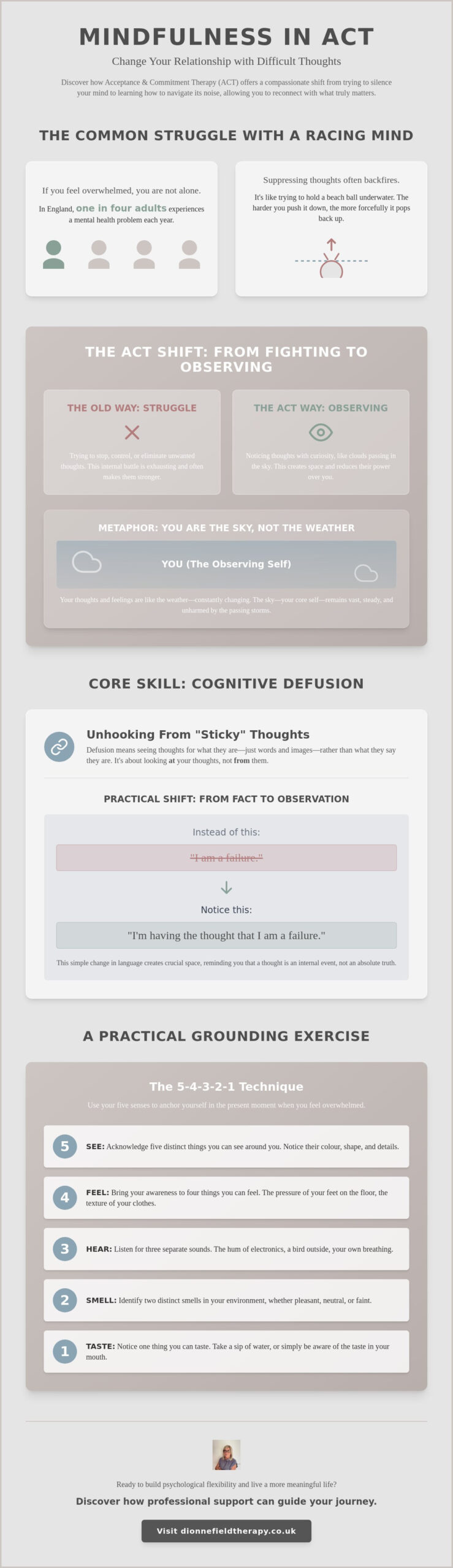
What if the goal of mindfulness isn’t to clear your mind of every noisy thought, but to simply change how much power those thoughts have over you? It’s a common frustration to find traditional meditation feels too passive, especially when you’re amongst the one in four adults in England who experience a mental health problem each year. If you’ve ever felt disconnected from the present because of a racing mind, you aren’t alone. Discovering mindfulness in ACT therapy offers a compassionate shift in perspective. It isn’t about silencing the internal noise; it’s about learning to navigate difficult thoughts so they no longer control your life.
You likely want to feel more grounded and present, yet the weight of worry can make that feel out of reach. This guide will show you how the unique approach of Acceptance and Commitment Therapy (ACT) provides practical tools to handle difficult emotions with kindness. We’ll explore how this therapeutic framework supports your mental well-being, helping you move from a state of overwhelm to a place where you can reconnect with your values and what truly matters.
Key Takeaways
- Move beyond the struggle of trying to “stop” your thoughts by adopting the practice of cognitive defusion, which helps you see them as mere words or images.
- Explore why mindfulness in ACT therapy is a powerful tool for building psychological flexibility, allowing you to stay present even amongst difficult feelings.
- Master practical grounding exercises, such as the 5-4-3-2-1 technique, to anchor yourself in the moment when worry begins to take hold.
- Overcome the myth that a busy mind prevents mindfulness by learning to observe your internal dialogue without judgment or frustration.
- Discover how working with a therapist can provide a safe space to tailor these strategies to your personal journey and long-term well-being.
What is Mindfulness in ACT Therapy?
Have you ever tried to stop a difficult thought, only to find it shouting louder in the back of your mind? Many of us approach mindfulness as a way to “clear” the head or reach a state of perfect calm. However, mindfulness in ACT therapy takes a different path. It isn’t about emptying your mind of its contents or forcing yourself to feel relaxed. Instead, it’s about noticing what’s happening right now, without trying to change it. In this context, mindfulness is the act of paying attention with openness, curiosity, and flexibility.
This approach is a cornerstone of Acceptance and Commitment Therapy, where the goal is to build psychological flexibility. This flexibility allows you to stay present even when things feel heavy or uncertain. Unlike traditional meditation, which often requires a quiet room and a cushion, ACT mindfulness is designed for real life. You don’t need to feel calm to be mindful. You can be mindful whilst feeling anxious, angry, or overwhelmed. It’s about how you relate to those feelings, rather than the feelings themselves.
The Shift from “Stopping” to “Observing”
When we try to suppress anxiety, it often behaves like a beach ball pushed underwater; the harder we press down, the more forcefully it pops back up. This internal battle is exhausting. Mindfulness helps you drop the “struggle switch” with your emotions. Instead of fighting the thought, you learn to observe it from a safe vantage point. We call this “the observing self.” It’s the part of you that notices your thoughts and feelings without being consumed by them. Think of yourself as the sky and your thoughts as the weather. The weather changes constantly, sometimes stormy and sometimes clear, but the sky remains vast, steady, and unaffected by the clouds passing through it.
Why ACT Mindfulness is Different
In many practices, the focus is on the technique itself. In ACT, the focus is on “workability.” Does holding onto this thought help you live the life you want? Does it help you move toward your values? This practical focus makes mindfulness in ACT therapy highly integrated into your daily routine. You might practice it whilst washing the dishes, walking the dog, or sitting in a stressful meeting. It’s about being “eyes-open” and fully engaged with your world. You can explore how this process connects to the wider ACT Pillar framework to see how it supports your overall journey toward well-being. By focusing on functional outcomes, you’re no longer just “meditating”; you’re actively navigating your life with more intention and less reactivity.
The Four Pillars of Mindfulness in Acceptance and Commitment Therapy
Whilst the full ACT model involves six core processes, your daily practice often rests upon four central pillars. These aren’t just abstract clinical concepts. They are practical skills that help you move through the world with more ease and intention. Understanding mindfulness in ACT therapy means seeing how these pillars work together to support your mental well-being, moving you from a state of struggle to one of quiet observation.
Recent research on mindfulness in ACT continues to highlight how these specific processes contribute to long-term emotional resilience. By focusing on these pillars, you aren’t just learning a technique; you’re developing a new way of being with yourself. If you find these pillars difficult to navigate alone, exploring Acceptance and Commitment Therapy with a professional can help you build these skills at your own pace.
Cognitive Defusion: Creating Space Between You and Your Thoughts
Cognitive defusion is the art of unhooking from the “sticky” thoughts that often dictate our mood. Think of the “Hands as Thoughts” metaphor. Imagine holding your hands tightly over your eyes. In this state, you can’t see the world clearly; you only see the “hands” of your anxiety or self-doubt. Defusion is the act of slowly lowering your hands. The thoughts are still there, but they no longer obscure your view. Defusion is about looking at thoughts rather than from them. Instead of believing “I am a failure,” you might notice, “I’m having the thought that I’m a failure.” This simple shift creates the space needed to choose how you want to respond, rather than reacting on autopilot.
Acceptance: Opening Up to Your Experience
Acceptance is perhaps the most misunderstood pillar. It’s not about liking your pain or wanting to feel anxious. It’s simply about acknowledging the presence of discomfort without trying to push it away. When we fight our feelings, we create a secondary layer of suffering. Acceptance involves making room for difficult feelings so they don’t overwhelm you. You might use somatic awareness to “breathe into” the physical sensations of anxiety, such as a tight chest or a racing heart. By meeting these sensations with self-compassion, you stop the internal war. You’re no longer a victim of your emotions; you’re a compassionate host for them.
The remaining pillars, Contact with the Present Moment and Self-as-Context, provide the foundation for this work. Present moment awareness keeps you anchored in the “here and now,” preventing your mind from drifting into past regrets or future worries. Self-as-context reinforces the idea that you are the steady container in which all these experiences happen. You are the space where thoughts, feelings, and sensations arise and fall. When you lean into these pillars, you begin to see that while you cannot always control the weather of your mind, you can always choose how to stand amongst the rain.
How to Practice ACT Mindfulness: A Step-by-Step Guide
If you’ve ever felt that your brain is simply too busy for traditional meditation, you’re in the right place. Many people find the idea of “quieting” the mind intimidating or even impossible. Within the framework of mindfulness in ACT therapy, we don’t ask you to silence your thoughts. Instead, we invite you to build a different relationship with them through practical, everyday actions. These steps are designed to be used in the middle of a chaotic day, not just in a quiet room.
Start with the 5-4-3-2-1 technique for immediate grounding when you feel a spike of anxiety. Acknowledge five things you can see, four you can touch, three you can hear, two you can smell, and one you can taste. This simple shift pulls your attention away from the internal “noise” and back into your physical surroundings. Once you feel more present, practice “Labeling Your Thoughts.” Instead of getting caught in a story, simply say to yourself, “I am noticing the thought that I’m worried about work.” This builds the cognitive defusion skills we discussed earlier, helping you unhook from the narrative. Research into the Mechanisms of Change in ACT suggests that these small shifts in perspective are what truly drive psychological flexibility.
You can also use the “Expansion” exercise to create space for difficult physical sensations. If you feel a knot in your stomach, don’t try to relax it. Instead, imagine breathing into and around that sensation, making room for it to exist without it needing to go away. Finally, try to engage in “Mindful Daily Chores.” Whether you’re washing up or brushing your teeth, focus entirely on the temperature of the water, the scent of the soap, and the movement of your hands. This integrates presence into your routine, proving that mindfulness is a way of living rather than a chore to be completed.
The “Leaves on a Stream” Exercise
This classic visualisation helps you observe your thoughts without getting swept away by them. Close your eyes and imagine a gently flowing stream with leaves drifting on the surface. For every thought that enters your mind, place it on a leaf and let it float past. If your mind tries to pull you into the stream, or if a leaf gets stuck, simply notice that it’s happened and gently return to the bank. This practice is particularly helpful for those using ACT for Social Anxiety, as it allows you to observe social fears without being controlled by them.
Micro-Mindfulness for Busy Lives
You don’t need twenty minutes of silence to find your centre. The “Ten Conscious Breaths” technique can be done anywhere. Simply count ten slow breaths, noticing the rise and fall of your chest. If you lose count, just start again at one with kindness. You might also try “Values-Based Noticing” during your commute. Ask yourself: “What can I notice right now that reflects what I care about?” Connecting your awareness to Values-Based Living ensures that your mindfulness practice has a clear, meaningful purpose.
Overcoming Common Barriers to Mindfulness
If you’ve ever sat down to meditate only to feel a surge of frustration, you’re not alone. The most common myth about mindfulness in ACT therapy is that you must have a “quiet” mind to succeed. In reality, your mind is designed to think, just as your heart is designed to beat. Expecting it to stop is like asking your lungs to stop breathing. When you feel restless or bored during practice, it isn’t a sign of failure. It’s simply another experience to notice with curiosity. Boredom is just a feeling; restlessness is just a sensation. By allowing these states to exist without trying to “fix” them, you’re already practicing the core of ACT.
Sometimes, the barrier isn’t just a busy mind but a feeling of deep discomfort. It’s natural to want to pull away when mindfulness brings up difficult or traumatic memories. This is why we prioritise a compassionate, measured approach. You aren’t “bad” at mindfulness if you find it difficult. You’re simply human, navigating a complex internal world. Understanding these hurdles is the first step toward moving through them with kindness rather than judgement.
When “Quiet” Feels Unsafe
For some, the silence of traditional meditation can feel overwhelming or even distressing. If you’ve experienced trauma, turning your attention inward might bring up painful memories or a sense of hyper-vigilance. In these moments, focusing on your breath or your internal state can feel like a threat rather than a comfort. This is why a Trauma-Informed Therapy perspective is so vital. You don’t have to close your eyes or look inside if that feels unsafe. Instead, you can use external anchors. Focus on the sound of the birds outside, the texture of the fabric on your chair, or the play of light on a wall. These external points of focus provide a bridge back to the present moment without forcing you to confront internal pain before you’re ready.
Consistency Over Perfection
You don’t need to spend hours in silence to see the benefits of mindfulness in ACT therapy. It’s far better to spend 30 seconds truly noticing the weight of your feet on the floor than to spend 20 minutes “faking” a state of zen whilst your mind is elsewhere. Find your favourite way to be present amongst the chaos of your daily life. Perhaps it’s the steam rising from your morning tea or the feeling of the steering wheel in your hands. When your thoughts inevitably wander, don’t be hard on yourself. Reframe those moments as opportunities. Every time you notice your mind has drifted, you’re practicing the skill of returning to the now. That act of returning is where the real growth happens.
If you’re finding it difficult to stay present amongst the noise, you might find that Individual Counselling provides the structured, compassionate support you need to build these skills safely.
Deepening Your Practice with Professional Support in Cheshire
Have you found that some days the tools feel easy, whilst on others, the internal noise feels too loud to handle? This is where professional guidance can make a profound difference. Working with a therapist allows you to refine your use of mindfulness in ACT therapy, ensuring the techniques feel like a natural extension of your life rather than another task on your to-do list. We provide a space where you can be truly seen and heard, offering both Face to Face Therapy and Online Therapy to suit your circumstances in Cheshire. Whether you are seeking support in Sandbach, Tarporley, or Chester, we can work together to tailor these strategies to the specific hurdles you face.
The transition from simply learning tools to actually living a values-congruent life is a deeply personal evolution. In a safe, non-judgmental environment, you have the freedom to explore difficult emotions without the pressure to “fix” them immediately. This therapeutic partnership acts as a bridge, moving you from a state of potential overwhelm to a state of calm, structured support. It’s about more than just managing symptoms; it’s about reclaiming your agency and reconnecting with what truly matters to you.
The Role of the Therapeutic Relationship
Why does having a “steady companion” make such a difference? The work of ACT involves sitting with complexity, and that can feel far more manageable when you aren’t doing it alone. In our sessions, we work to identify the specific “hooks”—those recurring thoughts or memories—that keep you stuck in cycles of anxiety or disconnection. By opting for BACP-accredited support, you ensure that your journey is guided by ethical standards and professional rigour. This relationship provides the grounding influence needed to lower your defences and build the emotional trust required for deep, lasting change.
Taking the Next Step Toward Wellness
Take a moment to reflect on what a “mindful life” would actually look like for you. Would it mean more patience with your loved ones? Would it mean a quieter mind during your commute? Or perhaps it simply means being able to breathe through a difficult moment without being swept away by it. It’s important to remember that healing is a journey, not a destination. There is no finish line where you suddenly become “perfectly” mindful. Instead, there is a path of continuous, compassionate returning to the present.
If you feel ready to move beyond the struggle and toward a life of presence and purpose, I am here to guide you. You can Book a session with Dionne Field to begin your ACT journey and discover how professional Psychotherapy can support your mental well-being.
Embracing a Life of Presence and Purpose
You have discovered that finding presence isn’t about achieving a state of perfect calm, but about learning to stay with yourself even when the weather of your mind is stormy. By understanding the four pillars and practicing grounding techniques like labelling your thoughts, you’ve started to build the flexibility needed to navigate life’s challenges. Mindfulness in ACT therapy is a lifelong practice of returning to what truly matters, one moment at a time. It’s a shift from fighting your internal noise to observing it with curiosity and kindness.
As a BACP-accredited therapist and specialist in ACT and somatic therapy, I offer trauma-informed support tailored to your unique needs. If you’re an adult in Sandbach or the wider Cheshire area looking for a steady companion on this journey, I invite you to reach out. You deserve a safe, non-judgmental space where your internal struggles are met with professional reassurance and deep empathy. You don’t have to navigate these difficult emotions alone; support is available to help you find your footing again.
Begin your path to presence; book an individual counselling session today.
Remember, the goal isn’t to be “good” at mindfulness. It’s simply to be present for your own life, exactly as it is, whilst moving toward the things that bring you meaning.
Frequently Asked Questions
Is mindfulness in ACT therapy the same as meditation?
No, they are not the same thing. Whilst meditation is a formal practice often done in silence, mindfulness in this therapeutic context is a set of psychological skills used to engage with the present moment. You don’t need to sit on a cushion to practice it. You can be mindful whilst walking, eating, or even during a difficult conversation at work.
How long does it take for ACT mindfulness to work for anxiety?
The timeline for seeing results varies for each individual. Some people feel a sense of grounding immediately after using techniques like the 5-4-3-2-1 exercise. For long-term changes in emotional regulation, a systematic review from December 2024 suggests that consistent practice leads to significant improvements in how people handle anxiety and stress over time.
What if I find it hard to focus during mindfulness exercises?
Struggling to focus is a natural part of the process and isn’t a sign of failure. The goal of mindfulness in ACT therapy isn’t to maintain perfect focus, but to notice when your mind has drifted. Every time you realise you’re distracted and gently bring your attention back, you are actually strengthening your “mindfulness muscle.”
Can I practice ACT mindfulness if I have a history of trauma?
Yes, ACT mindfulness is highly adaptable for those with a history of trauma, provided it is approached with care. We use a trauma-informed perspective that prioritises your safety. If looking inward feels overwhelming, we focus on external anchors like the sounds in the room or the texture of an object to help you stay present without feeling distressed.
Do I need special equipment or a quiet room for ACT mindfulness?
No, you do not need any special equipment or a dedicated quiet space. One of the greatest strengths of this approach is its portability. It is designed to be used in the “real world,” amongst the noise and chaos of daily life. You can practice being present anywhere, from a busy train to your own kitchen.
How does mindfulness help with “cognitive defusion”?
Mindfulness creates the necessary distance to see thoughts as mental events rather than absolute truths. By observing a thought as it arises, you “unhook” from it. This prevents the thought from dictates your behaviour. You learn to look at the thought, like a leaf on a stream, rather than looking from the thought and letting it cloud your entire perspective.
Is ACT therapy available online for residents in Cheshire?
Yes, online therapy is a flexible option for anyone living in Cheshire who prefers to work from the comfort of their own home. Accessing mindfulness in ACT therapy through a digital platform provides the same professional, BACP-accredited support as face-to-face sessions. This is particularly helpful for those in Sandbach or Chester who have busy schedules or limited mobility.
What is the “observing self” in the context of ACT?
The observing self is the part of your consciousness that notices your internal experiences without being defined by them. Think of it as a steady container. Your thoughts, feelings, and sensations are like the contents of the container, constantly changing and moving. The observing self remains constant, providing a safe and unchanging vantage point from which to view your life.

Article by
Dionne Field
Dionne Field is an integrative psychotherapist. She's passionate about helping clients understand themselves with greater compassion and clarity. With experience in both NHS mental health services & private practice, her work combines trauma-informed, person-centred therapy, ACT, CBT, DBT, 'parts work' & somatic therapy. Dionne believes that meaningful change happens when people feel safe, understood and empowered to reconnect with who they truly are.
Disclaimer
The information provided in this blog is intended for educational and informational purposes only and should not be considered a substitute for professional mental health advice, diagnosis, or treatment. Whilst every effort is made to ensure the information shared is accurate and up to date, the content reflects general therapeutic knowledge and perspectives and may not be applicable to your individual circumstances. Reading this blog does not create a therapeutic relationship between you and Dionne Field Therapy. If you are currently experiencing emotional distress, mental health difficulties, or require support specific to your situation, please seek advice from a qualified healthcare professional or mental health practitioner. If you are in crisis, experiencing thoughts of self-harm, or feel unable to keep yourself safe, please contact your GP, NHS 111, emergency services, or an appropriate crisis support service immediately. Any external links provided are for convenience and informational purposes only. Dionne Field Therapy is not responsible for the content, accuracy, or availability of third-party websites. By using this website and blog, you acknowledge and accept this disclaimer.
Leave a Reply