

What if the reason you feel stuck isn’t a lack of willpower, but simply that you’re using the wrong map for your internal world? Perhaps you’ve spent hours scrolling through profiles, feeling that familiar knot of anxiety tighten as you try to decode the difference between CBT vs psychotherapy. It’s a confusing path to walk… especially when you just want to feel like yourself again. If you’re amongst the 6 in 100 people in England currently diagnosed with Generalised Anxiety Disorder, you aren’t just looking for a clinical definition. You’re looking for a way to breathe again.
It’s natural to fear wasting time on an approach that doesn’t fit, or to feel vulnerable about the weight of that first session. We promise to help you discover the practical differences between these methods so you can find the most effective path for your mental well-being. We will explore how structured tools manage immediate symptoms and why deeper exploration creates lasting growth, whilst showing how a compassionate therapist can adapt their expertise to your specific story.
Key Takeaways
- Understand the structural differences between CBT vs psychotherapy, learning how one offers immediate coping tools whilst the other explores deeper emotional roots.
- Discover why CBT is often a preferred choice for managing specific anxiety symptoms and breaking cycles of negative behaviour in the “here and now”.
- Explore how psychotherapy provides a gentle space to uncover the “why” behind your struggles, fostering long-term personal evolution and healing.
- Learn how to identify whether your current journey requires a symptom-led approach or a more person-led, exploratory path to find lasting peace.
- Gain reassurance that a trauma-informed therapist can adapt these methods to your individual needs, ensuring you never feel rushed or misunderstood.
Defining the Landscape: Is CBT Different from Psychotherapy?
The mental health landscape often feels like a dense thicket of jargon, leaving many people feeling more confused than when they started. You might find yourself wondering if you need a counsellor, a psychologist, or a therapist; and then you encounter the debate of CBT vs psychotherapy. It’s understandable to feel a sense of overwhelm. When you’re already struggling with anxiety, the last thing you need is a vocabulary test. You just want to know what will help you feel better.
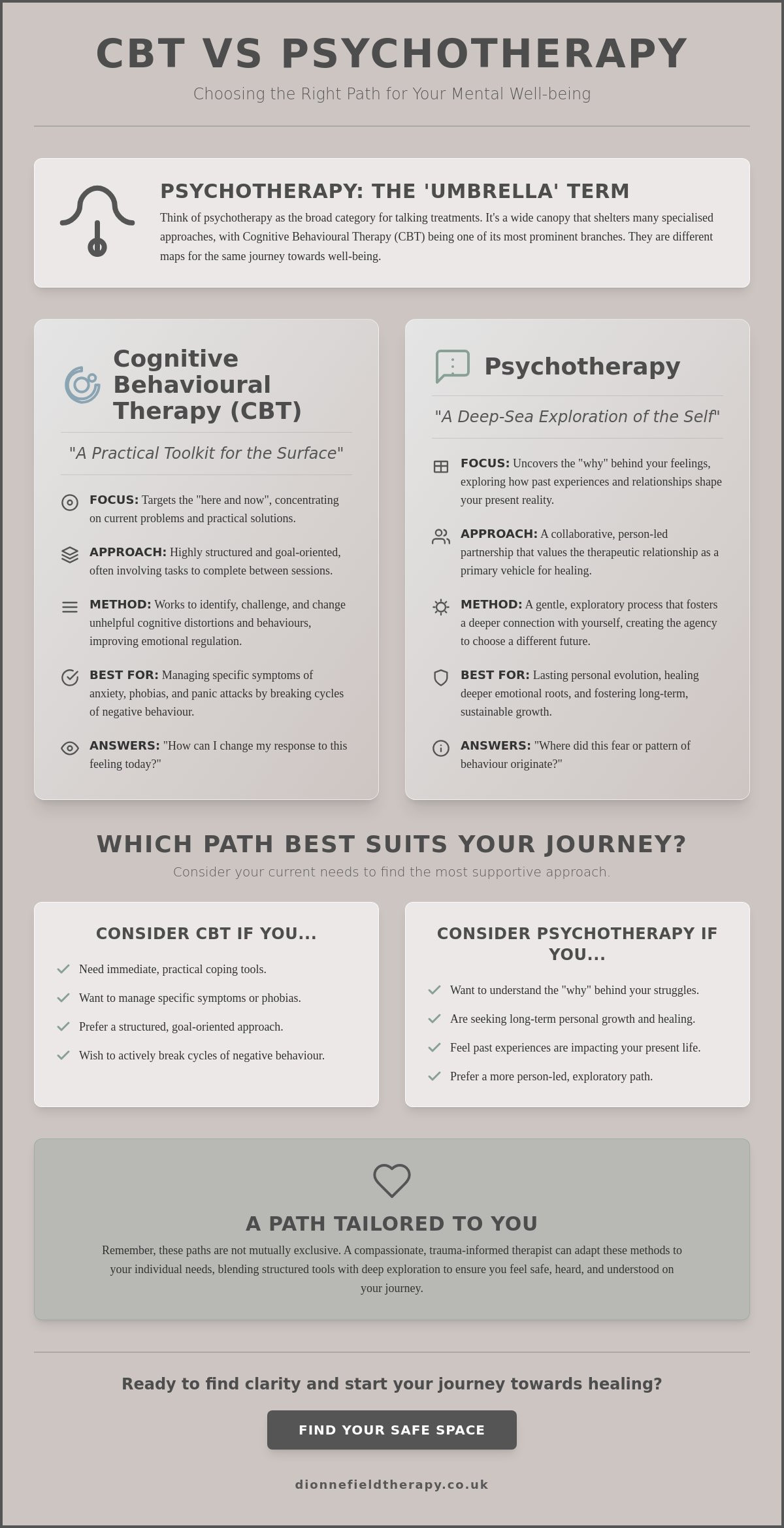
To simplify things, think of psychotherapy as an “umbrella” term. It is the broad category that encompasses almost all talking treatments. Underneath this wide canopy, you’ll find various specialised branches, with Cognitive Behavioural Therapy being one of the most prominent. Whilst they differ in their specific techniques, both paths share a single, compassionate heart: the desire to reduce your distress and help you move toward a state of lasting well-being. They aren’t necessarily rivals; they’re simply different maps for the same journey.
What is Psychotherapy?
Psychotherapy is, at its core, a collaborative partnership. It’s a safe space where you and your therapist work together to make sense of emotional difficulties that might feel tangled or heavy. Unlike some clinical approaches that focus solely on symptoms, psychotherapy places immense value on the relationship itself. It’s through this steady, non-judgmental bond that you can begin to explore deeper patterns and life history. By understanding how your past experiences colour your present reality, you gain the agency to choose a different future. It’s a process of uncovering the “why” behind your feelings.
What is Cognitive Behavioural Therapy (CBT)?
If psychotherapy is a deep-sea exploration, CBT is often described as a practical toolkit for the surface. It is a goal-oriented approach focused on solving specific problems in the “here and now.” What is Cognitive Behavioural Therapy (CBT)? Essentially, it looks at the interplay between your thoughts (the cognitive) and your actions (the behavioural).
When you’re trapped in an anxiety loop, your thoughts often become distorted, leading to behaviours that keep you stuck. CBT helps you identify these patterns and replace them with more balanced perspectives. It’s a highly structured method for managing current symptoms through active, practical exercises. Instead of asking where a fear originated, a CBT practitioner might ask how you can change your response to it today. It’s about building resilience through action.
The Cognitive Behavioural Therapy (CBT) Approach: Tools for the Present
Walking into a CBT session often feels different from what we might imagine therapy to be. It isn’t just about sitting on a sofa and reflecting on the distant past. Instead, it feels active. It feels like a partnership where you and your therapist are looking at a map of your current life together. This structured approach is designed to give you immediate traction when the ground feels slippery. When deciding on CBT vs psychotherapy, it’s helpful to remember that whilst Understanding Psychotherapy helps us see the wider landscape of healing, CBT provides the specific tools to navigate the immediate terrain.
One of the most defining features of this method is its focus on the “here and now.” We don’t ignore your history, but we prioritise how your past is showing up in your present behaviour. Each session typically begins with an agenda. This isn’t to be rigid; it’s to ensure your time is valued and your specific goals are met. You might find yourself working on between-session tasks… small, manageable experiments that help you build resilience in your real life, not just in the therapy room. It’s particularly effective for those struggling with specific phobias or social anxiety, where the fear feels like a physical wall you can’t climb over.
How CBT Targets Anxiety
Anxiety often thrives on a cycle. A thought triggers a feeling, which leads to a physical sensation, which then dictates a behaviour. CBT works by gently interrupting this loop. We use a process called cognitive restructuring; which is simply a way of looking at your thoughts as “guesses” rather than absolute facts. By testing these guesses in a safe environment, you can start to break the cycle. If you’re curious about how this looks in practice, you can explore specific CBT techniques for anxiety that we use to help clients regain their sense of calm.
The Practical Benefits of a Structured Approach
Many people find a sense of relief in the measurable progress that CBT offers. Because the goals are clear, you can often feel the shift in your perspective within a relatively short number of sessions. It’s an empowering experience. You aren’t just a passive recipient of care; you are an active learner mastering a new set of skills. Some worry it might feel like “school,” but in reality, it’s about reclaiming your agency. It’s about moving from a state of being overwhelmed to a state of being equipped. If you feel ready to start building your own toolkit, Online Therapy can be a flexible way to begin this work from the comfort of your own home.
Psychotherapy and Counselling: Uncovering the Deeper Narrative
Sometimes, having a toolkit isn’t enough. You might have the best strategies for managing a panic attack, yet that underlying sense of unease remains. This is where the conversation around CBT vs psychotherapy shifts from management to meaning. Whilst CBT helps you handle the storm, psychotherapy asks why the storm keeps returning. It’s a gentler, more exploratory path that prioritises the person over the problem. The therapeutic bond becomes the foundation here; a safe harbour where you can let down your guard without fear of judgment.
It’s a valid question to ask: Is CBT always the best option? For many, the answer depends on the complexity of their feelings. Some anxieties are “blurry.” They don’t have a clear trigger or a simple thought pattern to challenge. Instead, they are woven into the fabric of your daily life. Psychotherapy provides the space to sit with that complexity, unravelling the threads of your story with patience and care. It allows for a deeper evolution that goes beyond symptom reduction.
Exploring the Roots of Your Struggles
Our past experiences don’t just stay in the past; they shape our current “Window of Tolerance.” This is the emotional zone where we feel able to handle the ups and downs of life. When we’ve experienced significant stress, that window can become narrow, leaving us feeling constantly on edge or completely shut down. A trauma-informed perspective is essential here. It moves the focus from “what is wrong with you” to “what happened to you,” fostering a deep sense of self-compassion. This isn’t about blaming the past. It’s about understanding it so you can finally feel safe in the present.
Beyond CBT: ACT and Somatic Perspectives
Sometimes, our stories are held in places words cannot reach. This is why we often integrate Somatic Therapy, which focuses on how the body carries emotional weight. Have you ever felt a “knot” in your stomach or a “heaviness” in your chest that won’t go away? That’s your body speaking. By combining this with Acceptance and Commitment Therapy (ACT), we create a bridge between practical tools and your core values. ACT teaches us that we don’t have to “fix” every difficult thought before we can start living a meaningful life. It’s an invitation to move forward, even amongst the discomfort. Sometimes, just talking is only the beginning… the real healing starts when we listen to the whole self. Part of that listening involves building self-compassion in therapy, turning the inner critic into an ally rather than an obstacle on your path to recovery.
CBT vs Psychotherapy: Which Path Best Suits Your Journey?
How do you decide which path to step onto first? It’s a question that carries its own weight; almost as heavy as the anxiety you’re trying to manage. When looking at CBT vs psychotherapy, it helps to look at your needs through two distinct lenses: are you symptom-led or person-led? Only 27.6% of people with a diagnosed anxiety disorder in the UK are currently receiving treatment, often because the choice feels too final or too complex. You don’t have to get it perfect on the first day. A truly compassionate therapist doesn’t expect you to have the answers; they simply invite you to start where you are.
In reality, many private practitioners don’t ask you to choose a single side. They work integratively. This means they might use CBT tools to help you manage your week, whilst using psychotherapeutic depth to understand your year. Recent trends in 2026 show a significant move toward these hybrid models, often integrating somatic (body-based) awareness with traditional cognitive methods. A skilled therapist will adapt their expertise to you, ensuring the support feels like a bespoke fit rather than a rigid clinical procedure.
Choosing Based on Your Symptoms
CBT is essentially symptom-led. If your life is being interrupted by sudden panic attacks, specific phobias, or a very clear negative thought loop that plays on repeat, CBT offers the structure to halt those cycles. It’s about extinguishing the fire so you can breathe again. Psychotherapy, by contrast, is person-led. It is for the times when the distress feels more like a low-level hum in the background of everything you do. If you’re struggling with identity, complex trauma, or relationship patterns that seem to follow you through life, the exploratory nature of psychotherapy for anxiety in Tarporley and the wider Cheshire area provides the room you need to grow. If you’re unsure where to begin, our guide on how to overcome anxiety offers evidence-based strategies and somatic-informed tools to help you find your footing.
Practical Considerations: Time and Commitment
Time is often a deciding factor in this journey. A typical course of CBT is often shorter, typically lasting between 6 and 20 sessions. It is a focused sprint toward a specific goal. Psychotherapy is often more open-ended. It is a marathon of self-discovery where the finish line is determined by your own sense of peace and readiness. Whether you seek a short-term toolkit or a long-term transformation, the flexibility of online therapy ensures that support fits into your life, rather than becoming another source of stress. If you feel ready to explore which approach resonates with your heart, you can book an initial session to discuss your unique journey.
Finding Your Safe Space: Personalised Therapy in Cheshire
When you are looking for support in Cheshire, the decision between CBT vs psychotherapy becomes less about choosing a technical manual and more about finding a professional who truly hears you. Whether you are seeking help in Sandbach, Tarporley, or Chester, the local availability of private care means you can bypass the lengthy 12 to 18-week NHS waiting lists. At Dionne Field Therapy, we provide a sanctuary for both approaches, ensuring that your path to recovery is guided by your specific needs rather than a rigid protocol. It is about you. It is about your pace.
Safety is the cornerstone of effective healing. This is why choosing a therapist with BACP accreditation is so vital; it ensures your practitioner adheres to a strict code of ethics and professional standards. Beyond the qualifications, however, is the human element. We always encourage you to listen to your gut feeling during that first interaction. Does the space feel safe? Do you feel understood? A trauma-informed approach prioritises this sense of security, ensuring that you never feel like just another case file amongst many others. If you are based locally and want to understand how psychotherapy for anxiety in Tarporley and Sandbach can be tailored to your unique story, we invite you to explore what dedicated local support looks like in practice.
The Benefits of an Integrative Approach
Dionne Field Therapy does not believe in a “one size fits all” manual. Instead, we utilise an integrative approach that weaves together the practical tools of CBT with the values-based insights of ACT and the body-focused awareness of Somatic Therapy. This combination allows us to address both the immediate symptoms of anxiety and the deeper narratives that keep you stuck. Your therapy should be as unique as your own life story. By personalising the plan, we ensure that every session moves you closer to the person you wish to become, rather than simply ticking boxes in a workbook.
Next Steps: Booking Your Initial Consultation
Taking the first step is often the hardest part of the journey. One of the benefits of private care is the ease of starting; you don’t need a GP referral to begin your recovery. You have the choice between Face to Face Therapy in our Cheshire-based centres or the convenience of secure Online Therapy from the comfort of your own home. We invite you to book a gentle initial consultation with Dionne to explore how we can support your growth. You don’t have to carry this weight alone any longer; a steady companion is ready to walk beside you.
Your Path to Lasting Calm and Clarity
Finding the right support is a deeply personal choice… one that doesn’t have to be made in isolation. Whether you feel drawn to the structured tools of CBT or the exploratory depth of psychotherapy; the most vital element is that you feel safe and seen. We’ve explored how the debate of CBT vs psychotherapy isn’t about finding a “winner,” but about identifying which map helps you navigate your current landscape with the most confidence. By integrating trauma-informed care with practical strategies, we can address both the symptoms that disrupt your day and the stories that shape your life.
As a BACP Accredited Therapist specialising in trauma-informed care, I am here to help you bridge that gap. With local sessions available in Sandbach and Tarporley, as well as online options, professional support is closer than it feels. You deserve a space where your evolution is the priority. Begin your journey toward wellness with Dionne Field Therapy. The weight you’ve been carrying doesn’t have to be yours to hold alone; a lighter, more grounded future is waiting for you.
Frequently Asked Questions
Is CBT better than psychotherapy for anxiety?
Neither approach is objectively superior; the right choice depends on whether your anxiety is driven by specific symptoms or deeper, more complex narratives. CBT is exceptionally effective for breaking immediate cycles of negative behaviour and managing panic. Psychotherapy offers a gentler, more exploratory space to understand the roots of your distress. When choosing between CBT vs psychotherapy, consider if you need a toolkit for today or an exploration for tomorrow.
Can I do CBT and psychotherapy at the same time?
Whilst it is possible to engage in both, it is often more grounding to work with an integrative therapist who can blend these methods into a single, cohesive journey. Managing two separate therapeutic relationships can sometimes lead to emotional overwhelm. A personalised plan that combines practical tools with deeper narrative work ensures that your progress feels structured and safe. It allows the work to evolve as you do.
How many sessions of CBT will I need compared to psychotherapy?
CBT is designed as a shorter-term intervention, with a typical course lasting between 6 and 20 sessions to address specific goals. Psychotherapy is naturally more open-ended, often spanning 40 sessions or more to allow for deep, lasting transformation. The duration of your support depends entirely on your personal history and the complexity of the challenges you wish to navigate. Your therapist will help you determine a pace that feels right.
Does psychotherapy involve talking about my childhood more than CBT?
Yes, psychotherapy typically places a much greater emphasis on your early experiences and life history to uncover the “why” behind your current feelings. CBT acknowledges your past but prioritises the “here and now.” It focuses on the specific thoughts and actions that are keeping you stuck in the present. If you feel your current struggles are tied to old wounds, the exploratory nature of psychotherapy may feel more resonant.
Is CBT more effective for trauma recovery?
CBT provides excellent tools for managing the daily symptoms of trauma, but a trauma-informed psychotherapeutic or somatic approach is often essential for processing the root cause. Many people find that “talking it out” is only the beginning. Somatic therapy helps you understand how your body carries your story. Healing from trauma is about reclaiming a sense of safety in your own skin, which often requires a more holistic, person-led approach that includes building self-compassion in therapy as a foundation for lasting recovery. To see how this is applied in a dedicated setting for women, you can check out Female Focused Therapy for their guide on finding supportive, trauma-informed care.
What if I start CBT but feel I need deeper psychotherapy?
It is perfectly natural for your needs to shift as you gain more emotional awareness during the therapeutic process. You aren’t locked into one method. If you find that practical tools are helping but not reaching the underlying cause of your anxiety, you can transition toward a more exploratory style. A versatile, compassionate therapist will observe these shifts with you and adapt their expertise to support your evolving journey.
Are these therapies available online in the UK?
Yes, both CBT and psychotherapy are widely accessible through secure online platforms for anyone living in the UK. Online therapy has become a preferred choice for many, offering a sense of comfort and privacy that face-to-face sessions might not provide for everyone. It removes the stress of travel and allows you to build a therapeutic bond from a space where you already feel safe and in control. For those seeking specialised support beyond general anxiety, Citizen Coaching and Counselling offers therapeutic services and anger management online to help you navigate your emotional well-being.
How much does a private therapy session cost in Cheshire?
Current industry data from 2026 shows that private therapy rates in Cheshire typically fall between £80 and £100 per session. Across the UK, online sessions are often more accessible, with rates generally ranging from £40 to £80. Because titles like “counsellor” are not legally protected, you should always verify that your therapist is registered with an accredited body like the BABCP or UKCP to ensure professional and ethical standards.

Article by
Dionne Field
Dionne Field is an integrative psychotherapist. She's passionate about helping clients understand themselves with greater compassion and clarity. With experience in both NHS mental health services & private practice, her work combines trauma-informed, person-centred therapy, ACT, CBT, DBT, 'parts work' & somatic therapy. Dionne believes that meaningful change happens when people feel safe, understood and empowered to reconnect with who they truly are.
Disclaimer
The information provided in this blog is intended for educational and informational purposes only and should not be considered a substitute for professional mental health advice, diagnosis, or treatment.
Whilst every effort is made to ensure the information shared is accurate and up to date, the content reflects general therapeutic knowledge and perspectives and may not be applicable to your individual circumstances.
Reading this blog does not create a therapeutic relationship between you and Dionne Field Therapy. If you are currently experiencing emotional distress, mental health difficulties, or require support specific to your situation, please seek advice from a qualified healthcare professional or mental health practitioner.
If you are in crisis, experiencing thoughts of self-harm, or feel unable to keep yourself safe, please contact your GP, NHS 111, emergency services, or an appropriate crisis support service immediately.
Any external links provided are for convenience and informational purposes only. Dionne Field Therapy is not responsible for the content, accuracy, or availability of third-party websites.
By using this website and blog, you acknowledge and accept this disclaimer.
Leave a Reply